

The voices of Jack Black, Awkafina, Ke Huy Quan Viola Davis, Bryan Cranston, Ian McShane, James Hong, Seth Rogen and Dustin Hoffman?
Dim sum pretty big names.
Opens Thursday night, review at noon Eastern on Wednesday.
The voices of Jack Black, Awkafina, Ke Huy Quan Viola Davis, Bryan Cranston, Ian McShane, James Hong, Seth Rogen and Dustin Hoffman?
Dim sum pretty big names.
Opens Thursday night, review at noon Eastern on Wednesday.
This falls’ big Dreamworld animated fantasy is a sci-fi tale about a robot that crash lands on a verdant, wild and people free Earth.
Or a version of it.
A lot of famous voices are in the cast, almost none appear in this very early trailer.
Very strong “Wall E” vibes. But with all those voices cast, that may be misleading.
Looks lovely.

They’ve been singing and playing together since high school, and that was over 40 years ago. And their most popular period, with hit records and big tours, was the late ’80s.
But there was no getting around the fact that in 2023, Georgia’s fast folk duo Indigo Girls had themselves a moment.
Their exultant late ’80s hit “Closer to Fine” was given a grand showcase, front and center in the biggest movie of the summer, the hit of the year — “Barbie.”
A musical romance based on their tunes, “Glitter & Doom,” delighted the film festival circuit, as did the Sundance documentary-biography, “It’s Only Life After All.”
Now it’s 2024 and those last two films are coming to theaters, a “moment” of added curtain calls and much love for two activist singer/songwriters with some of the most devoted fans in all of music.
“It’s Only Life” lets them tell their story, in detail, and reminds us of what they endured even after they’d “made it,” being dismissed or ignored by the partriarchal rock and pop hierarchy and opinion-makers.
Amy Ray, the animated brunette of the duo and their unofficial archivist and home video and audio collector, thumbs through press clippings in her house and finds “one of the only times we were ever in Rolling Stone,” with the “boys’ misogynist magazine” insisting on photographing Ray and Emily Saliers in white robes, preachers baptising the audience with their music.
Yes, the sexist and probably racist Jann Wenner, publisher of the mag and myopic overlord of the Rock & Roll Hall of Fame, had the same problem many journalists did — figuring out where to pigeon-hole a self-described “lesbian Christian folk” duo that played loud and sang “earnest” grad student lyrics.
They became, to some, pop culture punchlines for their sexuality — Ray and Saliers have been “out” since the early ’90s — and being “your basic bleeding heart liberals,” outspoken environmental and social justice activists.
But as they pass age 60, this “moment” invites us to remember all they’ve been, why their fanbase is so devoted and the work that they haven’t stopped doing — playing, leading sing-along concerts and often raising funds for a wide range of charities, even during the COVID lockdown.
Filmmaker Alexandria Bombach (“Frame by Frame,” “On Her Shoulders”) dives into Ray’s extensive archives — early ’80s high school cassette rehearsals, photo albums, performance footage from their early Atlanta days — and interviews the “Girls” extensively, between photo shoots and shows — as they talk about their lives, their long history and their focus these days.
Saliers and Ray poke fun at their images and ridicule some of their early work and “overly ardent” stage performances, and their “earnest” singing and songwriting subject matter.
Bombach even has them read a particularly laughable — in a sexist and patronizing way — review they once got from New York Times critic Jon Pareles.
They met when Connecticut-native Saliers moved to Georgia with her theology professor father and librarian mother. They recognized each other as “the other girl with the guitar” in their high school.
Saliers was voted “most talented” at that school. But in her teens she was “an English major nerd” composing tunes like “Play it Again Sam,” riffs on Tennyson’s “Lady of Shallot” lyrical ballad, she remembers, with a laugh.
Ray was younger, “idolized” Saliers, but was “jealous” she confesses — and utterly taken with the mature performer Saliers was becoming and the harmonies they created together when they sang duets.
Each started college at a different school, but both “came home” and transferred to Emory U., where Saliers’ dad taught. That coincidence was a moment of “grace,” to Emily. They renewed their partnership, became Indigo Girls, started packing an Atlanta bar, Little Five Points Community Pub, and got “discovered.”
Anybody who remembers the pop radio of the late ’80s will pick up on the phenomenon that drove their stardom. Often it’s performers who sound nothing like anything else on the radio who break through. Nobody sounded like Indigo Girls.
No, they were “never a couple.” Saliers calls them “opposites” in so many ways, “like a chemical compound that won’t compound.”But on stage, in song, their singing harmonies are sibling-close in pitch, and spine-tingling in many of their most loved tunes.
Each talks about their sexuality, Emily sneaking into the groundbreaking lesbian romance “Personal Best,” the fears of “coming out,” the degrees of acceptance from their families.
And they discuss, with charming frankness, their clashes, “on the spectrum in a lot of ways” battles with substance abuse and discriminatory backlash, the latter being an issue they deal with to this very day.
They never did get to play for the kids at Irmo High School in South Carolina.



Bombach lets each singer’s personality find its natural footing in their group dynamic in the film — assertive, articulate and sometimes temperamental Ray, who does most of the talking, matched with smart, sensitive and expressive Saliers.
We glimpse lots of TV coverage of the band, that first appearance on “Late Night with David Letterman,” the many interviews they sat for over the decades.
And we hear from fans — the photographer who mentions how they “changed my life in college” because he “fell in love to the Indigo Girls,” the legions of Indigo enthusiasts who, almost to a one, insist “The Indigo Girls saved my life!”
Emily Saliers, for one, gets it. “I know what it’s like to have music save you at a particular time.”
One thing the film lacks, perhaps with some reason, is any voice of outside authority singing their praises and noting what makes them “special.” Yes, pop music criticism is still male-dominated and both Indigo Girls are “old” and “not cool,” as they’ll tell you. But having played with folk legend Joan Baez, with Michael Stipe and R.E.M. (fellow Georgians) hiring them as their opening act, and having the likes of Woody Harrelson introduce their shows back in the day, surely somebody outside the two singer/songwriters could add some perspective.
As Amy says early in the film, “I hope it’s about something besides US.“
But that “something” turns out to be their activism, their battles against homophobia and injustice, their “community building” work that has energized activist fans.
And that’s enough. Because as the film’s title reminds us, it doesn’t have to be wholly serious, “It’s Only Life After all.” Even the shortcomings in this documentary suggest it’s just another part of a long-overdue “moment” for two most-deserving musicans, still not in the Rock & Roll Hall of Fame, but “Closer to Fine” than ever.

Rating: unrated, PG-ish
Cast: Amy Ray and Emily Saliers, with Winona LaDuke, others
Credits: Directed by Alexandria Bombach. An Oscilloscope Laboratories release.
Running time: 2:03
Tough urban youth “reformed” by bicyling one of the toughest places to bike in America.
Leslie David Baker from “The Office” is here for comic relief, Sean Astin for moral support.
“Hard Miles” has good festival buzz, a crew of generally little known “youth” and opens in theaters April 19.

Donnie Yen gets his ass kicked in one scene in “Polar Rescue,” titled “Sou jiu/Come Back Home” when it opened in China. And frankly, it’s not a good look for the martial arts icon, who has been more at home in the delivering of on-screen ass-kickings than on the receiving end.
But he’s over 60, so maybe the sentimental slop of “Polar Rescue” is his filmic fate from here on out.
It’s a “I lost my kid in a blizzard” story of a family vacation gone wrong in the frigid north of China. And it’s a tale of frustrating lazy cops, not-secret-enough guilt, a mini media circus and the struggle to find a kid we have just enough time to get to know to note is quite the spoiled brat.
De and Xuan (Yen and Cecilia Han) are making the most of their trip “north,” showing their two young kids the pleasures of snow and winter sports. But headstrong Lele (Yuan Jinhui) has his heart set on seeing fabled Lake Tian and its mythic “monster.” He throws a tantrum when Dad informs him that the road is closed. So indulgent Dad finds a back way to drive their rented Chinese SUV there.
Of course they get stuck. Remember, Donnie Yen, “there is only one Jeep.”
That’s when Lele recklessly almost gets run over, standing in the middle of the snowy-icy road. Next thing we know, he’s gone missing and the parents are pleading with a do-nothing cop — “Southerners are so RUDE!” — to try and a search launched.
“How did you lose him?” (in Mandarin with English subtitles) De is asked for the first and certainly not the last time.
Even after the chief (Hou Tianlai) intervenes and a massive search gets underway, a lot of the searchers have their suspicions, which they gossip about in the cold.
De grows more frantic with each passing hour, even as “There’s no hope” and “Even an adult would be dead by now” gloom sets in.
Diving into social media for crowd-sourced “help” just makes matters worse, as users voice their darkest fears for what this seemingly distraught father might have done and online predators show up.
The snowy production design is first rate as this frigid melodrama feels chilly, first scene to last.
But the script, which is credited both to director Chi-Leung Law as “written and directed by” and separately by three other “screenplay by” writers in the credits, is a maudlin mess of weepy anecdotes, head-slappingly obvious parental “blunders,” tepid flashbacks and a pause for a patriotic song by the Red Army Chorus of searchers.
Action beats involving a river the distraught father tries to cross, heedless of the danger, and a frozen lake are impressive.
It’s just that whatever they spent the money on — Donnie Yen, effects and location shooting — it wasn’t on a compelling or even all that competent script.

Rating: unrated, violence
Cast: Donnie Yen, Cecilia Han, Yuan Jinhui and Hou Tianlai
Credits: Directed by Chi-Leung Law, scripted by Xiaoli Zhang, Sin Long Young and Chi Wen Ying. A Well Go USA release.
Running time: 1:42
Apple TV+ has this bad boy who calls himself “one of the good guys.”
He finds missing people. And busts the heads of those who would stop him.
John “Sugar” drives a “car with character (’60s ragtop Corvette), keeps his dog close and his demons down. And he talks in voice-over. A lot.
That’s “private eye” life in the City of Angels, kids.
James Cromwell, Kirby, Adrian Martinez and Amy Ryan co-star in this eight-episode Apple challenger to…”Fargo,” I guess. April 5.
Last year saw a Bille August mini-series based on the famous Alexandre Dumas novel. Jeremy Irons was featured in that.
This new theatrical take stars Pierre Niney of the Yves St. Laurent biopic of a few years back as Le Comte, Edmund Dantes, and was scripted and directed by Alexandre de La Patellière and Matthieu Delaporte, writers of the French thriller “22 Bullets” of a few years back.
It looks as if no expense was spared for this summer release.
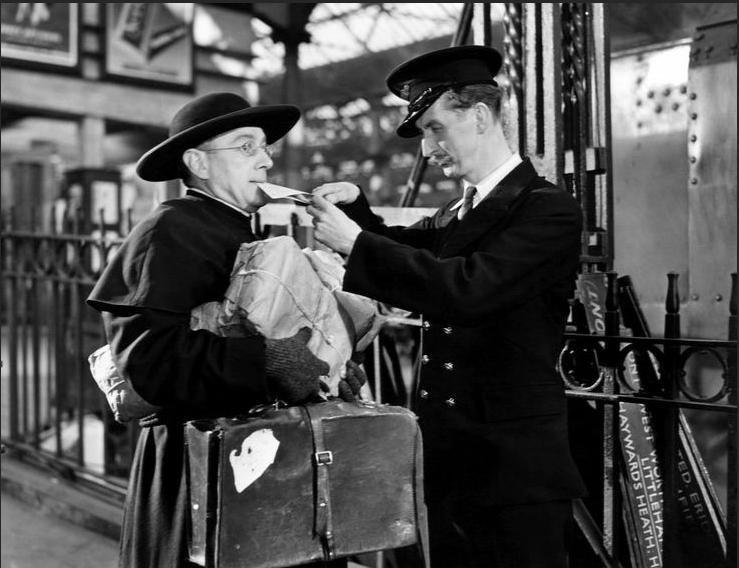


Alec Guinness brings a deft twinkle to G.K. Chesterton’s venerable saintly sleuth “Father Brown” in his only big screen outing as the Catholic crime solver, titled “The Detective” when it showed in the United States.
And while I can’t say with certainty that this 1954 British classic is the most faithful to Christian apologist Chesterton’s vision of a priest who solves crimes and tries to keep the coppers at bay as he tries to “save” the criminals, it does feel like one of the definitive takes on the character.
There’d been one earlier film of Chesterston’s crime solving creature of habits, and there have been several TV and radio series based on the “Father Brown” stories. But what other Father Brown got so into the part and so swayed by the man’s humanity, Christian piety, charity and forgiveness that he converted to Catholicism?
“Kind Hearts and Coronets” and “School for Scoundrels” director Robert Hamer, co-screenwriter Thelma Schneed and the cast get a lighthearted, faintly mysterious and fun film out of Chesterston’s oft-filmed first-ever Father Brown short story, “The Blue Cross.”
Father Brown is soft-spoken in the pulpit, ensuring that “He that maketh haste to be rich shall not go unpunished” (Jeremiah) plays to every parishioner, not just the burglar he interrupted and convinced to go the straight and narrow the night before.
Of course, as he was returning the man’s ill-gotten pounds sterling to the safe he’d cracked, Father Brown was arrested and spent the night in a cell. But once all that was cleared up, without the priest ratting out the thief despite the irritation of the cops and the church hierarchy, a little lecture seems in order.
“I’m disappointed in you, Bert,” he offers. “Firstly, because you did wrong. Secondly, because you did wrong in the wrong way. Frankly, you are an incompetent thief.”
We’re tossed into Father Brown’s world, in which most police don’t know of his amateur sleuthing, which his bishop (Cecil Parker) barely tolerates, a priest preaching to a full house in a modest old church in which no Sunday would be complete without his own personal Kato — a local tough – jumping him afterwards, giving him a weekly wrestling-for-your-life workout.
But the Church is lending out the one “priceless” relic housed in Father Brown’s parish, a cross owned by St. Augustine, to a Catholic convocation elsewhere in Europe. The police have gotten wind of plans by a notorious master thief named Guy Flambeau to snatch it.
Father Brown is merely warned of this, and told to leave guarding the cross to the authorities. But he preps several packages, only one of which holds The True Cross, to tote with him by train and ferry all the way to his destination.
Father Brown, wearing spectacles and wide-eyed with curiosity, must consider every fellow passenger, even ones from the sea of clergy making this pilgrimage with him, a suspect. See how he trips up James Bond’s future boss (Bernard Lee), a jolly chap who passes himself off as a Jaguar salesman.
The British carmarker, the non-driver Father Brown notes with a raised-eyebrow, “made a mistake” by equipping current models with “a single downdraft carburetor.” Only a con artist, or a cop traveling in disguise, would miss the fact that Jaguars were using twin “horizontal” (side-draft) carbs in the early ’50s.
Then there’s the helpful fellow priest who picks up on Brown’s concerns aboit his parcel and urge to ditch those tailing him. “A danger shared is a danger halved,” his fellow Bible-quoting Catholic clergyman intones.
Naturally, he’s the real thief, played by a bearded future Oscar winner (like Guinness himself) Peter Finch.
So this is to be one of THOSE sorts of mysteries, with the thief and the his pursuer meeting, bantering, matching wits and wrestling skills as crimes are considered and carried out. The twist here is that Father Brown isn’t interested in an arrest.
“I want you on behalf of a higher power.”
Guinness is so delightful in the title role that had this been a modern production, he might have been urged to sacrifice half his career to “franchise” the character.
Finch is properly sinister, but also amusing in various disguises. Joan Greenswood is the lone female presence of note, a widowed rich parishioner who becomes “bait” to trap our thief. And Lee and Parker play varying degrees of befuddlement as characters trying to track and rein in a priest who won’t stay in his lane.
A standout comic scene is an auction meant to smoke out our master criminal, with bit player Lance Maraschal hilariously embodying the British idea of a boorish, wealthy “Texan” — then and forever. Watch auctioneer Noel Howlett instantly convert the drawling blowhard’s Yankee dollar bids to “pounds sterling,” then “guineas” as the duel between our Texan and an Anglofile Indian (Marne Maitland) turns teasingly testy.
It’s always delightful to stumble across that rare Guinness comic outing you haven’t seen, and while “The Detective” is no “Kind Hearts and Coronets,” “The Ladykillers,” “Lavender Hill Mob” or even “The Horse’s Mouth,” it showcases him in fine form in a role that would change his spiritual life and inform many of his serene, considered and cerebral performances to come.

Rating: TV-PG
Cast: Alec Guinness, Joan Greenswood, Peter Finch, Bernard Lee and Cecil Parker.
Credits: Directed by Robert Hamer, scripted by Thelma Schneed and Robert Hamer, based on the Father Brown stories by G.K. Chesterton. A Columbia release on Tubi, Amazon, etc.
Running time: 1:26

“My Name is Loh Kiwan” is a downbeat Korean melodrama peppered with violence and victimhood and adorned with too many trials and tribulations for its own good.
Writer-director Kim Hui-jin stuffs a TV soap opera season’s worth of over-the-top challenges, sad flashbacks, ugly injustices and an unlikely romance in adapting Hae Ji-Cho’s novel for the screen.
It’s watchable but utterly predictable.
We lose track of what it is our titular hero is escaping and never are allowed to see the appeal in fleeing to racist, immigrant-bashing Brussels, Belgium. I guess between the EU red tape, the Chinese efforts to cover up corruption and crime, drug abuse, fake identites and sketchy workplaces that hire undocumented migrants and all those flashbacks to tell us about two dead mothers, they just didn’t have the time.
We meet Loh Kiwan (Song Joong-ki) as he’s weeping, cleaning blood off a street.
Next think we know, he’s on board a jetliner with several other folks who have paid to be taken from China and smuggled into Belgium, coached by their “mule” to not look sketchy and to just say “Je ne parle pas français” to the customs officials at Brussels airport. On the way from that airport, Loh Kiwan tries to pay a driver in blood-stained U.S. dollars.
“Bad luck.”
Loh Kiwan is fleeing North Korea by way of China. And since Koreans long native to China have been using that dodge to backdoor their way abroad, he is instantly under suspicion. He tells a customs officer, and the Korean translator who came to his aid, his sad story.
Up to this point, we’re allowed to wonder if he killed somebody, if he’s Chinese pretending to be Korean and just saying “Comrade” a lot to “pass” for a People’s Republican running from persecution and famine.
But as we see or at least feel implied in flashbacks, his mother sacrificed everything to get him across that North Korean border into China and later onto that plane. An uncle urged him on, no matter the cost. Who wouldn’t be moved? Who’d want to escape North Korea only to get stuck in China?
Loh Kiwan gets a hearing date for the chance to land a work Visa. It is months away, and all he has are a few bloodstained greenback dollars to tide him over.
“I don’t exist here,” he complains, in subtitled Korean (and French) or dubbed into English.
He is bullied out of a hostel, locked out of a public restroom where he hopes to winter, beaten up by xenophobes and finally robbed by a pretty punk as he’s passed out in a laundromat.
That’s how he meets Marie Lee (Choi Seong-eun), a sullen, well-kept junky in open revolt against her father (Jo Han-chul) but in debt to her dealer (Waël Sersoub).
Our hero finally turns tough guy with the skinny Chinese/Belgian woman. He wants that damned wallet back. It isn’t long before their fates are locked as we take a tour through the working poverty of illegal immigrants, high stakes gambling on an arcane European sport and the one thing these two have in common — losing their mothers.
As one bad circumstance after another piles up on his life, she invests in his wellbeing. As she struggles with her own demons, he invests in hers.
And every flashback takes us back to the trauma they’re both shouldering, which grows more dire with every bit of retelling.
For a story with this much overwrought tragedy attached to it, I found “My Name is Loh Kiwan” an oddly unemotional “weeper.” One can sympathize with the immigrant’s plight and still shake your head at the theatrical nature of the tragedies, which come close to “Oh come on now.” The layers of hurt and self-destruction added to it via flashbacks overwhelm you with soap opera suds.
The performances are engaging but not affecting, and the point of view of the story is kind of xenophobic itself. A South Korean film avoiding condemning its belligerant failed-state northern neighbor, condemning China without flinching and then slamming Europe and Europeans for bigotry, and simply being leery of taking in this guy with no marketable skills and no grasp of the language because they and we are supposed to be believe his increasingly fraught and over-the-top story?
It seems a bit much.
The sad saga kind of plods along a predictable path — courts, violence, love — with only a couple of mild surprises in store in the third act. But no, there’s nothing remotely surprising in the finale.

Rating: TV-MA, violence, drug abuse
Cast: Song Joong-ki, Choi Seong-eun, Jo Han-chul and Waël Sersoub.
Credits: Scripted and directed by Kim Hui-jin, based on a novel by Hae Ji-Cho. A Netflix release.
Running time: 2:12
Memorial Day Weekend, Sony Animation takes another shot at turning “Garfield” in a franchise.
Samuel L., Chris Pratt, Cecily Strong, Ving Rhames, Hannah Waddington, Nicholas Hoult, Bowen Yang (of course) and Snoop Dogg?
Whose idea was it to cast Bowen Yang and NOT make him the voice of Garfield?

 Movie Nation