Movie Review: An American Saint earns a stately screen biography — “Cabrini”

Mother Frances Cabrini was an Italian born nun whose advocacy of charity through her Missionary Sisters of the Sacred Heart of Jesus, which built schools, hospitals and orphanages all over the world and led to her being canonized as the “First American Saint.”

In “Cabrini,” she earns a stately, somewhat stodgy screen biography from the filmmakers who gave us the controversial human trafficking blockbuster “Sound of Freedom” last summer. So as you might expect, they’ve made a faith-based film with a conservative agenda.

But while “Freedom” has fallen into discredit because of all that the filmmakers didn’t know or chose to ignore about their dodgy “hero,” Mother Cabrini was vetted by the Catholic Church in the 1940s. Granted, that nature of their research might not wholly pass modern muster, and a many-decades-long -pedophile scandal has stripped the institution of the benefit of the doubt on such matters. Still, Cabrini’s story suggests a life of purpose, ambition and faith pretty much beyond reproach.

It’s a handsomely-mounted period piece with some impressive talent in the cast. And if it’s a bit vague about the passage of time, fictionalized incidents and the mission creeping “real estate” focus of her work, it tells her story with few embellishments.

Cristiana Dell’Anna of “Toscana” and “The King of Laughter” has the title role, a gaunt 19th century nun whom we meet as an adult with a tubercular cough and a determination to build “an empire of hope” out of orphanages, missions and hospitals the world over.

But in 1889, Mother Cabrini is finishing up an orphanage and school in Lombardy, just a pest to a pope (Giancarlo Giannini) whose lieutenants wish she would “stay in her place.”

Pope Leo XIII won’t grant her wish to become the first woman to head a Catholic mission abroad in China. But with Catholics struggling and children living on the streets in New York’s slums, she’s welcome to take over an orphanage there and do what she — still a “first woman to head a mission abroad” — can with it.

Cabrini and half a dozen sisters show up, disembark and hear their first ethnic slurs. With the help of a former street child turned prostitute (Romana Maggiora Vergano), they’ll learn the ropes and do battle with Five Points poverty, a cynical priest whose orphanage they’re taking over, the local archbishop (David Morse) and an anti-immigrant Mayor Gould (John Lithgow).

People on the street call and her sisters “dagos” and “guineas.” The mayor himself labels the entire 19th century Italian diaspora “brown-skinned filth.” Their Irish Catholic archbishop tries to prevent their fundraising. The police are used to oppress and harass their efforts and Italians goons and pimps menace their orphans and recruited help.

Mother Cabrini resorts to shaming “the greatest nation on Earth” for allowing the newest wave of immigrants to live worse than “rats.” And when mobsters threaten her, she’s not shy about playing the “wrath of God” card.

Continue reading
Posted in Reviews, previews, profiles and movie news | 1 Comment

Netflixable? Tyler Perry did WHAT?” “Mea Culpa”

“Mea Culpa” is the most over-the-top, lurid and hyper-sexualized soap opera Tyler Perry has ever served up.

Sure, it’s a thriller, and by the pull-out-all-the-stops finale, it acts like it. But soapy, turgid trash is one of the guy’s brands — when he isn’t playing Madea. And this eye-roller is on-brand, first scene to last.

It’s another tale set amid African American affluence, this time in Chicago. The cast is populated by beautiful people in beautiful clothes in striking, upscale settings, another Perry trademark.

And it’s got laughably clear-cut villains, ludicrous situations and a season’s worth of daytime TV soap “twists” that have to be seen to be believed. But “seeing” doesn’t really help.

Singer/actress Kelly Rowland (“Think Like a Man”) stars as Mea Harper, an in-demand Chicago criminal defense attorney pursued by an artist (Trevante Rhodes of “Moonlight” and “Bird Box”) accused of killing his girlfriend and splattering her blood and skull fragmants all over a painting.

Zyair Malloy has a James Harden beard and a 50cent menace about him. He’s smooth, a womanizer and one “arrogant mutha” shut your mouth.

Could he be guilty? He’s too touchy to answer tough questions, too picky about where he lets her intereview him, as if the court will let him testify from his artist’s loft and sex den. And he’s too intent on bedding Mea to take all of this seriously.

Mea’s tempted because her loser husband (Sean Sagar) has substance-abused himself out of a career, cheated with another woman and found a new addiction — online video games.

The ADA prosecuting the case (Nick Sagar) is husband Kal’s brother. And their tyrannical, sickly mother (Kerry O’Malley) “forbids” Mea from taking the case. ADA Ray is running for higher office. That’s the play. When ADA Ray joins Mom in “I FORBID it” that just seals the deal. Defiant Mea is on-board and all-in for the defense, no “culpas” about it.

Perry makes Mea laughably passive for a high powered attorney. He scripts some odd scenes in which Mea allows her trusty, all-seeing/all-knowing private eye (RonReaco Lee) to do the name-calling and harsh questioning, and plunges Mea into a covered-in-paint sexual dalliance after her “arrogant” client lets her watch him getting felatio from a compliant neighbor.

Quite the turn on. As I said, “Lurid.” Some will take guilty pleasure out of watching that. The dears.

Continue reading
Posted in Reviews, previews, profiles and movie news | Comments Off on Netflixable? Tyler Perry did WHAT?” “Mea Culpa”

Movie Review: Coarse, Crude, “Out” and proud, and not funny…at all — “Drive-Away Dolls”

One Coen Brother is either not enough, or one too many. If it’s the wrong Coen. Oh brother.

That’s “Drive-Away Dolls,” a crude, clunky and carnal romp that runs bits and pieces of “Raising Arizona,” “Fargo” and “Burn Before Reading” through a lesbian bar tour of the southeast, and can manage barely a laugh in the process.

Left to his own devices, Ethan Coen — sans brother Joel — is just a generic vulgarian grasping for laughs out of an ill-considered cartoon of a cultural commentary comedy.

Margaret Qualley of “Once Upon a Time…in Hollywood” and Geraldine Viswanathan of “The Beanie Bubble” and the best of the COVID lockdown rom-coms “7 Days” co-star as gay women of 1999 Philly who take on a one-way drive car delivert to Tallahassee just to get out of town.

Cocky womanizer Jamie (Qualley) just got caught cheating, and buttoned-down and uptight Marian (Viswanathan) was going to the corner of Florida aptly nicknamed “Florabama,” and not because of its enlightenment and tolerance.

“Why would anybody go to Tallahassee, Florida?”

“My Aunt lives there!”

“Can’t she MOVE?”

Good one. No. Seriously. Sentencing DeSantis there seems like fitting punishment.

But the guy who arranges such drive-and-deliveries, Curlie (deadpan Bill Camp) has these mobsters shipping a 1980s drug dealer (aluminum case) briefcase there he’s working for. He mistakenly assigns the Sapphic sisters to that beat-up Dodge Aries by mistake.

We know what our travelers don’t, that the guy who owned the case (Pedro Pascal) was murdered by corkscrew to acquire that case. And whatever is in it, somebody wants it real bad.

Jamie doesn’t know, and taking out an old-fashioned fold-out map and marking up the Southeast’s finest selection of lesbian (rhymes with “bike”) bars, she plots their trek. They’re in no rush. “Dismantling the patriarchy” takes time. And Marian...has needs.

The disappointed mob lieutenant (Colman Domingo) and his goons (Joey Slotnick and C.J. Wilson) will just have to find a way to track them in this pre-cellular phone (almost) era. Questioning Jamie’s ex (Beanie Feldstein) is just the beginning of their problems.

Marian’s planned ahead. She’s got a copy of Henry James’ “The Europeans” to polish off. The head mobster is reading James’ “The Golden Bowl.” To which the viewer can sigh and titter, “Better them than me.”

Qualley trots out Mama Andie Macdowell’s drawl, Viswanathan does her best tight-ass turn, Feldstein goes tough-broad to limited effect, and none of the big names in glorified cameos can stop the bleeding.

Bar pick-ups and a spirited encounter with the “very committed lesbians” of a woman’s college soccer team, what passes for a resort hotel in Tallahassee, intrigues involving a certain “family values” Senator (Matt Damon) and a hump-anything chihuahua give one an appreciation of how low this Coen will go, letting us figure that the Coen married to Frances McDormand is the classy one, the guy who got Denzel to make “Macbeth.”

Maybe. Maybe not. But suffice it to say, Ethan’s movie-making without Joel is lacking the sounding board that made even their worst excesses (“Hail, Caesar!”) marginally better than this.

Rating: R,  R, Full Nudity, Crude Sexual Content, violence and profanity

Cast: Margaret Qualley, Geraldine Viswanathan, Colman Domingo, Bill Camp, Beanie Feldstein, Pedro Pascal and Matt Damon

Credits: Directed by Ethan Coen, scripted by Ethan Coen and Tricia Cooke. A Focus Features release.

Running time: 1:24

Posted in Reviews, previews, profiles and movie news | Comments Off on Movie Review: Coarse, Crude, “Out” and proud, and not funny…at all — “Drive-Away Dolls”

Movie Review: Hilary Swank reminds us what “Ordinary Angels” can do

“Ordinary Angels” is a kind-hearted weeper that gets by on good vibes and the talents of the Unsinkable Hilary Swank.

Based on a true story, it’s a faith-based film about what people can do when they act out of compassion, not self-interest or hate, and a reminder that “miracles” aren’t supernatural. They’re the work of good people doing good deeds, out of character and against the odds.

Swank plays a blowsy, honky-tonkin’ Louisville hairdresser who isn’t shy about giving her denim skirts and fringed leather jackets a twirl from the top of the bar, drinking until she can “make just one’a these guys look my age.”

Sharon Stevens has a problem, but it’s only obvious the morning after. That’s when he colleague Rose (Tamala Jones, quite good) tries to intervene and get this drunk to a meeting. Whatever Sharon’s drinking to forget, her problems pale compared to some folks.

Take the Schmitt family. Ed (Alan Ritchson, terrific) is a roofer barely scraping by, a guy who buries his wife and doesn’t know how he’s going to pay for a liver transplant for his five year old daughter, Michelle (Emily Mitchell, adorable).

Because Ed’s buried under the bills he couldn’t pay when medical science failed to save his wife. Sharon reads about their problems in the newspaper, shows up at the funeral and makes that “If there’s ever anything I can do” offer.

She’s muttered what a “stupid” idea it is of her to just show up, a long time between “meetings,” a six pack in the car. But whatever her failings, she’s got a big heart and the pluck to turn her focus from addiction to “saving” this one little girl.

It begins with an unbidden “Shear-a-Thon” hair-cutting fundraiser. Next thing Ed and his mother (Nancy Travis) know, Sharon’s dressing up his work portfolio, diving into his stack of unpaid bills and strategizing, fundraising and “negotiating” her way through them.

“I’m good at plenty’o things,” she drawls. “Takin’ ‘No’ for an answer ain’t one of’em.”

Obstacles will arise, and Sharon’s “Say yes” until “you can figure things out” ethos comes in handy. But it can only take one so far. Tornados and blizzards will intervene. They’ll face the impossible odds of the national liver transplant registry. Sharon’s personal demons and a lot of phone calls and legwork dominate this 1990s story of Ms. “Can Do” trying to gin up a miracle.

Continue reading
Posted in Reviews, previews, profiles and movie news | Comments Off on Movie Review: Hilary Swank reminds us what “Ordinary Angels” can do

Movie Review: A Diet Fad points inducts indulged kids into “Club Zero”

Talk about your cinematic hot potatoes.

“Club Zero” is a drama played out in the soft-spoken tones of self-help speak, a satire on the indulged habits of indulged children of the indulgent rich. It’s about food and the swirl of modern issues surrounding our consumption of it.

Director and co-writer Jessica Hausner’s tale takes in the eating disorders of our “You can never be too rich or too thin” era, the cultural obsession with “health,” and dietary environmentalism as we visit a tony private school that dives into the “conscious eating” fad a tad too seriously.

The film folds “saving the planet” by eating less, anti-consumerism and survivalism into a story of “mindful eating” (the other name for it) run amok.

Mia Wasikowska plays an expert in the field — She has a website! — hired to be a teacher and coach to the first kids at this Euro-prep boarding school that is run, as such schools often are, by rich parents who serve on a board.

Being in tune with the latest “thing” and hearing their fad-hunting kids tell them “Vegan is so OUT” has them track down Miss Novak (Wasikowska) and put her on the faculty. The half-dozen teens who sign up for her first course of meditation, mindfulness and chewing very very slowly mention “weight” issues and health concerns, along with “saving the planet” and the like as their reasons for enrolling.

Miss Novak will be their spirit guide, helping them retrain their bodies to eat less, consider what they eat more and sharpen their minds with practices that she promises will prolong their lives, letting them outlive those outside their circle who are eating themselves into oblivion.

Fred (Luke Barker) is a ballet dance student and a diabetic whose distracted parents are running a help-the-natives project in far-off Ghana. He’s not well enough to endure life there, but he is convinced he can eat or fast his way out of his insulin shots.

Ragna (Florence Baker) is a trampoline gymnast who likes the weight control and mind-“sharpening” virtues of eating less. A lot less. Her weight-obsessed mother (Keeley Forsyth) seems on board with this program, but her impatient father (Lukas Turtur) rages at his perhaps bulemic wife and a daughter who seems determined to go down the same path, sanctioned by her school.

And Ben (Samuel D Anderson) is a “brilliant” student, son of a single mom (Amanda Lawrence) who cooks and feeds him in ways that belie his skinny frame. He will be a hard one to sell on this business of reducing your diet to a single potato wedge, carefully carved and consumed from one’s otherwise empty cafeteria plate.

Continue reading
Posted in Reviews, previews, profiles and movie news | Comments Off on Movie Review: A Diet Fad points inducts indulged kids into “Club Zero”

Classic Film Review: Fainty Surreal Italian noir — “The Possessed”

Enigmatic and obscurant, a film noir bathed in gloom and dreams within dreams, its “story” carried by voice-over narration, “The Possessed” is an Italian murder mystery all but conceived as a “cult picture.”

It had multiple titles — “La donna del lago (The Lady of the Lake)” in Italy, “Love, Hate and Dishonor” on U.S. TV, and “The Possessed,” as it is titled today. It was title-checked in Quentin Tarantino’s 1960s pop-culture Easter egg basket “Once Upon a Time…in Hollywood.”

Co-directors Luigi Bazzoni and Franceso Rossellini are largely forgotten figures now. The sound appears to be all post-production looped, and the star — Peter Baldwin — had bit parts in films and American TV, but a few starring roles in Italian films in the ’60s, before coming home and working steadily as a director of TV sitcoms for decades.

The film is basically an attempt at art house Hitchcock, something tried in a few Italian films of the era. This obscurant and somewhat mesmerizing film grabs and holds one’s interest, and not just the racier bits sometimes edited out for American TV.

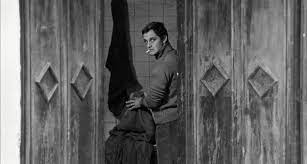
Baldwin plays Bernard, an award-winning novelist who is fresh off a break-up, needing an off-season vacation. He’s a regular at a hotel by a lake which his family used to visit when he was young.

There was this blonde there, Tilde, a housekeeper at the hotel. Bernard must have been infatuated with her. Why else would he ring for her, only to get a different housekeeper? He sees a coat he recognizes and knows she is near. He fantasizes or perhaps remembers spying on her lovemaking through a crack in a door. Or perhaps he was her lover.

In any event, he is determined to track down this beauty (played by Virna Lisi). And then, after others have avoided his questions about her, he gets the news. She died.

“Suicide,” the hotelier (Salvo Randone) sighs. “Poison.”

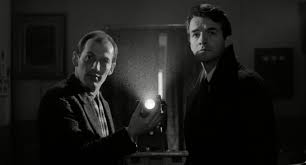
But the poison in her mouth and her stomach didn’t kill her, the conspiracy-minded local photographer (Pier Giovanni Anchisi) tells Bernard. Her throat was cut!

That sends Bernard on a downward spiral of “investigation,” perhaps for a new book, and dreams in which he imagines a couple of men as Tilde’s lover — the hotelier, and his butcher son (Philippe Leroy).

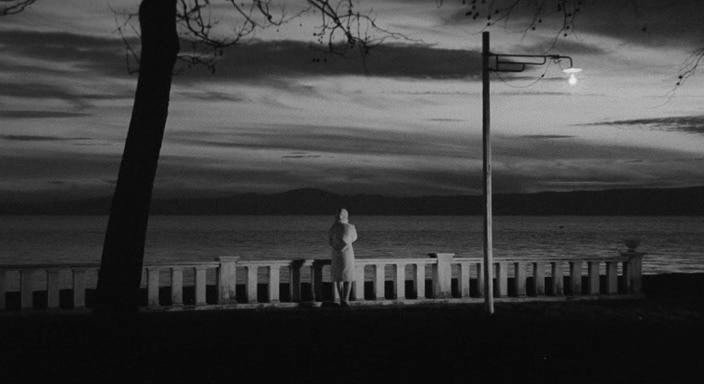
The hotelier’s daughter (Valentina Cortese) has a shifty way about her. The butcher’s wife (Pia Lindström) is hidden from public view, mysteriously driven to walk the lake shore late at night.

What’s going on here? Why are so many “clues” and suspects introduced in dreams? Is the guy who runs the hotel in town really “powerful” and capable of covering up a crime?

Asking questions, however obliquely, doesn’t so much provide Bernard with answers as allow him to dream out many scenarios, with none of them provable in court, not that the police are all that interested in re-opening this “banal suicide.”

Co-directors Bazzoni and Rossellini (the nephew of legendary director Roberto Rossellini) prioritize mood over mystery, but one reinforces the other in this puzzling narrative. The film is often mentioned as belonging in the genre of lurid “Giallo” murder mysteries and violent tales of ’60s Italian cinema. But it’s rarely anything more than a film noir that struggles to make sense.

The hoary voice-over device is novelistic, better at telling us Bernard’s state of mind than at helping him solve this mystery.

“The Possessed” is designed to frustrate, to make us wonder if Bernard feels responsible for this death and if this ties into his break-up, by phone, with another woman before making the trip.

It may make more sense in its slightly longer version, and Lisi is a fiery, beguiling screen presence, even in this. But this is a limp thriller that reminds us that sometimes a “cult film” is less interesting than the reasons a cult formed around it in the first place.

Rating: unrated, violence, sexual situations

Cast: Peter Baldwin, Salvo Randone, Pia Lindström,
Philippe Leroy, Pier Giovanni Anchisi, Valentina Cortese and Virna Lisi

Credits: Directed by Luigi Bazzoni and Franceso Rossellini, scripted by Giulio Questi, Luigi Bazzoni, Franceso Rossellini and Ernesto Gastaldi, based on a novel by Giovanni Comisso. An American International release now on Tubi

Running time: 1:25 on some prints, 1:35 on others

Posted in Reviews, previews, profiles and movie news | Comments Off on Classic Film Review: Fainty Surreal Italian noir — “The Possessed”

Netflixable? Operatic rom-com “Falling for Figaro” falls flat

The great Joanna Lumley adds another blowsy, foul-mouthed grump to the often hilarious third act of her career as she steals the operatic comedy “Falling for Figaro.”

But thanks to the atonal script and flat performances around her, that never amounts to more than petty theft.

A thin comedy about following one’s dreams, no matter the odds, and reaching for the high notes, it only occasionally hits the right notes. It’s not that the singing and would-be romance in it is too sharp. The filmmakers rub all the edges off, lowering the stakes and rendering the whole affair a lot more drab than its colorful setting.

Aussie actress Danielle Macdonald (“Patti Cake$”) plays Millie, an American fund manager making hay in a London firm and living with the bloke (Shaza Latif) who had the good sense to hire her. But she’s bored enough by the work and the money to turn down a plum promotion.

“I’ve always wanted to be an opera singer,” she abruptly declares.

“You mean, like in the shower?”

As this isn’t “just a whim,” she’s advised to seek out a former diva-turned-vocal coach, Meghan Geoffrey-Bishop (Lumley of “Absolutely Fabulous”) in the hinterlands of tiny Drumbuchan, Scotland, a one-pub/inn village where the chef, handyman and bellman is the “retired” Geoffrey-Bishop’s only other student.

Max (Hugh Skinner) has dreamed Millie’s dream a lot longer than her. He’s been taught, berated and coached by Geoffrey-Bishop for years, and still hasn’t quite “got it.”

Both of the aspiring singers hope to launch their careers via a national “Singer of Renown” new talent competition.

A few blasts of profanity, a “complete amateur” dig about her “just above karaoke standard” voice, and the lessons and “competing” begin, with hapless Max falling for the woman who figures on stealing his dream.

“Falling for Figaro” goes off the rails, almost right from the start. Millie’s beau, Charlie, may doze off at the operas she insists on attending. But he’s otherwise supportive. There’s no edge to the character and little conflict or sense that she needs to come to her senses about her dream or about him.

The players don’t do their own singing, which is understandable. They don’t have any chemistry, which isn’t.

The plot has Millie wowing the “Singer of Renown” judges and “going viral” with a Mozarted-up rendition of “Twinkle, Twinkle Little Star,” which is the film’s cutest touch.

But the idea that the scheming teacher decides that her two pupils need to break each others’ hearts a little to make them more empathetic performers and raise the stakes is meekly set-up and handled. No mention is made of why this should work, not even noting how dramatic and tragic the real life of a Maria Callas was, informing her art.

The singing is never dramatic or thrilling, and the “competition” is drably presented.

Macdonald first gained notice with a character and a film that were “out there,” “Patti Cake$.” She’s to be commended for elbowing her way out of her zaftig, brazen and funny niche (“Dumplin’,” “Poker Face”). But there’s nothing to Millie. All Macdonald’s interesting edges are rubbed off like pretty much all the other characters in the movie.

“Falling for Figaro” wastes some beautifully soggy Scottish locations and pointed character turns by Lumley and veteran actor Gary Lewis as the proprietor of The Filthy Pig Inn and Pub by simply never amounting to anything anybody would want to invest in.

Rating: unrated, adult situations, profanity

Cast: Danielle Macdonald, Hugh Skinner, Shaza Latif, Gary Lewis and Joanna Lumley.

Credits: Directed by Ben Lewin, scripted by Ben Lewin and Allen Palmer. An Umbrella, IFC release on Netflix

Running time: 1:44

Posted in Reviews, previews, profiles and movie news | Comments Off on Netflixable? Operatic rom-com “Falling for Figaro” falls flat

Movie Preview: Cate and Jamie Lee and Kevin Hart treasure hunt in Space in Eli Roth’s “Borderlands”

An action comedy with ELO inthe trailer? Go on.

Jack Black is the robot, Edgar Ramirez is the villain, Ariana Greenblatt is the kid.

An August Lionsgate answer to…”Guardians of the Galaxy?” Looks spirited and noisy. Could be fun.

Posted in Reviews, previews, profiles and movie news | Comments Off on Movie Preview: Cate and Jamie Lee and Kevin Hart treasure hunt in Space in Eli Roth’s “Borderlands”

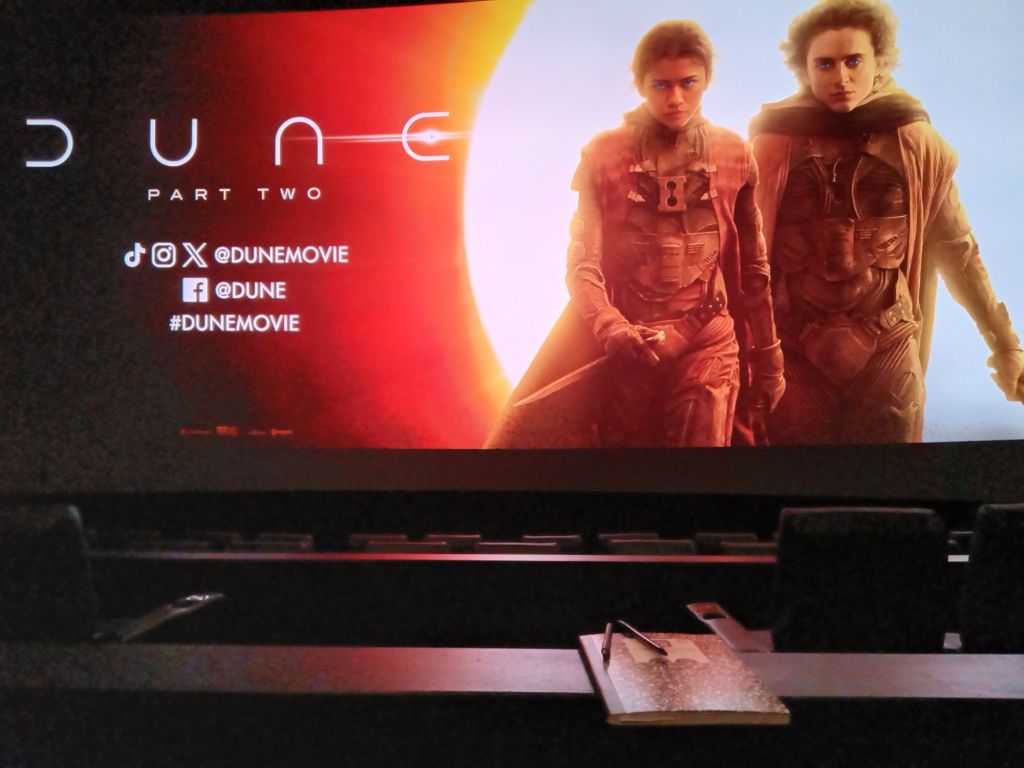
Movie Review — Worms and Warriors, love and destiny and death — “Dune: Part 2”

There’s a marked attention to grandeur in “Dune: Part 2.” The “world building” of this science fiction saga is more detailed and eye-catching, the sweep of the landscape and grit of those who live on it vastly more pronounced than in Denis Villeneuve’s first film, both of them based on Frank Herbert‘s 1965 novel.

With this film, Villeneuve more fully realizes his overarching intent, and “Dune” becomes what it was meant to be pretty much all along — the “Lawrence of Arabia” of science fiction. The sweeping source novel with its array of characters, settings, environmentalism and cultures may not share the subtexts of “Lawrence,” but it and this film of it are smart and large scale, so much so that every frame reminds you “This is Epic.”

“Part 2” is the aftermath of the slaughter of House Atreides, an ancient feudal spacefaring clan entrusted with administering the vital desert planet Arrakis, source of the “spice” that the rich and noble of their galaxy use to gain paranormal powers, make interstellar space travel possible and extend their lives.

The Duke (Oscar Isaac) and his lieutenants are dead and/or gone. But teen son Paul (Timothée Chalamet) survived the massacre, and a fight-to-the-death at the end of it. And he and his pregnant  Bene Gesserit mother (Rebecca Ferguson), from a race of seer women who act as manipulators and puppet masters of the fate of the empire, escape into the desert that covers the once-green planet. Son and mother, with her fetus communicating with her telepathically, pre-birth, find refuge among the Fremen of a planet that’s been enslaved and exploited for its natural resources. Among them, Chani (Zendaya) takes a special interest in Paul due to his bravery, his noblesse oblige and humility.

The fact that he’s pretty has nothing to do with her teaching him things like “sand walking” so as not to attract the attention of the gigantic worms, which the Fremen and others worship as “Shai-Hulud,” the makers of the spice.

The villains of House Harkonnen carried out the slaughter, and their monstrous Baron (Stellan Skarsgård) relishes this chance to control the spice supply line. His murderously cruel lieutenant, Beast Rabban (Dave Bautista) is charged with doing the actual work, deploying troops to protect spice harvesters and keep the various desert-dwelling native factions at bay.

Paul, dosed with spice and other chemicals by the Fremen and his mystic mother, has visions that formulate a plan of action. But he won’t hear of his mother’s plot to “propagandize” the natives with the idea that he is their prophesied “chosen one,” come to lead the people of the planet to liberty.

“Im no messiah!”

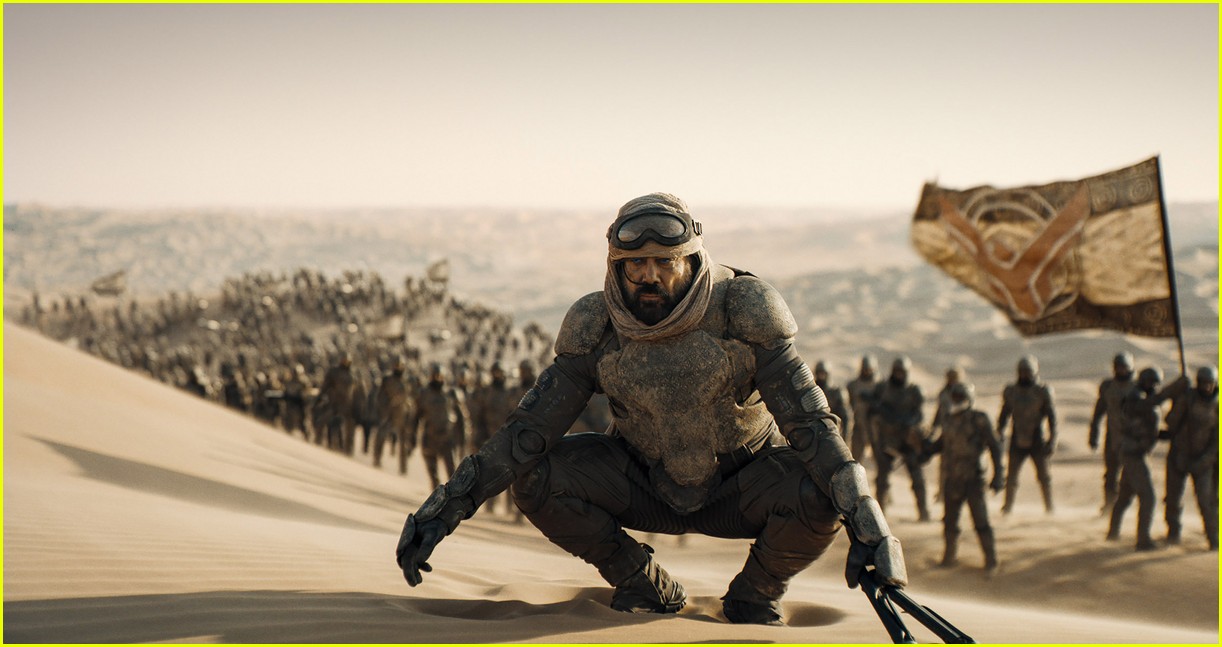
The fierce and religious Stilgar (Javier Bardem) wants to be believe in that prophecy, even if young Chani hisses that “prophecies” are how their oppressors “keep us enslaved.” Chani’s read her Marx. She knows “religion is the opiate of the masses.”

But destiny and his mother’s influence on it may not care how Paul would like to be just a warrior and not a leader.

The elderly Emperor (Christopher Walken) and his Bene Gesserit daughter (Florence Pugh) are watching the situation on Arrakis with interest and a hint of alarm.

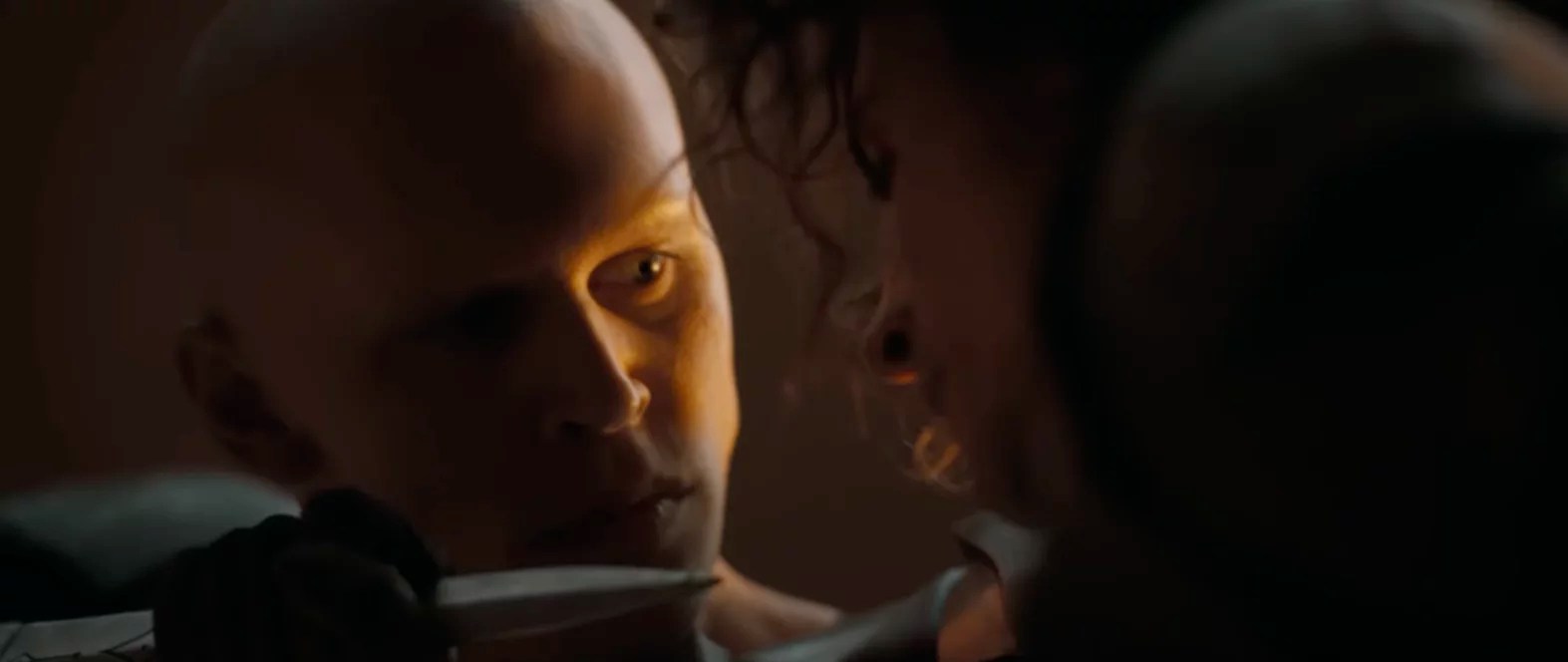
And a “psychopathic” “sociopath, a” young na-Baron of the Hakonnen, Feyd Rautha (a bald Austin Butler of “Elvis”) is angling for status on Arrakis, and within his clan. We foresee a rumble coming, both sweeping and gruesomely personal, as the Atriedes heir and the Harkonnen thug have a date with fate.

The novel “Dune” came out in the middle of a 1960s flowering of interest in all things desert Arabic, thanks largely to David Lean’s film “Lawrence of Arabia.” Herbert freely appropriates Arabic words, phrases and water-preserving customs — given icky sci-fi twists for this prototypical “desert planet” tale — for his galactic Bedouin and their world of sand and worms and ritual, with the “Southern Fundamentalists” of the planet the most devout.

Villenueve and co-writer Jon Spaihts wisely leave out some of Herbert’s Arabic words that have become commonplace in the half-century+ since “Dune” was published and Middle East and West have spent the ensuing decades in conflict. Refer to your war as “Jihad” and you take the viewer right out of the film.

The effects are just as dazzling as the sand-covered production design, with characters floating down (by wire and CGI) from heights on their exotic warcraft/spacecraft or cliffs on rocky outcroppings in the desert. Some sort of gravity gadget of their battered, armored suits? A “spice” benefit?

Bardem comes close to becoming the Auda Abu Tayi  of this interstellar “Lawrence of Arabia,” giving us hints of Anthony Quinn’s humor and larger-than-life presence in that movie. Crusty Josh Brolin gives the narrative additional humor and gravitas.

Ferguson and Léa Seydoux are inscrutably cunning sisters of the Bene Gesserit, with Pugh’s Emperor’s daughter character still moral and curious about her sect’s schemes and intrigues. Charlotte Rampling, one of the great beauties of the ’60s cinema, is properly scary as the Reverend Mother of this Women on Top heirarchy.

Villeneuve casts a broad spectrum of humanity among the various peoples of Arrakis, with very aged mystics, a wizened dwarf and characters so impossibly pale they must be kept indoors as human computers, “Mentats.”

Skarsgård’s Baron is undoubtably the visual model for George Lucas’s “Jabba the Hutt,” a beast of a man so large he needs technology and compliant, slaughterable females to keep him going. But the most interesting thing about the Skarsgård’s turn is the attention Butler, who did a pretty good job impersonating Elvis, pays to the Swede’s accent, tone and vocal cadences. Butler’s “na-Baron” sounds like Skarsgård, which is both apt and kind of cute to hear.

But in terms of performances, this is Chalamet’s star vehicle, and he takes Paul from boyish martial arts training to grieving (tiny bit) son to a Man in Full in this performance. The character wrestles with the morality of power and fearsome responsibility of being or at least play-acting a “chosen one.” Chalamet lets us see the reluctance, the fatalism and the doubts that warn Paul away from taking on this Mahdi role.

His chemistry with Zendaya is workable, although she seems like a character and an actress performing her in a somewhat more conventional “warrior princess” tale.

One thing that sticks with me about the “Dune” novels (there are five, should Warner Brothers find this universe too lucrative to leave idle) after reading them many years ago — OK, TWO things, one being the gigantic sandworms that people who “are one with the desert” can ride bareback — is the attention to water in a world where it is scarce.

Suits recycle water. The dead have their water “harvested.” Vomiting is a disaster. Shedding tears will earn you a “Never give your water away” lecture.

The second Battle for Arrakis hits a few action highs in the middle and later acts, giving us a welcome break from the exploration of desert mysticism and endless exposition from characters both new and older ones who return to the fold.

And the finale feels a tad perfunctory as it hews closely to the novel and every other filmed attempt at “Dune,” with an open-endedness that may be the studio’s demand, but which might be giving Villeneuve Peter Jackson “Hobbit” commiment nightmares.

One gets the feeling we will see more of this war-among-the-worlds and the “Houses” that rule them from here on out. But that open-endedness robs the climax of much of its impact. Would we still be visiting “a long time ago in a galaxy far, far away” had Lucas & Co. not given their initial film a big bang, a bigger sendoff and an almost literal curtain call? Maybe not.

Rating: PG-13 for sequences of strong violence, some suggestive material and brief strong language.

Cast: Timothée Chalamet, Zendaya, Javier Bardem, Rebecca Ferguson, Josh Brolin, Florence Pugh, Dave Bautista, Stellan Skarsgård, Léa Seydoux, Babs Olusanmokun, Austin Butler, Souheila Yacoub, Charlotte Rampling and Christopher Walken.

Credits: Directed by Denis Villeneuve, scripted by Denis Villeneuve and Jon Spaihts, based on the novel by Frank Herbert. A Warner Brothers release.

Running time: 2:46

Posted in Reviews, previews, profiles and movie news | Comments Off on Movie Review — Worms and Warriors, love and destiny and death — “Dune: Part 2”

“Dune 2,” and soon, too

Two hours and forty odd minutes of spice and worms and an all-the-stars cast. Here we go.

The eagerly anticipated, long-delayed sequel  opens Mar. 1.

Posted in Reviews, previews, profiles and movie news | Comments Off on “Dune 2,” and soon, too