Netflixable? Soapy Korean Immigrant Saga seeks a happy ending — “My Name is Loh Kiwan”

“My Name is Loh Kiwan” is a downbeat Korean melodrama peppered with violence and victimhood and adorned with too many trials and tribulations for its own good.

Writer-director Kim Hui-jin stuffs a TV soap opera season’s worth of over-the-top challenges, sad flashbacks, ugly injustices and an unlikely romance in adapting Hae Ji-Cho’s novel for the screen.

It’s watchable but utterly predictable.

We lose track of what it is our titular hero is escaping and never are allowed to see the appeal in fleeing to racist, immigrant-bashing Brussels, Belgium. I guess between the EU red tape, the Chinese efforts to cover up corruption and crime, drug abuse, fake identites and sketchy workplaces that hire undocumented migrants and all those flashbacks to tell us about two dead mothers, they just didn’t have the time.

We meet Loh Kiwan (Song Joong-ki) as he’s weeping, cleaning blood off a street.

Next think we know, he’s on board a jetliner with several other folks who have paid to be taken from China and smuggled into Belgium, coached by their “mule” to not look sketchy and to just say “Je ne parle pas français” to the customs officials at Brussels airport. On the way from that airport, Loh Kiwan tries to pay a driver in blood-stained U.S. dollars.

“Bad luck.”

Loh Kiwan is fleeing North Korea by way of China. And since Koreans long native to China have been using that dodge to backdoor their way abroad, he is instantly under suspicion. He tells a customs officer, and the Korean translator who came to his aid, his sad story.

Up to this point, we’re allowed to wonder if he killed somebody, if he’s Chinese pretending to be Korean and just saying “Comrade” a lot to “pass” for a People’s Republican running from persecution and famine.

But as we see or at least feel implied in flashbacks, his mother sacrificed everything to get him across that North Korean border into China and later onto that plane. An uncle urged him on, no matter the cost. Who wouldn’t be moved? Who’d want to escape North Korea only to get stuck in China?

Loh Kiwan gets a hearing date for the chance to land a work Visa. It is months away, and all he has are a few bloodstained greenback dollars to tide him over.

“I don’t exist here,” he complains, in subtitled Korean (and French) or dubbed into English.

He is bullied out of a hostel, locked out of a public restroom where he hopes to winter, beaten up by xenophobes and finally robbed by a pretty punk as he’s passed out in a laundromat.

That’s how he meets Marie Lee (Choi Seong-eun), a sullen, well-kept junky in open revolt against her father (Jo Han-chul) but in debt to her dealer (Waël Sersoub).

Our hero finally turns tough guy with the skinny Chinese/Belgian woman. He wants that damned wallet back. It isn’t long before their fates are locked as we take a tour through the working poverty of illegal immigrants, high stakes gambling on an arcane European sport and the one thing these two have in common — losing their mothers.

As one bad circumstance after another piles up on his life, she invests in his wellbeing. As she struggles with her own demons, he invests in hers.

And every flashback takes us back to the trauma they’re both shouldering, which grows more dire with every bit of retelling.

For a story with this much overwrought tragedy attached to it, I found “My Name is Loh Kiwan” an oddly unemotional “weeper.” One can sympathize with the immigrant’s plight and still shake your head at the theatrical nature of the tragedies, which come close to “Oh come on now.” The layers of hurt and self-destruction added to it via flashbacks overwhelm you with soap opera suds.

The performances are engaging but not affecting, and the point of view of the story is kind of xenophobic itself. A South Korean film avoiding condemning its belligerant failed-state northern neighbor, condemning China without flinching and then slamming Europe and Europeans for bigotry, and simply being leery of taking in this guy with no marketable skills and no grasp of the language because they and we are supposed to be believe his increasingly fraught and over-the-top story?

It seems a bit much.

The sad saga kind of plods along a predictable path — courts, violence, love — with only a couple of mild surprises in store in the third act. But no, there’s nothing remotely surprising in the finale.

Rating: TV-MA, violence, drug abuse

Cast: Song Joong-ki, Choi Seong-eun, Jo Han-chul and Waël Sersoub.

Credits: Scripted and directed by Kim Hui-jin, based on a novel by Hae Ji-Cho. A Netflix release.

Running time: 2:12
Posted in Reviews, previews, profiles and movie news | Comments Off on Netflixable? Soapy Korean Immigrant Saga seeks a happy ending — “My Name is Loh Kiwan”

Movie Preview: “The Garfield Movie” again

Memorial Day Weekend, Sony Animation takes another shot at turning “Garfield” in a franchise.

Samuel L., Chris Pratt, Cecily Strong, Ving Rhames, Hannah Waddington, Nicholas Hoult, Bowen Yang (of course) and Snoop Dogg?

Whose idea was it to cast Bowen Yang and NOT make him the voice of Garfield?

Posted in Reviews, previews, profiles and movie news | Comments Off on Movie Preview: “The Garfield Movie” again

Movie Review: Mario Van Peebles heads West again — “Outlaw Posse”

“Outlaw Posse” is a scruffy, old school blaxploitation Western from Mario Van Peebles, son of iconic African American filmmaker Melvin Van Peebles, who put the “Black” in blaxploitation, back in his “Sweet Sweetback’s BADASSSSS Song” day.

Mario V. P. charmed a lot of co-stars into mounting up for another movie reminder that the Old West wasn’t as John Wayne white as it has traditionally been portrayed. As with his 1993 Western “Posse,” this is a movie as intent on delivering a history lesson as it is on entertaining.

But the lessons here are heavy-handed, because while only one character stops the narrative cold with a “How about a little history?” suggestion, such pauses run right through to the anti-climactic climax. That weighs down the blazing shoot-outs, dance-hall girl come-ons, chases and trash talk.

“Take your Aboriginal Ass back to Africa!” “I ain’t killed nobody in a month!”

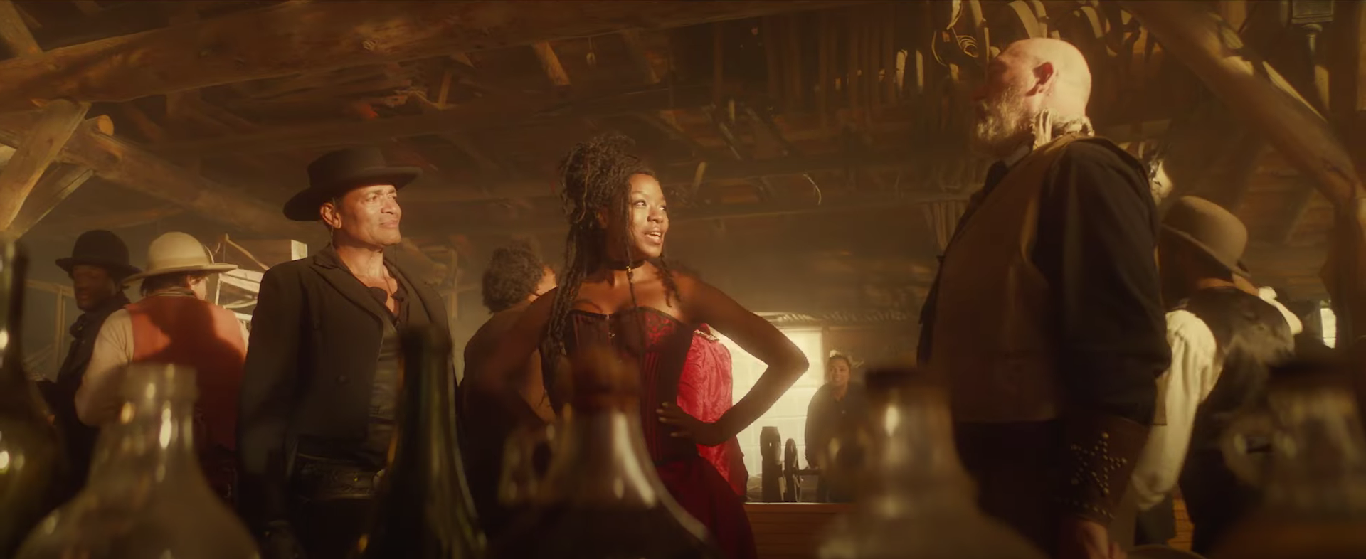
Van Peebles is “Chief,” given a heroic, backlit, super-sized-sombrero introduction by…himself — he also wrote-and-directed this. Chief is a gunman in a border town cantina who sticks up for a Native American against a punk gunslinger (Cam Gigandet) and his accomplices (Neal McDonough and M. Emmet Walsh).

No, “I got nothin’ against darkies” won’t get you off the hook when you start something.

Chief has re-crossed the border for a reason, a reason the one-handed outlaw king Angel (William Mapother) is most certainly interested in.

Chief will have to assemble a gang, an “outlaw posse,” to evade Angel’s outlaw posse. Gunslinger Southpaw (Jake Manley), dynamite fiend Carson (John Carroll Lynch), whiteface comic Spooky (D.C. Young Fly) and sex-worker Queenie (Amber Reign Smith) join up.

And Chief’s long-estranged son Decker (Mandela Van Peebles, Mario’s son) rides along as well. But Angel is the one who recruited him, to help Angel track down Chief and that buried Confederate gold he’s after. Decker’s musician wife (Madison Calley) is being held hostage until he delivers his father to Angel.

They stage a hold-up, get caught in a shoot-out and a chase or two, and track north through the Old West, meeting figures both historic and fictional on their way to a showdown.

While there are anachronisms in the speech, the historical figures — included hard-nosed mail driver Stagecoach Mary (Whoopi Goldberg), boxer Jack Johnson and the founders of the oldest Chinese restaurant in the United States — are real people, often erased from American history and the myth of the Old West.

But this isn’t “history.” It’s a movie. They turn a Black saloon into a 1908 juke joint at one point. Buthc and Sundance references are both historical and meant for amusement. And “dynamite” is a dead giveaway that your Western isn’t all that serious.

While Van Peebles is to be commended for his history lessons, for knowing how to film (with one impressively long take) a good shoot-out and chase, “Outlaw Posse” is at its heart cornball and old fashioned and entirely too wedded to its good intentions and self-righteousness.

A stop by a utopian racial settlement is just an excuse to give Cedric the Entertainer a scene or two and a lecture on tolerance. And everything from the “getting the gang together” bits to the shopkeeper (Edward James Olmos) they meet and chat up, to the arbitrary stagecoach ride from Stagecoach Mary is clumsily introduced. The narrative doesn’t flow, and some scenes seem superfluous or at least poorly set-up.

Mapother is a passable villain-on-a-tight budget, and the almost-ageless Van Peebles has always had great screen presence.

But this “Posse” is never much more than a mixed-bag — sometimes entertaining, sometimes pedantic, and never as quick or as nimble on its feet as it needs to be to come off.

Rating: R, violence, profanity, nudity

Cast: Mario Van Peebles, William Mapother, Amber Reign Smith, Mandela Van Peebles, John Carroll Lynch, D.C. Young Fly, Madison Calley, with Edward James Olmos, M. Emmet Walsh, Cedric the Entertainer, Cam Gigandet, Neal McDonough and Whoopi Goldberg

Credits: Scripted and directed by Mario Van Peebles. A Quiver release.

Running time: 1:48

Posted in Reviews, previews, profiles and movie news | Comments Off on Movie Review: Mario Van Peebles heads West again — “Outlaw Posse”

Movie Review: Canadians stage an intervention as the ultimate “Unfriending”

“Unfriending” is a deadpan Canadian comedy with “film festival darling” engrained in its DNA. It doesn’t quite come off, but being dark and droll, it might play to the right audience, a forgiving film fest crowd willing to ignore how slowly it starts, how low the ceilings are for the performances and how quickly it bogs down before The Big Finish.

It’s from The Butler Brothers, Brett and Jason, whose specialty is film festival movies such as “Confusions of an Unmarried Couple” and “Mourning has Broken.”

Blake and May (Sean Melrum and Simone Jetsun) are hosts for a dinner party, taking care to get the potroast just right, to make the table settings perfect and get their lovely two-story frame house ready for company, and to sneak their box wine into pricier empty bottles their more pretentious friends will lap up.

So what if blowhard Blake pours red wine into bottles that plainly say “blanc” on the label?

“I’m not bilingual! You can’t judge me!”

Mutual friends Radia and Barclay (Jenna Vittoria and Michael Pearson), models of political correctness, and former punk rocker Darby (Honor Spencer) and her lover Giselle (Rachelle Lauzon) all show up early for the “adult sleepover” in the country, most of them well-prepared for the occasion.

But being 30ish, this isn’t Blake and May’s house. It belongs to his parents. He’s a tad too prickly and myopic to have ever been a success at everything.

It isn’t just a “dinner party,” with “good friends, good wine and good conversation.” It’s an “intervention.” And it isn’t an ordinary intervention, either. They’re here to convince their awkward, introverted and suffering friend Isaac (Alex Stone) to kill himself.

It’s a pot-luck for suicide, with some friends bringing suggestions, and Blake contributing several possible means of Isaac’s self-administered demise — a rope, a switchblade, a pistol that was “John Wick’s” mass murder weapon of choice in the movies, pills, a hair dryer for dropping in the tub, a list of local bridges worth jumping from and, in the garage, “my 1999 RAV 4.”

Carbon monoxide? Good to keep your options open. And be thorough.

They do whisky shots and rehearse, with PC policeman Barclay correcting everything.

“I don’t think we can say ‘guest room’ here. Vintage things (Barclay shows up with a trunk, not a suitcase) are cool, vintage thoughts are not.”

And just as everybody save for the failed punk rocker have signed on for the evening’s activities, sad sack Isaac arrives, with a smart, assertive Black woman, Lexxi (Golden Madison) as his date.

Wait, what? Isaac doesn’t date! Might this change everything they think about him? Or does it merely “complicate” the best laid plans of May and especially Blake?

There are a few promising directions the Butlers could have taken this story, but the twists they toss at us are barely able to keep this short, dark comedy in motion.

A couple of the performances have enough charismatic pop to come off, but the dialogue and characters they play aren’t enough to push “sit-com bit players” out of one’s mind.

The whole “circle of care for our friend” selling point doesn’t make the sale.

By the time the narrative rallies for an over-the-top finale, the deadpan has drained most of the energy out of it and “Unfriending” simply lurches over the finish line when it should sprint.

But in the right film festival with the right audience…

Rating: unrated, violence, sexual situations, profanity

Cast:Sean Melrum, Simone Jetsun, Jenna Vittoria, Michael Pearson, Honor Spencer, Rachelle Lauzon, Golden Madison and Alex Stone.

Credits: Scripted and directed by Brett M. Butler and Jason G, Butler. A Tiny Cabin release.

Running time: 1:27

Posted in Reviews, previews, profiles and movie news | Comments Off on Movie Review: Canadians stage an intervention as the ultimate “Unfriending”

Movie Review: Teen Boys come of age in the “Snack Shack”

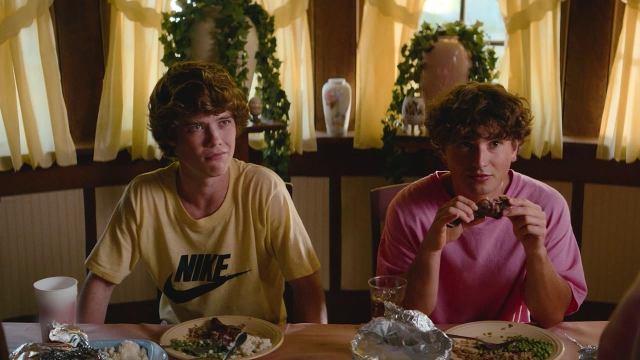
The coming-of-age teen sex comedy genre goes younger and supposedly edgier in “Snack Shack,” which tells the story of randy Xennials in 1991 Nebraska City, Nebraska.

The follow-up to writer-director Adam Rehmeier’s quirkier “Dinner in America” is a transgressive, tedious and terribly predictable slog whose few light moments don’t break the coarse spell it casts.

The novelty here is that A.J. (Conor Sherry), aka “Eagle” (as in Eagle Scout) and Moose (Gabriel Labelle), the besties smoking and hustling, cutting out on the class field trip to bet on greyhounds at an Off Track Betting office in Iowa, learning how to make beer and learning how to make bongs out of beer cans, are 14.

All their best-laid plans all seem to pay off. Betting at the track, for instance, requires a “system,” they assure the adults.

“You’re 14 years old! You don’t have a friggin’ SYSTEM!”

Imagine how shocked A.J.’s parents, Jean and The Judge (Gillian Vigman and David Costabile), are to learn that he’s emptied out his college savings account for their next scheme, bidding on the rights to run a small business — the “snack shack” at the popular town pool over the coming summer.

The generation that would later be labeled “lazy” (by Time Magazine and other old timers) has produced two chatterbox entrepreneurs who have brewed some convincing “real beer,” and who — Moose insists — are about to make bank on selling hot dogs, drinks, candy and other snacks to avid poolgoers the summer after “The Liberation of Kuwait.”

Their protector and chief enabler is a soldier (Nick Robinson) pal and mentor home on leave. And the free electron who will break up these two molecularly-joined friends is the hot new lifeguard and “cousin” to a neighbor kid, Brooke (Mika Abdalla) who is old enough to drive and oddly “interested” in each boy in a kind of pervy “Jules and Jim” way.

Such pictures typically trot through the usual rites of passage — coping with bullies, after hours “night swims,” pre-Rave “raves,” bringe drinking, non-sibling rivalry over a lady fair, bonding, making big plans and playing poker.

As our two leads in no way pass for middle schoolers chomping at the bit to go to high school, Rehmeir is offering up a genre parody, just not a funny one. And he’s not actually sending-up the male wish fulfillment fantasy that drives some male-dominated movie memoirs, but he might as well be, leaning on “Fast Times at Ridgemont High” and others that trafficked in that.

Young Sherry, an alumnus of Nickelodeon’s “Are You Afraid of the Dark?” makes a sensitive-if-not-remotely age-appropriate lead. Labelle (“The Fabelmans”) is Every Teen Hustler you’ve ever seen, and former child actress Abdalla, most recently seen in “The Flash,” is well cast as that voluptuous “older woman” object of many a horny teen’s desire.

The period piece setting is indifferently managed, with more cars from the ’70s than the ’90s, and a modest sampling of the pop music of the era — Tone Loc’s “Wild Thing,” etc.

For a film that flirts with a statutory rape/child endangerment edge, “Snack Shack” is awfully tame, a movie about enterprising kids growing up too fast and permissive parenting that enables that with trite lessons about life and love and recklessness borrowed from decades of movies like this, going back to “American Graffitti.”

“Personal” picture or whatever larger objective Rehemeier was aiming for, he’s made a very long and not that funny comedy connected by disjointed and generally unoriginal scenes rather than a coherent narrative.

Rating: R, fisticuffs, sexual situations, underage drinking, pot use and profanity

Cast: Conor Sherry, Gabriel Labelle, Mika Abdalla and Nick Robinson

Credits: Scripted and directed by Adam Rehmeier. A Republic release.

Running time: 1:52

Posted in Reviews, previews, profiles and movie news | Comments Off on Movie Review: Teen Boys come of age in the “Snack Shack”

Movie Preview: A peek at the remake of “Don’t Tell Mom the Babysitter’s Dead”

Iantha Richardson, Nicole Richie, Jermaine Fowler and June Squibb (as the about-to-die babysitter) star in this version of a 1991 film that starred Christina Applegate.

Perhaps the trailer will have an actual laugh in it, as the teaser doth not. Just novelty casting.

April 12.

Posted in Reviews, previews, profiles and movie news | Comments Off on Movie Preview: A peek at the remake of “Don’t Tell Mom the Babysitter’s Dead”

Netflixable? “Spaceman” stars Adam Sandler, if that answers your question

One can appreciate Adam Sandler using his Big Deal with Netflix to try and branch out as an actor, to act in more serious films that the self-described “moron” comedies he’s churned out for decades, keeping himself, assorted family members and legions of his cronies fat and happy.

But one must note how limited his skillset remains, how ill-suited he is in certain guises, how bad he is in “Spaceman” and how gorgeous but indifferent the film surrounding him is.

The Swedish director Johan Renck (TV’s “Chernobyl”) and under-credentialed screenwriter Colby Day adapt Jaroslav Kalfar’s hallucinatory novel of a solo space mission undertaken by a man whose marriage to his very pregnant wife is disentegrating, mid-voyage, and put Sandler in the middle of it.

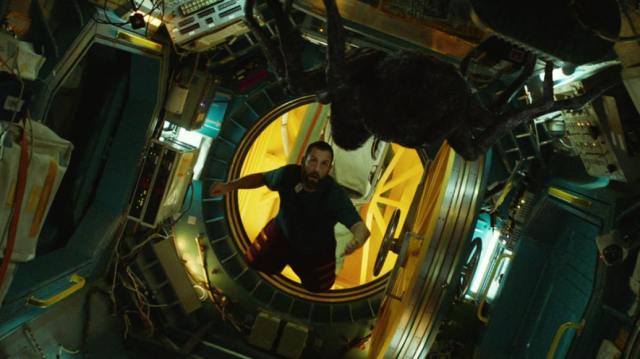
Jakub, our “Spaceman” cracks up, hallucinating a long debate with an imagined gigantic space spider given the soothing vocal tones of Paul Dano, as the spacefarer’s wife Lenka (Carey Mulligan) tries to end the marriage via phone calls, somewhat supported by her mother (Lena Olin) but blocked from finishing the breakup by a space agency chief played by Isabella Rossellini.

Yes, the deal that got this movie off the ground, involving Netflix, Sandler and a cluster of more accomplished if not more famous screen icons, is more interesting than the movie itself. And yes, it’s entirely possible that they got Sandler’s attention by informing him the spider would repeatedly address him as “Skinny Human.”

It’s a sad, dreamy, impressively-financed space travel tale about the spiritual isolation of a daying marriage, stress and abandonment that presents Sandler’s Jakub struggling with system failures, listening to opera, and explaining opera in a stilted, half-assed attempt at a “European” accent to a giant imaginary spider.

“Skinny Human, I have never heard such silence before.”

The real struggle involves trying to add tools to Sandler’s always-limited repertoire. He shouts a lot in dramas, because that’s all he’s got to lean on that’s “serious.” He doesn’t shout much here, but that doesn’t help. His line readings are creaky affectations that sound so unnatural coming from his mouth that it’s a relief when he has the odd grammatical noun-verb agreement blunder.

His character carries a son’s trauma of his father’s downfall and memories of the dark communist crimes of Czech history. He’s on his way to Jupiter, racing “the Koreans” to get there, grasping at sanity, and desperate to reach his wife before she cuts off contact altogether.

“Whatever” is the only line Sandler delivers with conviction.

The narrative changes points of view, following the spaceman and then his wife, each spiraling into an existential crisis, each crisis driven by loneliness and panic.

And the film skips by the biggest question in the plot with a Carey Mulligan shrug.

“Why can’t you wait until he comes back?”

The best one can say for “Spaceman” is that it’s a trippy curiosity. The worst is that it’s a serious swing-and-a-miss for the Sand Man, and a career low for Carey M.

Rating: R, profanity

Cast: Adam Sandler, Carey Mulligan, Lena Olin, Isabella Rossellini and the voice of Paul Dano.

Credits: Directed by Johan Renck, scripted by Colby Day, based on a novel by Jaroslav Kalfar. A Netflix release.

Running time: 1:47

Posted in Reviews, previews, profiles and movie news | Comments Off on Netflixable? “Spaceman” stars Adam Sandler, if that answers your question

Movie Preview: “Robot Dreams” in animated form

This March release was named “Best Animated Feature” by the Nevada Film Critics coffee klatch.

So, they’ve got that going for them.

An ’80s period piece about a Manhattan dog that builds himself a companion? Why didn’t Pixar think of that?

Posted in Reviews, previews, profiles and movie news | Comments Off on Movie Preview: “Robot Dreams” in animated form

Movie Review: Understated to unstated altogether –in search of working class “Perfect Days” in Tokyo

There’s a mesmerizing tranquility to German director Wim Wenders’ homage to Japan and the cinema of Japanese icon Ozu Yasujiro.

The filmmaker who gave us “Wings of Desire” and a pretty good documentary on Ozu (“Tokyo-Ga”) loses himself in a Westernized interpretation of Japanese minimalism in the style of the “everyday Japanese life” filmmaker who gave us understated meditations such as “An Autumn Afternoon,” “Late Autumn,” “Early Spring,” “Early Summer” and most famously, “Toyko Story.”

Wenders’ Oscar-nominated Tokyo reverie “Perfect Days” might better be titled “Zen and the Art of Tokyo Public Toilet Maintenance,” because that’s what it’s man-of-few-words antagonist does for a living, and “zen” is the best word for describing his approach to this “untouchable” career.

We may wonder how Hirayama, played by “Shall We Dance” hearthrob Koji Yakusho, came to be an exacting 50-60something scrubbing public restrooms for The Tokyo Toilet contractors. But Wenders gives us more a collection of intriguing details than anything resembling an answer.

Hirayama is a man of rigid routine. He eats the same things and covers the same route on a daily and weekly basis. And he is a worker with high standards. He takes out a mirror to examine what needs to be scrubbed off the bottom of the urinals in “the cleanest public bathrooms on Earth.”

Hirayama is a loner, but he has hints of a poetic soul, taking photos of shadows of leaves against the sky with his cheap Olympus film camera, listening to “House of the Rising Sun” or “Sittin’ on the Dock of the Bay” on vintage cassettes in his self-owned work truck, taking his lunches in the open air, reading Faulkner, Patricia Highsmith and others by the light of the sole lamp in his spartan apartment.

What, we wonder, will interrupt this routine and form the basis for the drama here? Will it be his amusingly doltish, slacker Millennial “junior” cleaner, Takashi (Tokio Emoto)? Takashi’s efforts to woo bar woman (kyabajō) Aya (Aoi Yamada), a blonde pixie plainly out of Takashi’s league?

She is so moved by Hirayama’s cassette of Patti Smith’s “Horses” that she pockets it after the lazy and always-imposing Takashi gives her a lift in Hirayama’s truck.

Then there’s the long-estranged niece (Arisa Nakano) who shows up, stays with Hirayama and shadows him on his job, anything to get away from her mother (Yumi Asô).

There’s a strange woman Hirayama smiles at in the park every day, with only a dead-eyed stare sent in return. Maybe the bar owner nicknamed “Mama” (Sayuri Ishikawa) who regularly flirts with Hirayama is singing her heartbreaking Japanese version of “House of the Rising Sun” directly to him.

Wenders layers details on top of details, obsessively focusing on Hirayama’s holy reverance for seedlings that he takes — with permission — from a shrine to raise in his own mini teacup planter forest, his nightly trips to a public bath, weekends of laundry, bike rides to bars as he runs errands and his morning ritual of rolling up his futon, donning his coveralls with a fresh towel around his neck, looking up to check out the morning sky, and exult in it, buying a canned iced coffee from the vending machine conveniently right out in front of his flat and then selecting a vintage cassette — “Feeling Good” by Nina Simone? — to ride to work by.

It’s more a film of feelings, subtle emotions, and a fascinatingly committed lead performance than it is a straightforward narrative. Things happen, but the arc of a life this myopic won’t be broad. When these slight things do roll up, they can be life affirming, but only in the broadest “quiet desperation” sense, and even then there’s more “quiet” than “desperation.

The title, “Perfect Days,” would be an unkept promise if it weren’t taken from one of several (mostly) Western pop songs that do a lot of the heavy lifting in the film — “Brown-Eyed Girl” and Patti Smith album tracks to Nina Simone and Otis Redding and The Animals (“House of the Rising Sun” is almost a pun here) warhorses. The title tune, as it were, is Lou Reed’s “Perfect Day.”

“Oh, it’s such a perfect day
I’m glad I spent it with you
Oh, such a perfect day
You just keep me hanging on
You just keep me hanging on…”

Seeing as how the tune is about being in a heroin-narcotized state, even that’s a functional dead end, ironic and nothing more.

But the slice of Tokyo life is lovely and arresting. It’s as if Japanophile Wenders noticed the spotless restrooms that other visitors to the land of the rising sun rave about and pondered “How do they get that way?”

Your appreciation of “Perfect Days” hangs on how fascinating you think a toilet cleaner would be, and how much interior life you’re willing to add to Wenders’ repetitive and superficial “meditation” on such a character.

Rating: PG, smoking, some nudity

Cast: Koji Yakusho, Arisa Nakano, Sayuri Ishikawa, Inuko Inuyama, Yumi Asô and Tokio Emoto

Credits: Directed by Wim Wenders, scripted by Takuma Takasaki and Wim Wenders. A Neon release.

Running time: 2:03

Posted in Reviews, previews, profiles and movie news | Comments Off on Movie Review: Understated to unstated altogether –in search of working class “Perfect Days” in Tokyo

Classic Film Review: Orson Falls Hard for “The Lady from Shanghai” (1947)

Many Orson Welles‘ films can be labeled “noirish” without a lot of debate among cinephiles. But only a couple might rightly be regarded as “film noir,” sordid crime tales exposing the dark underbelly of pre-war to post-war America.

The two films most clearly fitting into that genre are also defining films in Welles’ legacy, “marred” and studio-edited masterpieces, joining “The Magnificent Ambersons” as among the many projects that make Welles fans salivate over “what might have been.”

“Touch of Evil” (1958) has long been a favorite of film buffs, thanks largely to its glorious excesses, degree of difficulty and “Hollywood comeback” nature. For decades the film didn’t exist in accordance with Welles’ vision of it — the celebrated long take that opens it allowed to roll under the opening credits, etc. There is a “Welles cut” of that film extant, which could scarcely improve the picture’s already-lofty reputation.

Welles labored under similar circumstances on “The Lady from Shanghai.” He filmed this 1947 release for a major Hollywood studio, Columbia Pictures, and it starred the most powerful lady on the lot, Rita Hayworth. As she was married to Welles at the time, this picture gave him the leverage to make his own picture, and even dye her famous red tresses blonde, and chop them off short, enraging studio chief Harry Cohn.

Cohn, for whom Welles made the movie as a “favor” as the Columbia chief had invested in Welles’ disastrous stage production of “Around the World in 80 Days,” with music by Cole Porter, took out his revenge on the former “wunderkind” by heavily hacking away at “Shanghai,” cutting the big funhouse “hall of mirrors” climactic showdown from twenty minutes to just over three, for instance.

What’s left is still brisk and brilliant, a picture whose stature has soared in the decades since its badly-reviewed/box-office bomb release.

Welles slings an Irish accent and takes on an anti-heroic “action hero” role, playing a two-fisted brawler, writer and itenerate merchant mariner and sailor. That was a bit of a stretch, as we can make out the stunt men doubling for the tall, hulking Welles in the fight scenes.

“Black Irish” Michael O’Hara falls under the spell of the blonde Elsa — he prefers to call her “Rosalie” — on a hansom cab ride in New York. Some thugs come for her in Central Park, he knocks them about, and thus impressed, she starts to fall for him.

But bookish Irish Mike must not know the French phrase “femme fatale,” which he should sense the moment he spies the pistol she didn’t pull out of her purse to defend herself.

He’s disappointed to learn she’s married, but his sardonic, sarcastic voice-over narration all but brushes that off.

“Personally, I don’t like a girlfriend who has a husband,” he brogues. “If she’ll fool a husband, I figure she’ll fool me.”

The radio drama veteran Welles indulges in his most playful use of voice-over narration, which even if it was a product of re-edits and re-shoots, is some of the most charming film noir monologuing ever.

Black Irish Mike refers to himself as a “fathead,” and “big boob that I am” as he narrates himself right into a trap.

“This is I, thinking myself a very gay dog, indeed. But, here was a beautiful girl, all by herself, and me with plenty of time, nothin’ to do but get myself into trouble. Some people can smell danger. Not me.”

The “danger” may come from Elsa’s crutch-walking husband, the high-powered criminal defense attorney Arthur Bannister, deliriously overplayed by Welles’ “Citizen Kane” pal Everett Sloane. Bannister is a cynic and a realist. He wants Black Irish to crew on his sailing yacht, Circe (Errol Flynn’s yacht Zaca, was rented for the shoot, with Flynn along to sail it), which is to voyage from New York to California through “the (Panama) canal.” Bannister wants Mike because his wife wants him.

And what “Lov-errr,” as he calls her wants, Lov-errr gets.

Bannister has a sweaty, sketchy smart-ass partner, Grisby (Glenn Anders). And there’s a goon in the legal eagle’s employ (Ted de Corsia), some sort of private eye. If the lady of the yacht is making a play for the big “boob” of a bosun, this could get very messy very quickly.

The violence comes from an expected direction, but not with the expected victim and/or consequences.

The “big boob that I am” seems cagier than he lets on, resisting the lady’s charms as they sail to small Mexican towns and arrive in a small boat port near San Francisco. Yet somehow O’Hara is trapped, in a fix, with no way of knowing how to finagle his way out of it.

Welles shot in San Francisco and Sausalito, Acapulco and Pie de la Cuesta, Mexico. The picture has an intentional documentary realism at times, but peppered with telling close-ups, grim violence and grave pronouncements rendered by one and all, always with O’Hara’s resigned, world-weary voice-over spin as the icing on the cake.

“I never make up my mind about anything at all, until it’s over and done with.” “The only way to stay out of trouble is to grow old, so I guess I’ll concentrate on that.”

Watching the film, you can see what’s here as tight and polished and quick. Reading about it, you can see what might have been had Welles been left to his own devices. But like the thoroughly entertaining thriller “The Stranger,” “Touch of Evil” and “The Magnificent Ambersons,” there’s a briskness to the proceedings that make one wonder — not for the first time — if Welles wasn’t his own indulgent worst enemy. Even those films that only exist in truncated form are dazzling in technique, great fun to watch and timeless.

“Touch of Evil” plays as dark and droll with those credits rolling over Charlton Heston and Janet Leigh’s long walk across from a Mexican border town to an American. “Lady from Shanghai,” jumpy and choppy as it can seem, just skips by, a brutally efficient thriller with mystery and a grim determination to get on with everyone facing his or her fate.

“Maybe I’ll live so long that I’ll forget her,” O’Hara muses. “Maybe I’ll die trying.”

Welles the filmmaker and Welles the actor rarely told a tale that held us as firmly, from start to finish, as this one.

star

Rating: unrated, violence

Cast: Rita Hayworth, Orson Welles, Everett Sloane, Glenn Anders, Ted de Corsia, Gus Schilling, Evelyn Ellis and Erskine Sanford

Credits: Scripted and directed by Orson Welles, based on a Sherwood King novel. A Columbia release streaming on Tubi, Amazon, etc.

Running time: 1:27

Posted in Reviews, previews, profiles and movie news | Comments Off on Classic Film Review: Orson Falls Hard for “The Lady from Shanghai” (1947)