
An expertly shot and edited thriller built around a cringey/creepy performance by Josh Hartnett is undone by an indulgent father trying to make a pop starlet/actress out of his daughter in “Trap,” the latest from M. Night Shyamalan.
Mr. Suspense-with-a-Twist Hitchcock for the fanboy era takes another shot at passing on the family business to his offspring. And as this tale of serial killer dad possibly undone by indulging his daughter’s fervent desire to see her favorite pop diva in concert goes utterly off the rails in the third act, one cannot help but smirk at the irony of it all.
Because that’s how Daddy Shyamalan’s film is undone, indulging singer/songwriter/actress Saleka Shyamalan to the point where she’s not just the remote performer whose big Philly show “The Butcher” is trapped in, but a key player in the drama that will decide the fate of this monster.
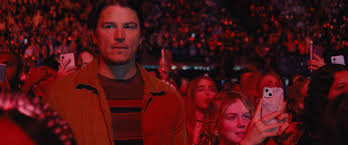
Screen veteran Hartnett plays Cooper, rewarding his tween Riley (Ariel Donghue) for her latest report card by taking her to the big arena concert by Lady Raven (Saleka S.). She’ll sing along with the rest of the crowd, dance with her fellow fans and capture a bit of the spectacle on her cell phone.
But whatever everybody else thinks of the massive police presence at the show, ol’Dad is put on edge. His dark (shadowed in many shots) eyes dart about the venue, not exactly alarmed, but warily and instinctively searching for a cop-free exit.
Some officious Brit, played by Hayley Mills (a LONG way from “The Parent Trap”), seems to be in charge.
As the good-time vibes of the PG-Gaga stage show get underway, Dad makes it his business to avoid the mother (Marnie McPhail) of a child who’s gone mean girl on his daughter. And he turns on his toothiest grin to get answers from a too-helpful shirt vendor (Jonathan Langdon) who might know what’s up.
“You know that serial killer, ‘The Butcher?'” Twelve grisly dismemberment murders and all? The cops know he’s here, and they’re going over everyone the profiler (Mills) thinks could be their suspect.
“Trap” thus becomes a puzzle, an escape room exercise, with the city fireman Cooper refusing to panic, pilfering a security pass and police radio and plotting his getaway.
That “working the problem” is well-handled, with the camera letting us see much of what Cooper might view as a means of slipping through the dragnet. Shyamalan’s shot strategy was to film Hartnett in close-ups and extreme close-ups, highlighting his sinister guise and efforts to mask it for bystanders, police and his daughter, who can’t help but ask “Is something WRONG Dad?” more than once.
Sometimes we see just a portion of Hartnett’s face — one eye only in the frame, or just eyes and mouth — underscoring a situation closing in on a cool-headed killer.
Cooper considers this option and that one, and being the Best Dad Ever, lies to a talent handler (M. Night Shyamalan himself) to help his kid get selected to be the “Dream Dancer” who shares the stage with Lady Raven in one of her numbers. He has ulterior motives.
And every so often, he checks his phone where he has a camera on his latest imprisoned and doomed victim.
Some touches here pay off nicely, such as the fact that the more we see and hear of Mean Girl Mom, the more we let ourselves smirk at her possible fate. But as the plot unfolds, Shyamalan’s work-the-problem steps become more and more far-fetched. And the more he involves his daughter in those machinations, to more of an eye-roller this thriller becomes.
The character’s place in all this we might buy. Her performance of it we won’t.
Young Ms. Shyamalan isn’t wincingly bad, but her inane self-written/self-performed songs are best absorbed in tiny samples, her stage presence as a pop diva is adequate only up to the moment when she stops singing and starts talking with the crowd.
She might “get there” someday, but jumping her to the front of the line does her no favors. All of Daddy’s tricks can’t cover a performance that demands more from her than merely dressing and play-acting “famous.”
Kid Cudi has a fun cameo as The Thinker, a singer/rapper who helped Raven get her start and as Cooper and Riley note backstage, is bitter about it. The Thinker “notices” hunky Cooper, too.
Mills was an odd, gimmicky choice for the all-seeing, all-predicting profiler, who might as well be a psychic.
“Trap” still succeeds in wrong-footing the viewer more than once, but at least some of that comes from Shyamalan’s third-act contortions to bring this thing across some sort of finish line — or finish lines.
As events take their turn in that direction, plot points and narrow escapes become a series of more and more absurd twists.
In other words, if any of us are ever on the lam, maybe traveling north to the City of Brotherly Love to lay low is our best option. Shyamalan’s version of Philly’s finest couldn’t find Rupaul in a rodeo.

Rating: PG-13, violence
Cast: Josh Hartnett, Ariel Donaghue, Saleka Shyamalan, Kid Cudi, Marnie McPhail, Jonathan Langdon, Hayley Mills and Alison Pill.
Credits: Scripted and directed by M. Night Shyamalan. A Warner Bros. release.
Running time: 1:45