Movie Preview: Reese and Will have the dueling weddings blues — “You’re Cordially Invited”

A filmed-in-Georgia comedy about two parents steamrolling a rural inn/venue on behalf of their respective ready-to-marry children, this one has
Geraldine Viswanathan, Meredith Hagner, Jack McBrayer, Wyatt Russell, Bobby Moynihan and Celia Weston.

Jan. 30, hear come the brides! Love the way they have to label this “New Movie” in the trailers. Because it doesn’t seem “new,” much of what’s promoted with trailers these days is of the streaming series variety, or bogus “fan made” AI-assisted fakery.


Posted in Reviews, previews, profiles and movie news | Comments Off on Movie Preview: Reese and Will have the dueling weddings blues — “You’re Cordially Invited”

Movie Preview: Nick Frost goes OFF on the Home Renovation from Hell — “Krazy House”

A suburban sitcom — Alicia Silverstone co-stars — turns into a comic nightmare of slaughter, splatter and revenge.

Guaranteed to offend someone — EVERYone? Finishing its festival run, “coming soon” to theatrical and streaming?

Posted in Reviews, previews, profiles and movie news | Comments Off on Movie Preview: Nick Frost goes OFF on the Home Renovation from Hell — “Krazy House”

Netflixable? End of life issues lay bare the rift between “His Three Daughters”

“His Three Daughters” is an awards-bait drama about three quarreling adult children gathered for a death watch for their father. A drama-savvy reader will recognize that as the plot to Anton Chekhov’s “Three Sisters,” even if the writer-director doesn’t credit that classic as his inspiration.

Compact, almost claustrophobic in its setting, the size of the cast and the myopic scope of the drama, it’s theatrical, made for theater.

Characters talk at each other more than they talk TO one another — soliloquizing, taking deep breathes and launching into long anecdotes about Dad, their lives since growing up in his New York home and of course, their grievances with one another.

But while the power trio at the heart of the piece, Carrie Coon, Natasha Lyonne and Elizabeth Olsen, play variations on character “types” — the shrill, brittle and OCD “organized” sister Katie (Coon), the weepy, touchy-feely, not-quite dizzy youngest Christina (Olsen) and the oldest, a slacker/stoner “professional” gambler, Rachel (Lyonne) — can impress and serve up shades of subtlety, it’s a dry and dry-eyed journey through a beloved parent’s last days.

Katie’s first impression is the one that sticks — a woman on edge and in charge, not just keeping it together but staying on task, one task that she obsesses over between backbiting about sister Rachel and testy calls with an unruly teen back home.

“Back home” is across town, “town” being New York City. Katie lives a few boroughs away, close enough to have visited before their Dad (unseen until the film’s finale) a lot before he entered hospice care. Did she?

“The past is the past,” she sermonizes. But it isn’t. As irked as she is about the present, she has an endless succession of bones to pick with Rachel, whom we gather is the oldest, a “leeching, broke-ass f—–g punk” pothead set to inherit the rent-controlled apartment.

Christina lives far away, has a pre-school daughter she Facetimes with at night and when she isn’t sharing airy fairy idylls about motherhood, she’s taking on her “shifts” sitting with Dad, and more than her share of the actual mourning going on.

Rachel isn’t taking “shifts.” She was their father’s caregiver for years, knows how often or how little the other two have visited and works at her obsession — sports gambling, “parlays” involving a collection of long shots, something she may have shared or learned from their working class father.

Katie’s situational obsession is the fact that their father didn’t sign a “DNR,” a do-not-resuscitate” request. Christina’s is “I think you should go a bit easier on (Rachel).” And Rachel’s is just getting through every not-wholly-aimless day, surviving this “sister” time, and not interrupting her life of lighting-up, placing bets and watching games with her beau Benjy (Jovan Adepo).

The script’s arch tendency towards speeches is thrown ino sharpest relief by the ironically-named “Angel” (Rudy Galvan), the hospice worker whose every word is an all-knowing pronouncement o finality. He is trying to keep the trio on task, letting them know when their father is losing his connection to the world and that it’s time to “say anything that you feel must be said.”

The sisters get as irritated with him as we do.

There are fantasy grace notes in the third act, but mostly “His Three Daughters” is a soapy, predictable “family” rift, Chekhov’s “Three Sisters” rendered in modernized Oscar-bait strokes.

Our three leads are good, with Lyonne giving us subtle moments that lift her character above caricature, Olsen’s West Coast “feeling” backed by an enviable level-headedness and Coon’s shrill martinet occasionally humanized.

But there is nothing here that comes close to touching the heart, and no attempts at “Terms of Endearment” tears or grappling with the growing sense of loss that aching dramas from “Amour” and “Departures” to “Biutiful” managed.

It’s set up the way Chekhov’s play is traditionally-mounted these days, as an actor’s showcase. That’s just not enough to put “His Three Daughters” over.

Rating: R, drug and alcohol abuse, profanity

Cast: Natasha Lyonne, Carrie Coon and Elizabeth Olsen

Credits: Scripted and directed by Azazel Jacobs. A Netflix release.

Running time: 1:41

Posted in Reviews, previews, profiles and movie news | 2 Comments

Movie Preview: A Kiwi “Bookworm” is more than Absent Dad Elijah Wood bargained for

Nell Fisher’s a precocious kid who’s grown up without a Dad.

Then, her children’s magician for celebrity parties dad from America shows up.

And they set out on an adventure.

Looks sweet, cute and juvenile, all one could want in an adventure comedy made for tweens.

Posted in Reviews, previews, profiles and movie news | Comments Off on Movie Preview: A Kiwi “Bookworm” is more than Absent Dad Elijah Wood bargained for

Movie Preview: Daisy Ridley is a new-mother wronged — “Magpie”

Is he cheating? What will she do about it? Why’s her baby crying all the time?

Oct. 25, we find out.

Posted in Reviews, previews, profiles and movie news | Comments Off on Movie Preview: Daisy Ridley is a new-mother wronged — “Magpie”

Classic Film Review: An early Kurosawa/Mifune/Shimura VD lecture and morality play, “The Quiet Duel” (1949)

Before making his global reputation with epic period pieces from Japan’s samurai past, Akira Kurosawa made movies for domestic consumption in a Japan recovering from the trauma and ruin of fascism and the world war that their militaristic state started.

“Stray Dog” and “Drunken Angel” have value as early genre pictures that capture bombed-out Japan at its postwar low-ebb. Films like “Scandal,” “Those Who Make Tomorrow” and “The Quiet Duel” have their melodramatic elements, and seem to be re-teaching the culture its values in an ethically unmoored era under American occupation.

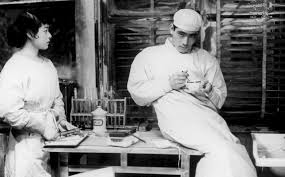
“The Quiet Duel” (1949) employs two of the master filmmaker’s favorite actors, Takashi Shimura and Toshiro Mifune, as father and son physicians practicing medicine in a country wracked by shortages and an unrecovered supply chain, grappling with notions of honor, reputation and doing the right thing when confronted by the “shame” of venereal disease.

Based on a play from that era, it presents a tightly-confined world — a hospital — and moral absolutes, taking the noble path when the “worst” happens, even if it shatters your dreams and those of the woman you love.

Claustrophobic, symbolic and emotional, “The Quiet Duel” (“Shizukanaru kettô”) tells an intimate story with efficiency and tenderness, even if it isn’t the timeless crowd-pleaser that many of the films that followed Kurosawa’s global breakthrough, “Rashomon” (1950) were and remain.

We meet Dr. Kyoji Fujisaki (Mifune) asleep on his feet, passed-out between waves of wounded at a rainy jungle Imperial Army field hospital. His round-the-clock work has him taking shortcuts in the frantic effort to get to every patient. That’s why his gloves are off when he operates on one soldier. The man’s wounds are one thing, but when the doctor nicks his finger, mid-operation, the fact that the soldier has syphilis means the consequences could be dire.

It’s only later, after returning home to the hospital that his OB-GYN father (Shimura) runs that he gets himself tested. Facing years of treatment with a drug in short supply, Kyoji takes on a chaste, resolute determination to do right by his patient fiance of six years, Misao (Kyoji Fujisaki). That means that he must break things off and not tell her the reason he does.

The sexual stain of this illness is such that even the pregnant, unmarried apprentice nurse Minegishi (Noriko Sengoku) looks down on him, because she “never fell that far.” But her judgment turns more pitying, as does his father’s, when word gets around how Dr. Kyoghi Fujisaki met this fate.

When he crosses paths with the very soldier (Kenjirô Uemura) who infected him, Kyogi makes it his mission to lecture (in Japanese with English subtitles) the lout on proper treatment and the simple humanity of avoiding passing this curse on to an unsuspecting woman. “Think about other people!” Too late. The drunken creep has married and impregnated an unsuspecting wife, heedless of consequences, even when he learns them.

Everybody suffers, but the “responsible” and “honorable” doctor suffers most of all, bearing this burden, sneaking those injections and struggling to do the right thing as he throws himself into his work. Not that he carries this weight in silent good humor.

“My stupid conscience!”

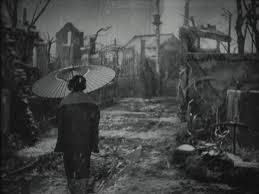
Kurosawa takes us into a world of limited horizons, aptly presented in monochrome — shortages, privation, patients who can’t afford to pay for their care in a ruined grey and white city still rebuilding from carpet bombing.

The message the play and the film of it sends is that it’s only by diligence, compassion and thinking of others and society as a whole can the people pull themselves out of this.

The technique on display here is surehanded but rudimentary compared to Kurosawa’s later work. One arresting tracking shot grabs your attention, and a simple frame of the weather hitting an old ironwork fence depicts the change of seasons and the passage of years.

The performances have a hint of soap opera weepiness about them, but Mifune and Shimura hint at the international icons they would become, and Sengoku and Sanjô give us a taste of the long careers each had in her future, with Sengoku becoming a Kurosawa favorite (“Seven Samurai,” “I Live in Fear,” etc).

The murky print that the free streamer Tubi is using right now should be a candidate for restoration. But it’s clear enough for us to see the talent, if not the future genius, behind “The Quiet Duel,” a filmmaker who documented Japan as he knew it and a Japan he hoped it would be before turning to its epic past for his greatest works.

Rating: TV-PG, adult subject matter

Cast: Toshiro Mifune, Takashi Shimura, Miki Sanjô, Noriko Sengoku and Kenjirô Uemura

Credits: Directed by Akira Kurosawa, scripted by Akira Kurosawa and Senkichi Taniguchi, based on a play by Kazuo Kikuta. An Art Film Association release on Tubi.

Running time: 1:35

Posted in Reviews, previews, profiles and movie news | Comments Off on Classic Film Review: An early Kurosawa/Mifune/Shimura VD lecture and morality play, “The Quiet Duel” (1949)

Movie Preview: A Black child in London during the “Blitz”

“Twelve Years a Slave” filmmaker Steve McQueen, a Brit, saw a photo of a Black child on London’s streets during the darkest days of World War II and was inspired to make this film.

Saoirse Ronan is the big name in the cast of this Nov. 1 (theatrical) Apple Films release, Nov. 22. Benjamin Clémentine, Stephen Graham and Elliott Heffernan also star.

Posted in Reviews, previews, profiles and movie news | Comments Off on Movie Preview: A Black child in London during the “Blitz”

Movie Preview: Bong Joon Ho and Ruffalo…and RPatts and Tony Yuen and Toni Collette, in space in “Mickey 17”

Life and life and life and life prolonged,and cloned a sci-fi comedy about “multiples” and how they’re dealt with, even when they look like Robert Pattinson. Naomi Ackie also stars.

Dino makes every “Edge of Tomorrow” death amusing in the trailer. for this ilm, based on an Edward Ashton novel.

Jan 31.

Posted in Reviews, previews, profiles and movie news | Comments Off on Movie Preview: Bong Joon Ho and Ruffalo…and RPatts and Tony Yuen and Toni Collette, in space in “Mickey 17”

Movie Review: Josh Radnor & Co. dissect the comic messiness found in “All Happy Families”

Fitfully amusing and unfailingly sweet, “All Happy Families” is a rom-com that pleasantly passes the time to a sitcom beat. It’s also topical — sexual harassment and gender dysphoria come up — and it’s sensitive, which reflects the baggage of its star.

Josh Radnor’s “How I Met Your Mother” may have uneasily walked the line between romantic and cringey between its mostly unsubtle laughs, a series that felt instantly-dated. But Radnor came through it largely unscathed, easily cast to this day as a guy too much in his head, uncertain and “blocked,” but a true romantic at heart.

Here, he’s Graham, a failed Chicago actor well in his ’40s, still going on auditions, still living rent-free in the house where he grew up, a place that could very well fall to ruin on his watch.

Graham’s more successful actor-brother Will (Rob Huebel, dryly self-absorbed and contemptible) bought the house from their parents and lets Graham run it and insists he “use my name” when trying to rent the bottom floor, “because people LOVE my show.” That would be his soapy family drama “Winsome Falls.”

Will’s the kind of sibling who drops in for an unannounced visit, let’s slip that his son has come out as his daughter (Will’s divorced) and still tries to make his whole visit about himself.

Even taking Graham and their parents (Becky Ann Baker and John Ashton) on a Chicago River tour boat ride becomes another place to showboat his TV fame.

But the house has a basement that floods and needs all new plumbing. The rentable half is a mess. An old college classmate (Chandra Russell), now a chef who makes Graham’s heart skip a beat, wants to lease it.

Mom just retired, and her sleazy employer groped her at her retirement party. Dad’s still working with a bad back, a drinking problem and an even worse gambling one.

And that Stephen Collins vibe we got from Will’s scenes in “Winsome Falls” comes home to roost as he’s publicly-accused. VERY publicly.

A sitcom season’s worth of “drama” befalls the Landry clan, with Graham bearing the brunt of too much of it, not all of it with good humor.

What plays here is how easy this family is to buy into. They bicker like real siblings, a real married couple and a real family

“I hate you!” “I love you!”

Dad’s an out-of-step Neanderthal who uses phrases like “Don’t get your panties in a twist” and clings to notions like the missing “father figure” contributed to Will’s kid’s gender confusion. Mom’s put up with a lot from all of them, and is living with the frustration of her own performing arts dreams. We see and hear her duet with Rodney Crowell in a pub scene, at one point.

There’s a lot that feels incomplete here, introduced and abandoned or at least never wrestled with. And much of what transpires after the assorted ingredients are introduced is utterly predictable.

But Radnor is in his wheelhouse with this character, and the supporting cast sparkles. Colleen Camp plays Graham’s long-suffering agent, Natalija Nogulich the stereotypical Russian neighbor, Antoine McKay a pushy plumber and Ivy O’Brien the classically brassy barmaid.

So what if it’s a more than a little sitcommy, if the big “twist” is too on-the-nose and left hanging, along with the troubled parental marriage and the unresolved #MeToo cancellation? “All Happy Families” plays. And Rodney Crowell and Broadway’s Becky Ann Baker sing. That’ll do. That’ll do nicely.

Rating: unrated, fisticuffs, drug use, sexual harassment, profanity

Cast: Josh Radnor, Chandra Russell, Becky Ann Baker, Rob Huebel, Colleen Camp and John Ashton, with Rodney Crowell.

Credits: Haroula Rose, scripted by Coburn Goss and Haroula Rose. A Freestyle release.

Running time: 1:30

Posted in Reviews, previews, profiles and movie news | Comments Off on Movie Review: Josh Radnor & Co. dissect the comic messiness found in “All Happy Families”

Movie Review: A Creepy, Kubrickian satire of Sexism, Beauty Standards and Ageism — “The Substance”

As the sun rises over Hollywood today, there are creeps who look like Harvey Weinstein, D.J. Qualls and Steve Buscemi passing judgment on the appearance, sexual allure and filmic “fertility” of young women from all over the world who come there, aspiring to careers in show business.

And when the suitably talented, driven and most importantly gorgeous few get their big break, there are guys, young and very old, who look like Roger Ebert, Jeffrey Wells and me who pass judgment on their work, sometimes even mentioning their beauty or relative lack of it (a matter of preference) as they review films, pop records and TV shows.

French filmmaker Coralie Fargeat eviscerates that whole unsavory-to-the-point-of-sinister ecosystem with “The Substance,” a brutal, savage and savagely-funny satire that cuts to the chase and beats it to death.

It’s so on-target and “out there” and knowing that you figure our writer-director — best known for “Revenge” — must have had dashed acting stardom in her dreams at some point. There are traces of “The Player” in its warped values and view of the homely preying on the gorgeous. The production design and almost inhuman dissection of human failings bring to mind the pull-no-punches about humanity films of Stanley Kubrick.

And there are two actresses, rightly celebrated for “putting it all out there” by critics (mostly male) in performances that start out naked — Demi Moore and Margaret Qualley are often unclothed — and venture into “stripped bare” in their versions of the frailty and insecurities of being famously beautiful but growing old, and the pitiless arrogance of the young, the “hot,” the “It girl” of the moment.

Demi Moore, over 60 and at the stage of the Hollywood game where Nicole Kidman appearance “refreshings” no longer have the desired effect, goes full Jamie Lee Curtis here. It’s a performance built on the insecurities of ageing in a business that has no mercy for women who do, and Moore, playing a former actress turned exercise show queen named Elisabeth Sparkle, lets us see the natural ravages of time.

Not at first. Sparkle, whose star we see placed on the Hollywood Walk of Fame, followed by the cracking and wear and tear that the years have on that star in an opening credit montage, keeps up appearances on camera.

Makeup and hair dye hide much. She’s still wearing the leotard, leading a younger crew of pretty women in dancersizes, a morning show “queen” to the vile network boss, played by Dennis Quaid, in his wildest, ugliest performance in decades.

There’s talk of “an Oscar” in her past, which we hear him laughingly dismiss as happening “in the ’30s” in a shockingly cruel phone call he takes at the urinal in unflattering extreme closeup. Elisabeth hears it, too.

All those posters promoting her show over the years, her “Sparkle your life” brand and her ratings mean nothing. “Young” is what matters the most, Mr. “I have to give the people what they want” insists. A horrific no-injury car-accident (stunningly created here) merely hastens the inevitable for her.

Elisabeth is out. But a secret tip is passed onto her in the emergency room. An almost AI-polished looking young man examines her, says she’d be a “good candidate,” and lets her go.

She finds a memory stick in her coat when she gets home. A video with vague promises of “rebirth” doesn’t impress her, until the network’s farewell bouquet of roses arrives.

Getting to “The Substance” distribution point requires a cryptic phone call, a back-alley entrance and a pass key. The script and the drug maker — illustrating its rebirth by showing chicken egg yolks replicating themselves after injection — leaves the “science” and everything about it sketchy, underground and beautifully under-explained.

The box with the syringes and the drug is similarly lacking in detailed instructions. But Elisabeth shoots up like the Hollywood veteran she is, and as her nude body collapses onto her pristine, “2001” inspired bathroom floor, the promised “another version of yourself” tears through her spine, with all the blood and ickiness that entails.

Elisabeth has a fresh start, with a new body (Qualley) and a chance to do it all over again, this time with the wisdom of decades in Hollywood to guide her.

Sure, it’s deliciously apt in a screenwriterly sense that young “Sue” as she calls herself will audition for and land the job as her own replacement, doing a younger, stripper-pole sexy version of Elisabeth’s exercise show. But is that the limit of her ambition?

Then we remember the solitude, the loneliness of fading stardom over 60 that we’ve seen. We can sense what Elisabeth went through to get here, the humiliations and moral compromises. And we can see the emptiness of “fame” even if she never does. In the dark recesses of her monomaniacal soul, getting “back” is more important than getting whole or rebuilding a film career.

All she has to do is follow the “rules” — be the “matrix” version of herself for seven days, then switch to the “better version” via an exchange of fluids — and follow them to the letter.

“Remember, there is no ‘she’ and ‘me.’ You are one.”

We can guess how that works out, and what’s coming. “Sue,” the new “you,” gets all the attention and wants more of the time. No “seven days” off. And so on.

Every science fiction story about any version of “The Fountain of Youth” dwells on the regrets, the loneliness of losing some of yourself as you lose loved ones and abandon the physical manifestations of “life experience.” Fargeat seriously shortchanges that, but gets at it in a single scene where Elisabeth’s resentment at the invisibility of old age has her trying to summon up the courage to meet with an old high school classmate for drinks.

She hasn’t the guts. She’s all-in on the value system that abused her and tossed her aside.

Moore’s performance is unfiltered and fierce, manic at times, a tour de force turn and maybe even her career best. Qualley is similarly invested if not quite as showy. Quaid’s delicious villainy is like icing on the cake, Every Overdressed Exec who ever aged way beyond the point where he has any business commenting on anyone else’s appearance.

The satire is aimed at the youth-obsession and narrow parameters of beauty in Hollywood, but by extension we see the cruelty of the process — trolls and gargoyles, sitting at a table in an empty audition room, making snap judgments about sex appeal on actors at their most vulnerable.

This is the darkest takedown of Hollywood since “The Player” or “Swimming with Sharks.”

“The Substance” can be a bit much, at times. The violence is horrific, the nudity — each “version” of our heroine is left on the bathroom floor, naked, while the other one takes over — gratuitous, at times.

And the film rather outstays its welcome, stumbling on past a legitimate climax or two.

But Fargeat found something worth saying and she says it, in unblinking close-ups and uncensored “This is how we look when we age” bluntness. It’s seriously sick to spend all this cultural bandwidth on embracing the “fresh,” the “new” and the “young” as our yardstick for beauty and relevence. It’s even sicker to think how most of us buy into that and the extremes we make women go through to prolong it.

Rating: R, graphic, gory violence, nudity

Cast: Demi Moore, Margaret Qualley and Dennis Quaid

Credits: Scripted and directed by Coralie Fargeat. A Mubi release.

Running time: 2:21

Posted in Reviews, previews, profiles and movie news | Comments Off on Movie Review: A Creepy, Kubrickian satire of Sexism, Beauty Standards and Ageism — “The Substance”