
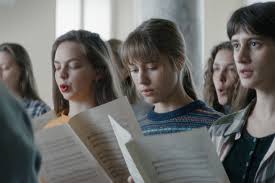

“Little Trouble Girls” is a conventional girls’ coming-of-age tale whose clever twist is equating sexual awakening with spiritual awakening, at least in the eyes and ears of an impressionable teen.
Slovenia’s bid for a Best International Feature Film Oscar covers what would pass for overly familiar ground in many other culture’s cinemas. But visual reveries and poetic touches unique to its setting lift it above many similar tales, which also use a pop song (in this case by Sonic Youth) as their title.
Lucia, played by wide-eyed ingenue Jara Sofija Ostan, is the new girl at her Catholic school. It’s as cliqueish as any high school, but perhaps one way to fit in would be to join the choir.
That’s where she meets Ana-Maria (Mina Svajger) and her besties Karla and Ursula. They’re into lipstick, gossiping about sex, making jokes about the dorky choirmaster (Sasa Tabakovic) and playing “Truth or Dare.”
But it’s established early on that Lucia isn’t like that, or so her mother (Natasa Burger) insists. She’s too young to wear the lip gloss her aunt sent her from Paris, too naive to run with a fast crowd. And she’s prone to daydreaming, which gets her in trouble in choir, and perhaps beyond that.
Ana-Maria may seem mild by any modern Western teen’s archetype of what constitutes “growing up too fast.” She’s more talk than “experience” and still adheres to her grandma’s form of teen penance — forcing herself (and Lucia) to chew green/sour grapes for any perceived “sin.” But she’s assertive, pushy and down for doing anything she can to distract from the braces that give away her “awkward” years.
Everything comes to a head on road trip to a choral concert competition which entails a stay at an Ursuline Convent. The convent is undergoing renovations. There are brawny young workers.
You can guess some of what’s to come but still guess wrong as often as not as director and co-writer Urska Djukic recognizes the script is trafficking in coming-of-age cliches. Twisting some of those tropes doesn’t just create surprises. Djukic gets at something almost profound in the nature of self-discovery, which can be not just sexual or spiritual, but both at the same time.
Lucia is “tested” by oncoming adulthood. She’s responsible for staying focused and doing good work. As far as sex goes, she has lots of questions, at least some of which this adult or that one — a nun in one case — will try and probably fail to answer. And those questions don’t make a life of chastity, community, teamwork and sacred singing sound as unappealing as the conventions of these movies usually suggest.
There’s something to be said for looking for an easy escape from the world of hormones. Not that even that is an “answer.”
Ostan registers layers of puzzlement over the mysteries that Lucia ponders, with Djukic’s closeups of her and her experiences and reveries suggesting something ethereal in life choices made at an age where Hollywood comedies obsess over who to lose one’s virginity to. That’s not enough to render this largely conventional drama transcendent, but it is enough to recommend it.

Rating: nudity, sexual situations
Cast: Jara Sofija Ostan, Mina Svajger, Natasa Burger and
Sasa Tabakovic
Credits: Directed by Urska Djukic, scripted by Urska Djukic, Marina Gumzi and Maria Bohr. A Kino Lorber release.
Running time: 1:29


 Movie Nation