

A badass ronin swaggers and slices his way through Medieval Kyoto in “Samurai Fury,” an action epic about a tax revolt in a time of plague and famine.
Ryosuke Kakine’s historical novel — “Muromachi Outsiders” — was inspired by real events in 15th century Japan. Director Yû Irie (“8000 Miles,” “Ninja Girl”) leans into the tropes and archetypes that earned samurai films the nickname “Japanese Westerns” for this action-packed, Spaghetti-Western-scored Soba Noodle swashbuckler.
In the Kyoto of 1461 (Muromachi Era), plague and famine have killed tens of thousands. But the ruling shogunate, which “did nothing” to lessen the suffering or save lives, has allowed its ruling class, lords and monks, to maintain their lifestyle at the expense of impoverished peasants, who are in debt — taxed and tolled at every turn.
The regime’s fearsome head of security, Honekawa Doken (an imposing Shin’ichi Tsutsumi), is charged with keeping the peace even as the prissy, posh shogun forces debt slaves to haul a vast stone to decorate the center of his palace’s lake, a stone he then decides he doesn’t like after he sees it installed.
“Flowers would be prettier, I think,” he decides, in Japanese with English subtitles.
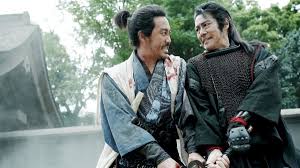
There’s talk of a revolt or insurrection among the peasants and ronin, with one form of uprising being more serious than the other. So Doken meets up with a ronin (unemployed “vagabond” samurai) he knows, Hasuda Hyoe (Yo Oizumi,) and commissions him to take the pulse of the public and help fend off the threat.
The canny, charismatic Hyoe not only drives a hard bargain, he cracks that his old friend Doken has become “the shogun’s pooch.” He agrees to do the job if the Doken will let him take this “brat” Saizo (former pop idol Kento Nagao) who resisted the “bloodsucking monks” who bound and gagged him over a debt with plans to have Doken execute him.
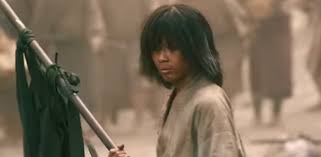
“Frog,” the roaming samurai nicknames his pupil. The kid fended off monks and their henchmen for a while with just his staff, is a lad with “spirit but no skills.” Hyoe gives him a few life lessons about “money,” and giving the monks what they deserve, drops Saizo off for a year’s training with his weapon of choice with the Old Master (Akira Emoto).
Because whatever he’s been paid to do by Doken, Hyoe is playing the long game. He paid the Old Master from money he robbed from a monk-run tolling station that he trashed and robbed after slashing up a score of monk minions. Hyoe cautions peasants and couriers (teamsters without teams, mostly) that the time isn’t right for a revolt. But it will be in a year, once “Frog” has finished his training.
The training montage features some clever twists in prepping a kid for combat with a blunt-pointed staff. His final test? A pay-to-play tournament in which he faces all comers in a “Kill Saizo, Win a Prize” bout.
The supporting insurrectionists include the Old Master’s mute lady archer and a small crew of would-be ronin — Hyoe fanboys — headed by the hilariously hulking Emontaro (Yasushi Ami), who speaks loudly and carries a huge club.
There’s an experienced courtesan (Wakana Matsumoto) in a bit of a love triangle with Doken and Hyoe, right up to the moment she bats her eyes at the suddenly buff Saizo. And the most callous and bloodthirsty of the shogun’s supplicants, Lord Nawa (Kazuki Kitamura) must be dealt with if there’s any justice to be had in this world.
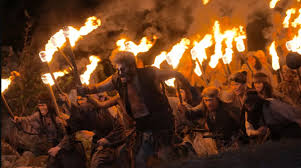
Intrigues will make us wonder who is on whose side, a village will be slaughtered and the final assault on Kyoto and its house of money changers where debt records are kept is epic and set after dark, a furious, witty action set piece by torch light, where torches are the weapon of choice against the paper-pushing, record-keeping oppressers.
Yes, the acting is loud and often broad. There’s always a lot of shouting in samurai tales, and our young J-pop star bellows with the best of them. The leads are well-matched even if the story gets cluttered with supporting players who keep them apart, more or less, until the final act.
The fights are off-the-charts spectacular with Irie’s camera swooping in and around the various maelstroms of violence — trailing the thundering horde led by Emontaro and his club, staring down the shaft of Saizo’s staff as it pokes, fends-off, bludgeons or vaults over foes, and catching the clash of Tachi swords among the warriors, with peasants hurling rocks, stabbing and clubbing their way towards an elusive debt-free future.
It’s not “Lawrence of Arabia” or “Seven Samurai” or “Yojimbo.” But “Samurai Fury” is cleverly and patiently plotted, with good acting and very good fighting. And when the big battle finally begins (86 minutes in) it goes on and on until it proves its been worth the wait.

Rating: unrated, lots and lots of bloody violence
Cast:Yo Oizumi, Shin’ichi Tsutsumi, Kento Nagao, Wakana Matsumoto, Hannya, Yasushi Ami, Kazuki Kitamura and Akira Emoto
Credits: Scripted and directed by Yû Irie, based on a novel by Ryosuke Kakine. A Well Go USA release.
Running time: 2:15


 Movie Nation