

The director of “Welcome to Sarejevo, ” “A Mighty Heart” and “The Road to Guantanamo” reaches for another hot button topic with “Shoshana,” a historical thriller about the bloody birth of Israel.
With global condemnation and outrage over Israel’s apartheid regime diving headfirst into Gaza genocide, this film about the Jewish zionist factions — socialist/egalitarian vs. violent, intolerant and “fascist” — that have struggled for primacy in founding and governing a Jewish state in “the Promised Land,” could not be more timely.
Michael Winterbottom tackles the last years of the British Mandate that governed Palestine as seen through the eyes of an idealistic Russian Jewish immigrant. Shoshana Borochov was the daughter of Russian Zionist Socialist Ber Borochov, a woman who emigrated to Israel in the 1920s, a few years after her father’s death.
She narrates this history she was a witness to, noting the “zionist” leanings of the Herbert Samuel, first British High Commissioner for Palestine, a Jew who opened the doors to a huge influx of people who altered the demographics and enraged many in the Arab majority in what had been a “sleepy backwater in the Ottoman Empire” until World War I ended that empire.
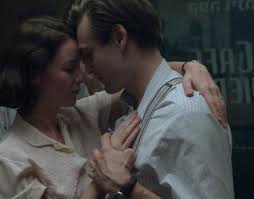
In 1938, Shoshana (Irina Starshenbaum of the Russian sci-fi thriller “Attraction”) is an office employee of the Histadrut trade union and a member of the banned Haganah zionist paramilitary organization. But even the Brits who “banned” it recognize it as the more moderate of the armed groups — including the terroristic Irgun — trying to lure and protect Jewish immigrants to Palestine, and squeeze out the Arabs already there.
Douglas Booth (of “Mary Shelley” and “Pride and Prejudice and Zombies”) is Tom Wilkin, one of the British Detective Constables added to the Mandate’s police force to try and keep the peace as Palestine lurched towards the 1917 Balfour Declaration’s stated goal — a Jewish state within the historical/Biblical boundaries of ancient Israel.
Wilkin works the beat in the new Jewish city of Tel Aviv, which is how he meets and becomes smitten with Shoshana, as famous “for her beauty” and she is “her political passions.” She’s carrying on the “Let’s set up a socialist state where Arabs and Israelis can get along” beliefs of her father, who historians note figured the Arabs would “assimilate” and be overwhelmed by the “superior” European Jewish immigrants flooding in.
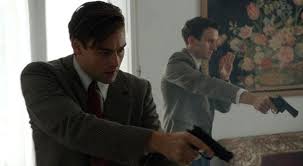
Wilkin tries to track down Jewish caches of weapons and hunts Jewish bombers, who dress in Arab garb to go plant their explosives among the civilians in the Arab towns and cities (Jerusalem included) in the tit-for-tat terror campaigns that the Balfour Declaration set off. Wilkin, who has learned Hebrew, is nothing if not diplomatic.
To the north, Detective Constable Geoffrey Morton (“Harry Potter,” “Pale Blue Eye” and “Old Guard” alumna Harry Melling) is stationed among the Arabs. He’s more ruthless in his running of informers, and seemingly more trigger happy as he quells the after shocks of the latest “Arab revolt.”
As matters in and out of Tel Aviv get out of hand and Britain struggles to keep the peace there while fighting the Nazis in Europe, with officers and officials of the British police force assassinated by Jews, Morton is brought in “to treat the Arabs and the Jews equally.” That spells even more trouble for the brittle romance between Shoshana and Wilkin as Palestine simmers, ready to explode and both lovers’ loyalties are tested.
It’s sometimes hard to reconcile the director of those delightful “Trip” comedies with Steve Coogan and Rob Bryden with the political hot potato-grabbing filmmaker who spent “Eleven Days in May” of 2021 filming Israel bombing and killing civilians by the hundreds in Gaza.
Palestine is a dreadfully complicated subject, something more appreciated when you see how many footnotes you have to include to make a simple review come off fair and have it make sense.
Imagine Winterbottom’s challenge.
But he makes this filmed-in-Italy romantic thriller work, even if the romance plainly takes a back seat to the politics, especially as far as Shoshana is concerned.
What’s sobering here is the depiction of Zionist violence predating the Holocaust victimhood that sort of got all that shoved under a rug in Hollywood celebrations of the Birth of Israel — films such as “Exodus” and “Cast a Giant Shadow.”
“Shoshana” shows fewer Arab provocations, jokes that “Arabs aren’t very good shots” and focuses instead on the precursors of the Israeli Defense Force carrying out assassinations, bombings, reprisals and judge-jury-and-executioner murders of those deemed “traitors” to the cause within the Jewish immigrant population.
Filmed in and around Taranto, Italy, which is dry and rocky but not nearly dry and rocky enough to pass for Palestine, with a Russian star and a lot of Brits (Ian Hart plays the head of the Mandate government, Robert Chambers, which appears to be the name of an academic/author who wrote about Palestine in that era) in supporting roles for a movie that lacks Israeli or Hollywood support, Winterbottom gets at the difficulty of examing the root causes of this not-that-ancient conflict.
But he kind of/sort of pulls it off. In an era of both rising Anti-Semitism and a soaring use of that term to shut down criticism of an Israeli fascist government that has ended any semblance of pluralistic democracy in that country and has played a role in ending American democracy and hobbled politics in other Western democracies, that’s no mean feat.
I watched this piece of little-covered Israeli history and found myself remembering the elementary school music classes where kibbutz songs about Israeli statehood were a part of the curriculum, for reasons only Golda Meir and Nixon could explain.
The narrative of “Shoshana” is simple in structure but complex in its politics, and it’s a credit to Winterbottom’s years of experience dealing with material like this that it plays as well as it does, and that it comes off.
The love story doesn’t deliver. But everything historically referenced, explored and explained that keeps it from being the emotional heart of “Shoshana” does. And if ever we needed to understand the difference between a “Zionist” and a “fascist/nationalist/terrorist,” that time is now.

Rating: unrated, graphic violence, sex, nudity
Cast: Irina Starshenbaum, Douglas Booth, Harry Melling, Aury Alby, Oliver Chris and Ian Hart.
Credits: Directed by Michael Winterbottom, scripted by Laurence Coriat, Paul Viragh and Michael Winterbottom. A Greenwich Entertainment release.
Running time: 2:02


 Movie Nation