



In the mind, at least, one can envision the three credited screenwriters of Hitchcock’s “Young and Innocent” pacing a smoke-filled room, belting back cups of tea like they were bourbon.
They were in a pickle. They’ve reached the climax of their loose adaptation of a Josephine Tey novel, but they can’t figure out how to suspensefully drag out the discovery of a murder suspect in a crowded dance hall.
The suspected killer has a physical tic. The hero, the heroine and the “tramp” who met this fellow and would recognize him on sight know about it.
“Can we disguise him,” writers Charles Bennett, Edwin Greenwood and/or Anthony Armstrong, working together or alone on “their” draft, wonder? Perhaps Alfred Hitchock himself, or Alma Reville, his writer/ continuity director wife, suggested it.
Let’s put the suspect in the dance band. It’s 1937! Let’s paint the musicians up in BLACKFACE!
That could very well have been the “thinking” that went into this bit of screenplay problem-solving, clever and “racist” only if you think anybody’d mind — anybody with a “voice” back then, anyway.
After all, it’s just a variation of what Billy Wilder & Co. would do with the 1930s period piece “Some Like It Hot” twenty years later — put Jack Lemmon and Tony Curtis in drag so they can escape The Mob,. But one disguise is recognized as a gross, demeaning, exaggerated and offensive parody of people unlike the writers. And the other’s well, let’s not go down the road that J. K. Rowling ran off of, shall we?
“Innocent” is Hitchcock on the verge of hitting his confident comic stride. It’s a near romp of a chase picture about an accused killer on the lam, the Chief Constable’s daughter (and her Schnauzer) aiding him in the pursuit of evidence that will clear him and find the “real killer” for the quick-to judge inept coppers to pin the murder on.
Hitch would elevate his “Man Who knew Too Much” supporting player Nova Pilbeam to her most famous big-screen role for this lighthearted murder mystery, and promote”Things to Come” support Derrick De Marnay into a leading man.
He’d discover how funny eyebrow-raising Basil Radford could be, cast as a quizzical bystander in an amusing children’s birthday party scene, and bring him back for the role that would immortalize him — Caldicott in the comical cricket-loving big screen duo Charters and Caldicutt — in Hitchock’s even jauntier “The Lady Vanishes” filmed the next year.
“Innocent” features police clumsily railroading the suspect in an actress’s murder, then losing him on the way into the courtroom. The Chief Constable’s (Percey Marmont) youngest son wants to know, “If you don’t find him, will you get the sack, father?”
There’s a wee boy of about seven called on to pump gas out in the provinces. He has to climb up the towering pump to even attempt to manage that, and call for help.
Two coppers “commandeer” a farmer and his tiny pig wagon for their pursuit. They gripe about the amount of room in it.
“Aye don’t reckon it’d hold more’n TEN pigs!”
It’s a lark, almost from start to finish, a film that opens with a jaunty bit of jazz and launches into a heated argument so theatrical and broadly played we wonder if it’s part of a filmed play within the movie.
An actress (Pamela Carme) from that argument turns up dead. A young writer (De Marnay) stumbles across her body on the beach, flees from the scene and is seen fleeing. For some reason, a screenwriter who sold the now-dead actress a single “story” has been mentioned in her will.
The cops figure they have their man and grill him. His missing raincoat? That had the belt she was strangled with, they’ll bet.
Writer/suspect Robert Tisdall passes out from the all-nighter interrogation, but the Chief Constable’s plucky oldest child Erica (Pilbeam) revives him. He resolves to get away shortly after he meets the dithering local dope — “Well, it doesn’t look too good for you, does it?” — assigned as his defense counsel.
“Are you representing the police, by any chance?”
Tisdall escapes, and the enterprising Erica finds herself off with him, not sure of his “innocence” and fighting the idea that she’s on the other “side” by birth and by logic.

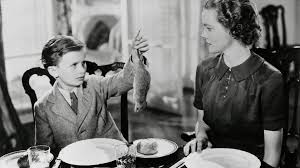

There’s a brawl at a roadside diner, triggered by Erica’s questions about the MacGuffin coat, assorted narrow escapes from exhausted police, a “china mending” “tramp” (Edward Rigby) to track down, and that amusing kiddie birthday party that the leads get roped into by Erica’s aunt (Mary Clare) and comically suspicious uncle (Radford).
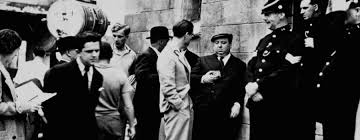
Hitchcock’s cameo has him playing a news photographer at the suddenly in a tizzy courthouse.
The sharply shot and designed picture pretty much trots by at a brisk 83 minutes, from murder to big band rendition of “No One Can Like the Drummer Man” in the finale. The comedy works, start to finish. But I have to say, that plot “problem solving” leaves a LOT to be desired.
Erica is a great creation, the most competent character in the lot. She’s the only one who can start and manage her clunky ’26 Morris Bullnose roadster. Are we meant to think that Tisdall was hiding in the rumble seat when she and the two cops with her run out of gas in hot pursuit of their escapee?
He turns up to help her push the car after the coppers commandeer that pig wagon. Where was he and how’d he GET there?
Logic takes a holiday more than once as Hitch takes his usual shots at police, whom his biographers say he feared and held in a measure of contempt.
As the opening scene is a heated argument between a recently-ditched husband (George Curzon) and his Hollywood actress wife who’s obtained “a silly Reno divorce” in the States, why would the cops never consider him a suspect in her death?
And why would the actress generously remember young writer-for-hire Tisdall in her will, of all things?
Of course, the deal-breaker with “Young and Innocent” is that “clever” bit of Blackface gag writing in the finale, something one can’t dismiss despite the American performing “tradition” that did nothing to sanitize it or excuse one and all of the era “because everybody (white) was racist back then.”
British films dropping the “n” word popped up in that era and on into the ’50s. A sailing magazine I subscribed to in the ’90s had some uproar over a limey who made a plea for a “boat n—er,” and damned if some British Empire celeb didn’t drop that noxious phrase just a couple of years ago on TV.
I judged a University of Tennessee fraternity sketch show competition with one group of fake-Greeks performing in Blackface in the ’90s, and white politicians have had careers rattled by revelations that they took part in such transgressions in their college years.
It’s inexcusable, and knowing that the folks who concocted the gag in ’37 gave it less thought than they gave the assumed name — Beechtree Manningcroft — that they have the hero invent, is just disheartening.
But that’s the biggest reason this otherwise fun film isn’t remembered with Hitchcock’s other peak pre-Hollywood era work and the reason it is shown on TV with an “offensive” content disclaimer attached to the beginning.
And to think that all they had to do to dodge that bullet was to dress the band in drag.

Rating: TV-PG, “dated cultural practices (blackface)
Cast: Nova Pilbeam, Derrick De Marnay, Percey Marmont, Pamela Carme, Edward Rigby, Mary Clare and Basil Radford
Credits: Directed by Alfred Hitchcock, scripted by Charles Bennett, Edwin Greenwood and Anthony Armstrong, based on a novel by Josephine Tey. A J. Arthur Rank release on Tubi, other streamers
Running time: 1:23


 Movie Nation