


Hollywood won the race to get a drama about the Allied invasion of North Africa into theaters largely due to luck. Warner Brothers bought the rights to an unproduced play written in 1940 that just happened to be set in a bar in a city that would make headlines when American, British and Free French troops stormed ashore in Algeria, Oran and Morocco in early Nov. of 1942.
“Casablanca,” as it was titled, had its premiere moved up to November 26, 1942 to take advantage of the triumphant war news headlines, and came to be regarded as one of the greatest films ever made, certainly the high water of Hollywood’s studio system.
But the Brits, who’d been fighting in North Africa since the summer of 1940, were not to be left out.
“Candlelight in Algieria” may not have had the punchy title “Casablanca.” But it’s got a rogueish romantic hero, played by James Mason, on his way to becoming Britain’s biggest box office star. He’s paired-up with plucky Canadian actress Clara Lehmann , playing a not-so-neutral “American” caught up in intrigues. It’s got espionage, shooting, a car chase, Vichy “patriots” under the thumb of urbane, ruthless Nazis, a fancy night club where love songs are sung in French and you’d never know there was a war on, thanks to the way the French, German and other Europeon swells there dress.
And it’s got a place for a spy on the lam to lay low, “the Casbah, home to vice, lair to criminals and the hideout of every thief and murderer in Algiers!”
“Candlelight” is a rakish, flippant thriller about a spy enlisting an American sculptress into stealing a camera with a photo of a map that gives away the location to a meeting between French, American and British military men.
It was inspired by a real event in WWII lore, the “lonely house” meeting of Allied and Vichy officers that fixed the landing points in Morocco for the invasion of North Africa.
Lehmann plays a “not interested in politics” Kansas artist who wakes up in an Algerian hospital just as the victory parades are wrapping up (documentary footage) in 1943. She tells a nurse nun her story about her role in the victory just achieved.
A supposed escape POW pilot (Mason) tries to burgle the Biskra house where Susan Ann Foster is staying. She gets the drop on him, so he tells her this fantastic story.
Mistrust or not, soon Alan Thurston has entangled Susan in his scheme to nab this camera from the actress (Enid Stamp-Taylor) where the ladies’ man “operative” stashed it. As that actress has the romantic attentions of a German officer (Raymond Lovell) and the camera is being pursued by the sinister German intelligence agent and Armistice Commission enforcer Dr. Muller (Walter Rilla), this is going to be tricky.
But a few feminine wiles and clumsy plot contrivances later and Susan has the camera and is on the hunt for Thurston, questioning women like the fetching waitress Yvette (Pamela Stirling) because, as she soon figures out, our proto-James Bond is a ladies’ ‘man.
Through it all, the takes are high even if the romantic banter between “Kansas” and “Mister Stiff Upper Lip” or “Old School Tie” never lets us fear for their safety.

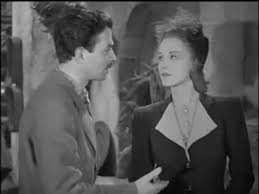

Lehmann isn’t the most convincing “American,” thanks to a script that has the Kansas gal refer to “Britishers” and use entirely too many Britishisms to “pass.” But Lehmann embodies the cliched “American pluck” the Brits were so sold on, a smart alec who never tires to telling this fake “escaped” POW to lose his facial hair.
“The only job a man can do that a woman can’t is grow a mustache, like that one!”
Mason makes a dashing rogue of a leading man, a status he’d only recently attained. Lehmann has more scenes and more agency in the plot, making our brave hero something of a delegator when it comes to dangerous spywork.
But the dialogue, juiced up by actor and sometime writer John Clements crackles.
“Do you know, I think I believe you?”
“That’s decent of you.”
Shot on soundstages (save for the car chase) in wartime Britain, “Candlelight” is more impressive as “Casablanca” in its gritty look, and dusty lived-in desert town feel, making art director Norman G. Arnold one of the true stars of this black and white classic.
No, it’s not “Casablanca.” The romance is perfunctory, as is the way the script disposes of Thurston’s other paramours. The nightclub is limited to one scene and the songs heard never became iconic. There’s more suspense, a little more action. But the cast is a little thin on big name character actor support — Lovell’s amusingly inept German, Leslie Bradley’s swooning-over-Susan French officer barely suffice.
That doesn’t mean this barely historical lark isn’t fun. Making a light action thriller in the middle of a world war was no mean feat. And in its way, the Brit film endures, unburdened by the label “masterpiece” and playing more lightly than some other classic of the era we can think of “as time goes by.”

Rating: “approved,” violence
Cast: Carla Lehman, James Mason, Walter Rilla, Pamela Stirling, Enid Stamp-Taylor, Leslie Bradley and Raymond Lovell.
Credits: Directed by George King, scripted by Brock Clements, Katherine Strueby and John Clements. A British Lion/20th Century Fox release on Tubi, other streamers
Running time: 1:26


 Movie Nation