
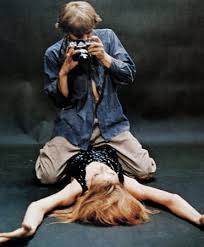


A young photographer is shaken to his core when he finally sees the beyond the Mod London surface gloss he so ably captures in “Blow-Up,” a vivid snapshot of a moment in time and a patient, chilling thriller about a murder and a generation unready to face such realities.
Michelangelo Antonioni (“The Passenger,” “Zabriskie Point”), adapting a Julio Cortázar short story, depicts a prelapsarian ’60s of “free love,” easy money, mod fashion, drugs, sex and rock’n roll.
And after slowly and deliberately setting all this up by following the life of rich, greedy, womanizing photographer Thomas — greedy for women (“models”), fame from his arresting images, money and real estate — Antonioni shocks our anti-hero. Thomas realizes, as he blows up a photograph of a couple’s assignation in a park, that he’s captured a murder or attempted murder with his SLR camera. It hits him square in the face that he lacks the ethical, moral and intellectual grounding to handle this awful truth.
He has no idea what the right thing to do is and no sense of responsibility to do it.
David Hemmings had his greatest film role in Thomas, an arrogant bully of a fashion photographer who callously preys on his subjects, and on too-eager wannabes who flock to his studio door. He’s even sleeping with his artist neighbor and pal’s girlfriend (Sarah Miles).
Thomas takes art shots in his spare time, because he wants it all — big paydays for photographing women in sexy poses, fame and “respect” as an artist published in a picture book.
He tools around a London of colorful street-protests carried out by a comical, carefree flash-mob in mime makeup in his new Rolls Royce Silver Cloud convertible — always with the top down, no matter how grey the day. Thomas parks it away from the factory where he’s posing as a worker just to get candid shots of London labor. And he abuses the flashy ride, because it’s come easily to him.
He’s even dabbling in real estate. He has his eye on an undervalued antiques shop in an about-to-gentrify neighborhood.
“Already there are queers and poodles in the area,” he crows to his business manager. This place is about to explode.
That goes for London as well. British youth born during and just after the war are celebrating their newfound affluence and influence. Thomas is cruising among them — clubbing where The Yardbirds (Jeff Beck, Jimmy Page, et al, pre Page’s Led Zeppelin) are playing, throwing away clothes he’s worn once or twice.
But hunting for other candid shots in a London park has Thomas spying on two lovers — a younger woman (Vanessa Redgrave) with an older man. She freaks out when she sees who he’s snapping.
“This is a public place. People have a right to be LEFT in PEACE!”
Not to Thomas. But as she goes to great extremes to procure those pictures, he prints the pictures and starts to notice background detail. Is that…a shooter in the bushes just to the right of them?


Antonioni doesn’t turn this into a detective story with Thomas as amateur sleuth. Our shallow anti-hero crows to his business manager what he’s snapped, that he’s “saved” the intended victim’s life. But Thomas takes no responsibility for showing what he has to the cops, even after it’s obvious that the worst has happened and the criminals are covering up their crime.
The amorality of all that hangs over “the scene” that Thomas still sees, but is no longer swept up in.
The plot of Antonioni’s film was so clever that Brian De Palma paid homage to it with his ’80s thriller “Blow Out.”
The time and place — mod, fashion-mad 1960s “Swinging London” — were so perfectly captured that Mike Myers made comic hay out of it for a string of “Austin Powers” farces.
Hemmings never again reached the level of fame “Blow-Up” promised. He’d enjoy a long career in support of bigger stars with “Crossed Swords,” “Islands in the Stream,” “Gangs of New York” and “Gladiator” among the jewels on his resume.
Redgrave and Miles would have bigger post-“Blow-Up” careers.
Seen today, one appreciates the patience of films from a more self-consciously artsy era, the slow boil Antonioni goes for in setting up his generational moment of judgement.
Modern viewers will raise an eyebrow and grimace at the sexism, ageism and homophobia glimpsed here.The fashions are peak “mid century mod” and kind of timeless when they aren’t hideous.
“Blow-Up” was made for the HDTV/high-resolution DVD/video era. I first saw it at a university film society projected on grainy 16mm. Much of the effect Antonioni was going for, forcing the viewer to only slowly “see” what Thomas’s trained eye eventually discerns in the background of those simple snaps taken in a park, has been lost to home viewers of this classic for generations.
But now this metaphor for a generation about to come of age can be appreciated for what it was, in all its Metrocolor glory. “Blow-Up was a film with something to say whose message resonates even today, over half a century removed from Swining London.

Rating: TV-MA, sexual situations, pot use
Cast: David Hemmings, Vanessa Redgrave, Sarah Miles, John Castle, Peter Bowles and The Yardbirds.
Credits: Directed by Michelangelo Antonioni, scripted by Michelangelo Antonioni, Tonino Guerra and (English dialogue) Edward Bond, based on a short story by Julio Cortázar. An MGM/Warner Bros. release on Tubi, other streamers
Running time: 1:52


 Movie Nation