


The movies used to sentimentalize mobsters, especially during “the Wars” — WWII and the Cold one that followed.
They might be cutthroats, thieves, lowlife grifters and rummies. But when it came to fascists and commies, flesh and blood threats to The American Way, you could count on the lowliest mug to do the right thing.
“I’ll do business with a Red, but I don’t have to believe one.”
Those days and delusions are long gone. But that combination of hardboiled and sentimental is preserved forever in movies like Samuel Fuller’s 1953 classic “Pickup on South Street.”
There’s this pickpocket, see? He picks the wrong dame’s purse on the subway. It wasn’t just a cash score he plucked that day. There was microfilm. And the Feds were watching the dame in search of their own big score, the Mister Big among the Russia-lovers who’d take delivery of that film.
The Feds go to the cops for help and they bring in the most respectable stool pigeon in New York. Everybody knows Moe. Even her victims, the guys and dolls she fingers, figure “She’s gotta make a living, too.”
And with commies involved, maybe these children of the night can be persuaded to pitch in on a red hunt. You think?
“Are you wavin’ a flag…at ME?”
This picture, released at the height of the Korean War and Hollywood red-baiting and hot on the heels of The Rosenbergs’ treason, crackles with the furious energy and violence of Fuller’s best pictures.
“Pickup” is an immersive, engrossing ticking-clock thriller hurtling along with Richard Widmark at his most sinister, Thelma Ritter at her most flinty but pathetic, Jean Peters as one of the great “molls” with a heart of gold and Richard Kiley as the bristling, sweaty embodiment of America’s idea of the “fellow travelers” in our midst.
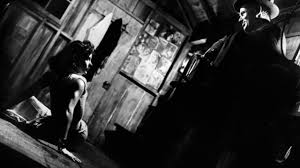
Widmark’s the pickpocket who picks the wrong pocket. Skip McCoy has the perfect hideout — the abandoned Mart’s Bait Shop down on the docks of the Bowery.
Veteran character baritone Willis Bouchey is the Fed who loses him and turns to two-fisted police detective Tiger (Murvyn Vye) for help. Tiger’s ace in the hole is “professional stool pigeon” and part-time tie-seller Moe (Ritter). She peppers the Fed with questions about the pickpocket’s MO. “Newspaper?” Opened to the “classifieds” page?
Will she ID the right guy, for a price? Or will she throw the armed arms of the law off the scent?
“I got almost enough for the stone and the plot,” she haggles. Loner Moe’s greatest fear is a pauper’s grave “in Potter’s Field.” Everybody who comes to her for leads has to feed her cash stash.
That includes Candy (Peters), the unknowing delivery girl just helping out an ex-lover (Kiley) who insists, “How many times do I have to tell you, we’re NOT criminals!”
But his sneering, mustachio’d, cigarette-in-a-holder accomplice (George Eldredge) is character-coded to tell us otherwise.
Moe points the cops and Candy towards Skip, who has no hard feelings about this when he parrots a version of the same “gotta make a living” line she used about him. Who will get to him, make him crack and grab the film first?
Fuller, adapting a story cooked up by Dwight Taylor (“Top Hat”), cranked out a script with crackling dialogue that would put Raymond Chandler and John Huston to shame.
“You’ll always be a two-bit cannon. And when they pick you up in the gutter dead, your hand’ll be in a drunk’s pocket.”
“That girl was carrying TNT. And it’s gonna blow up in your face!”
Skip punches a hole in that WWII mob patriotism “eye wash” with two simple lines.
“So you’re a Red, who cares? Your money’s as good as anybody else’s.”
Widmark made this sort of hustling weasel a specialty in his youth. Here, he lays on the cockiness of a three-time loser. Ritter picked up one of her many Oscar nominations for her turn. Long a Hollywood favorite, she earned this honor for a single scene — sentiment and fatalism doled out in equal portions.
Peters, more famous as one of Howard Hughes’ wives, delivers the great performance that defined her rich-marriage-shortened career. Her Candy is slapped around and slapped some more, but that could be an ex-lover’s panic or “love language” of a lowlife thief, in the Hollywood psychology of the day.
And Kiley makes a fine template for a mid-level spy getting it from both ends, grittier than most versions of this sort of guy — Martin Landau’s urbane, closeted “Leonard” in Hitchcock’s “North by Northwest,” for instance.
Keen-eyed viewers will spy Parley Baer and Milburn Stone, two staples of 1960s TV, in bit parts.
But Ritter’s nomination aside, Fuller is the star here. The crisply-drawn characters, sharp-edged dialogue, unhurried but urgent pacing and world building and populating show an auteur in his element. His career was only recently established, but the sure-handedness of the direction, acting and editing make this his masterpiece, the sort of movie that would give him nearly 40 years of attempts to match it.
“Underworld U.S.A.,” “The Big Red One” and “White Dog” were the closest he’d ever come to achieving that. But when the French critics of the ’50s cooked up their auteur theory of filmmaking, Fuller became one of their darlings mostly because of “Pickup on South Street.”

Rating: “approved, violence, inuendo
Cast: Richard Widmark, Jean Peters, Thelma Ritter, Willis Bouchey, Murvyn Vye, Milborn Stone, Parley Baer, George Eldredge and Richard Kiley
Credits: Scripted and directed by Samuel Fuller. A 20th Century Fox release streaming on Tubi
Running time: 1:21


 Movie Nation