
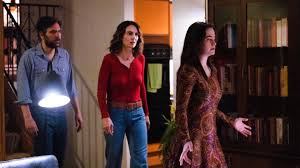



“Radical” politics — sexual, racial and otherwise — Vietnam, the first Earth Day, the sexual revolution, “female solidarity” and Kent State are the backdrop of “Three Birthdays,” a downbeat family melodrama about the day “The Sixties Died.”
Writer-director Jane Weinstock is old enough to know her subject, to be connected to an age of violent political division yet alive with the possibilities of change on many fronts of American culture. But this dissection of the “destructive honesty” of living lives locked into the dogma of your beliefs feels watered-down, tepid and weary almost from the start.
Josh Radnor and Annie Parisse (TV’s “Friends from College”) play professors at an unnamed but famously-progressive Ohio college. Nuala Cleary is Roberta, “Bobbie,” their daughter who celebrates her April, 1970 birthday as the film opens by writing a poem about “When I’m no longer a virgin.”
She’s 17, liberated and always wearing Mom’s “Female Solidarity” t-shirt. And today’s the day she’ll lose that virginity.
Parents Kate and Rob preach tolerance, protesting injustice and “sexual freedom” at home with the daughter they treat like an adult, and fold these messages not just their homelife but their classes. Kate’s published books on feminism, and Rob’s finishing up a book on J. Edgar Hoover and the Red Scare — The House Unamerican Activity Committee ’40s and ’50s.
But those cherished beliefs are tested by both generations as Bobbie finds out something about her parents’ fraying marriage, Rob realizes he won’t get tenure and Kate’s forced to confront the consequences of the marital liberties she’s demanded and the “experimenting” she’s carrying on.
“It’s a lot easier to be a purist when you don’t have a kid. Or a husband.”
Rob’s mocked for throwing a Black power salute at some Black students at this Oberlin-ish bastion, just the beginning of his maybe-my-liberalism-is-a-tad-tone-deaf awakening.
“If only you could be a Black woman, all your problems would be solved.”
And Bobbie’s “I’m a WOMAN now” arguments to the ticket-taker at the cinema where and her prematurely “mature” pal Joyce (Gus Birney) want to see “Women in Love” hit the cold hard reality of adult problems of the worst sort that come with thinking you’re more grown up than you are.
One problem with “Three Birthdays” is the unintentionally quaint way many of these issues — the revolutionary act of lighting up a joint, mentions of “Kent State,” which we know is lingering on the horizon, “the times, sexual revolution and all that” — play today.
Casting Ohioan Radnor, playing yet another “Liberal Arts” and “I Used to Go Here” variation of his “enlightened liberal romantic” character from TV’s “How I Met Your Mother,” just doubles down on that sense of a time studied and talked-about, but not actually lived by those involved.
With this subject and message, avoiding casting Radnor seems like the smarter play here, unless you’re connecting the politics of those fraught times with a history of cinematic Jewish parenting, which Weinstock is not.
For all the seriousness of the subtexts “Three Birthdays” feels shallow, lightweight and less serious than it should, with a cast “acting as” rather than inhabiting characters from that strangest setting of all — the distant-enough but not-terribly-distant past.

Rating: unrated, sex, profanity, marijuana use
Cast: Josh Radnor, Annie Parisse, Nuala Cleary, Jasmine Batchelor, Dolly Wells, Uly Schlesinger and Guy Burnet.
Credits: Scripted and directed by Jane Weinstock. A Good Deeds Entertainment release.
Running time: 1:31


 Movie Nation