
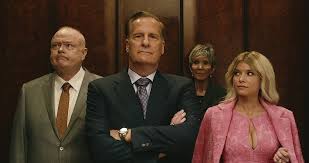


Tom Wolfe’s darkly comic 1998 novel “A Man in Full” comes to the screen, courtesy of another king of ’80s and ’90s entertainment, TV writer/producer David E. Kelley.
The book, uneven but page-turning trash encompassing Wolfe’s favorite themes — class, race, wealth and how sex and media and myth weave through them — becomes an R-rated spectacle of exaggerated characters, egos and situations in the hands of the prolific creator of TV’s “L.A. Law,” “Ally McBeal,” “Big Little Lies” and the TV versions of “Presumed Innocent,” “The Lincoln Lawyer” and “Mr. Mercedes.”
Kelley updates the book, trying to give it present-day currency as we see a blustery big talker facing the consequences of being a showboating braggart and perpetually over-extended builder and businessman.
Jeff Daniels gives full value, as always, playing a larger-than-life Atlanta developer whose reputation, career and business of juggled excesses is about to crash to the ground. As it is a handful of vindictive, resentful bankers who bring him down, the story enters the realm of fantasy, as America knows how compliant bankers enable bungling gamblers just like this. They’re not in the business of punishing them. Those guys don’t face consequences, even in Tom Wolfe’s “Vanity Fair” era America.
Charlie Croker was a Georgia Tech football star back in the last millennium, the “Sixty Minute Man” in the backfield of a national championship team. He’s parlayed that fame into a “Man Who Built Atlanta” empire.
Now in his 60s, with an ex-wife (Diane Lane) and a “trophy wife” (Sarah Jones of TV’s “For All Mankind”) half his height and half his age, drawlin’ Charlie Croker has his name on the biggest building in the Capital of the South, his crown jewel, Atlanta’s Concourse. He’s got a 29,000 acre ranch/plantation/game preserve he’s named TurpMtine and a portfolio that dominates Atlanta’s skyline.
And when we meet him, an overmatched, foul-mouthed and furiously jealous younger banker (Tom Pelphrey of “Ozark” and “Iron Fist”) and his blunt, hardass superior (the estimable Bill Camp) have him in a big bank boardroom where they’re going for a full-fledged emasculation.
Testicles are the big talk in this big talking man’s world, and Charlie’s aren’t just in a vice. He’s in the hole for over $800 million to just this one bank. Others are also holding hundreds of millions in bad paper over Charlie’s toppling businesses and Gulfstream Jet over-extended lifestyle.
This “Man in Full” has his manhood on the line as he schemes to fend off the wolves and keep up appearances in “his” town.
The city’s Black mayor (William Jackson Harper of “Midsommer” and TV’s “The Good Place”) is facing electoral defeat at the hands of a MAGA conservative with a shady past, a man who happens to be a former teammate of Charlie’s.
Charlie’s lawyer (Aml Ameen, who played Martin Luther King, Jr. in “Rustin”) was a Morehouse classmate of the mayor, and finds himself tested by both men’s crises, and in over his head in court defending the husband (Jon Michael Hill) of Charlie’s secretary (Chanté Adams), who gets in trouble for resisting an unjust arrest.
The divorced, late model BMW-driving banker Raymond Peepgrass (Pelphrey) has his own legal and financial issues, a patrimony suit by a Finnish sex worker. He’d like nothing more than sticking it to Charlie, and Charlie’s ex-wife (Lane), just not in the same way.
And that ex-wife’s beauty-icon pal (Lucy Liu) has her own testy relationship with Charlie and past connections that tie her to his difficulties, and the mayor’s.
I listened to the book on tape (read by a drawling David Ogden Stiers) on a cross country road trip when “A Man in Full” came out, and all that stands out in the memory is of the novel’s lurid thoroughbred “siring” scene, something delivered in all its sordid glory here.
Kelley does entirely too much to emasculate what was admittedly an inferior book to Wolfe’s “A Bonfire of the Vanities,” thinning out the manly outdoorsman/horseman/sportsman activities from our “full” man. But Daniels gives us the essence of the character, a poseur who would hate to be thought of as the embodiment of the put-down, “All hat and no cattle” he credits Georgia for coining about showboats like himself.
Lane gives the series a touch of heart and a few moments of fire.
But as Kelley plays up the court case, with its smirking biased judge (Anthony Heald) and the life threatening Fulton County Jail consequences that the stoic victim of an unjust system, Conrad (Hill), faces, it’s easy to see why Kelley focused on what he knows best — legal proceedurals. He’s out of his depth with most everything else.
Wolfe got “the South,” even if he wasn’t able to wrestle all the issues and threads of the culture into his bulky, researched but cartoonishly broad novel.
The performances — Camp is at his most venomous here — are what we cling to, as the narrative isn’t coherent and believable enough to cliff-hanger us through all six episodes.
But if this hits enough eyeballs, maybe Netflix will take a stab at turning Wolfe’s greatest novel — “Bonfire” — into a series. God knows that deserved better than the miscast, botched “blockbuster” that Brian De Palma, Tom Hanks, Bruce Willis and Melanie Griffith gave us in 1990.

Rating: TV-MA, violence, explicit sex, profanity
Cast: Jeff Daniels, Diane Lane, Aml Ameen, Tom Pelphrey, Chanté Adams, Jon Michael Hill, William Jackson Harper, Lucy Liu and Bill Camp.
Credits: Created and scripted by David E. Kelley, directed by Regina King and Thomas Schlamme, based on the novel by Tom Wolfe. A Netflix release.
Running time: 6 episodes @45-50 minutes each


 Movie Nation