

A person hellbent on maintaining his dignity in the face of everything thrown at him to deny it, and failing, is the essence of comedy. So it was with Keaton, and so it is with Cleese.
Somebody said that once. Maybe it was John Cleese himself, that paragon of British reserve, keeping up appearances, keeping calm and carrying on, and convulsing in barely-controlled fury when the world conspires to be uncooperative.
A tall, lean, business-suited sight-gag, Our Lord J.C. was long the tentpole who held up the canvas over “Monty Python’s Flying Circus” and the very picture of British reserve-upended as Basil Fawlty, hotelier from hell. And Torquay.
His greatest film outing, “A Fish Called Wanda,” illustrated this, with Cleese writing himself a posh upper-class barrister, stuffily-married, but outed as a man willing to throw character, ethics, morality and British reserve out the window the moment vamp outlaw Jamie Lee Curtis shows him a little leg.
But 1986’s “Clockwise” shows Cleese as his peers saw him. The English playwright Michael Frayn, hot off the success of the grand farce “Noises Off,” tried his hand at screenwriting a role tailor-made for Britain’s premier funnyman, still basking in the glow of “Fawlty Towers” himself.
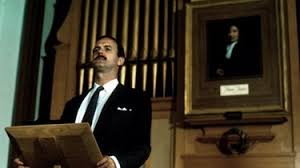
Brian Stimpson would be the quintessence of Cleese, an officious, class-conscious over-achiever who runs Thomas Tompion Comprehensive School with a Big Brotherly iron fist. His eyes peering through all-seeing binoculars, his every bark betraying that he knows each and every student by name, his every utterance announcing their shortcomings.
“Right,” he snaps at each and every miscreant who isn’t toeing his narrow line. “9:20!”
That’s their appointment for a visit to his office for a very firm chewing out — “EXECUTION!” Because Stimpson’s every move is a “correction” aimed at turning out successful students destined to show-up the posh “elites” sent to the far pricier Eton, Harrow and Westminster.
On the day we meet him, Stimpson will lead the school through another singing of “He Who Would Valiant Be,” and then hop a train to Norwich for a meeting of the elite Headmaster’s Association. Brian Stimpson of downmarket Thomas Tompion is the newly-elected chairman of that group of his betters.
He’s a clock-watcher, scheduled down to the minute. His wife (Alison Steadman, who’d go on to glory in Mike Leigh’s “Life is Sweet” and “Topsy-Turvy” and TV’s definitive “Pride and Prejudice”) shows up early, and that’ll never do.
His tendency to snap “RIGHT” at the beginning of every sentence is about to be his undoing. A clock-conscious martinet is about to experience an existential crisis, a trip to Norwich that becomes a long, sunny stumble into tortured, tested tardiness.
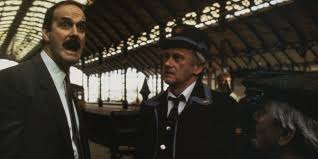
He goes “RIGHT” when the rail ticket collector keeps trying to tell him “left.” A train is missed, his wife is off to give little old ladies (including Ann Way and future Miss Marple Joan Hickson) from the nursing home a drive in the country.
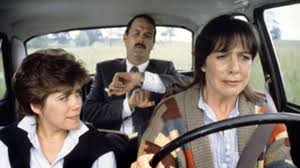
It’s 1986, when the film scores were synthesized and there was no cell service or cell-enabled ride-shares. Brian Stimpson, who left the “this is a historic day” speech he’d been rehearsing to give to the headmasters on the wrong train, sprints and scrambles and eventually arm-twists a star pupil (Sharon Maiden) into driving him 163 miles to Norwich.
“Call your parents,” before they set off in her family car, he orders. She doesn’t. She calls her beau to break up with him, leaving one and all in the dark.
Her parents panic at the stolen car, then at the missing daughter. Her “beau” turns out to be the creeper school music teacher (Stephen Moore of the BBC’s “Hitchhiker’s Guide to the Galaxy”). Stimpson’s neglected wife spies him chatting up student Laura as he fills up her parents’ Morris 1100.
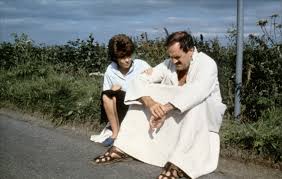
All sorts of scandalous misunderstandings, threats of real justice and rough justice and reprisal pile up as our “couple” make their heedless, hapless way to scenic Norwich.
Parents, his wife, cops and that groomer-teacher are all in hot pursuit. But none of them, and no fender-bender, stuck car, smart aleck farmer, monastery full of not-utterly-silent monks, no Porsche-driving posh who resents being carjacked, British busybodies or a college girlfriend (Penelope Wilton, later a star of “Downton Abbey”) can keep Brian Stimpson from his date with destiny.
Cleese is marvelously self-absorbed as Stimpson, taking care to never show us the raging Basil Fawlty of his most recent series as Stimpson faces every fresh challenge with a panicked “adapt to our circumstances” logic. Brian is simply dismayed at each new obstacle to achieving his simple goal — that meeting, his speech and the glory and meaning it will give to his hyper-focused life.
“It’s not the despair, Laura. I can stand the despair. It’s the hope” that breaks him.
What Frayn, Cleese and director Christopher Moraham conspire to give us is the promise of a Cleese spitting, bug-eyed rage, looking for laughs in denying us what we crave — a meltdown for the ages.
This 90 minute picture is never rushed, ticking over clockwork fashion, logically and amusingly leading us from one barrier to the next, paying off with that big “meeting” with his more privileged (all white “old boys” of the original “Old Boys’ Network) where everything and everyone will come to a very English (reserved) boil.
The finale doesn’t wholly come off. But this picture plays, and Cleese sparkles in one of the only genuine big screen showcases he ever starred in, a slow-boil farce from a master at writing them paying tribute to an actor tailor-made to star in them.

Rating: PG, innuendo
Cast: John Cleese, Alison Steadman, Penelope Wilton, Sharon Maiden, Stephen Moore, Joan Hickson, Peter Cellier, Ann Way and Geoffrey Palmer
Credits: Directed by Christopher Morahan scripted by Michael Frayn. A Thorn EMI/Universal release on Freevee, Vizio, Mubi, Youtube, Amazon etc.
Running time: 1:36


 Movie Nation