

The shifting sands of editor-turned-director David Lean‘s career took him through early adaptations of Noël Coward scripts, included some definitive adaptations of Charles Dickens and eventually settled on the sweeping epics which is he best known for today — “Bridge on the River Kwai,” “Lawrence of Arabia” and “A Passage to India” among them.
One thing he was never known for was having a flair for comedy. Romances (“Madeleine,” “Doctor Zhivago,””Summertime”), sure. Casting Alec Guniness produced smiles here and there, but aside from the intermittently amusing “Hobson’s Choice,” Lean never made much effort to film “funny.”
But as Noël Coward was Lean’s champion and mentor, putting him behind the camera (with Coward co-directing) “In Which We Serve,” letting him adapt his play “This Happy Breed” and pitching in with rewrites for “Brief Encounter,” only Lean would do if Coward’s witty drawing room comedy “Blithe Spirit” was to be put on the screen.
Lean’s initiation to filming in Technicolor was such an ordeal that he dove into Dickens adaptations in black and white after “Blithe Spirit.” Technicolor had its own “consultants” on set in films using their cameras and film stock, lighting and relighting and slowing film productions to a crawl so that every Technicolor movie would look as perfect as “The Wizard of Oz” or “Gone with the Wind.” That’s no way to make comedy.
The film’s star, Rex Harrison, returning from years of military service, wasn’t sure he was up to being funny again. It kind of shows, as does his belief that Lean knew nothing about how to film comedy.
If you’ve ever seen the play on the stage, you know how hard it is to keep it moving and the witticisms landing. A 2020 film remake with Dame Judi Dench and Dan Stevens merely reminded one of how dated and musty the material, an upper class British ghost story, can be.
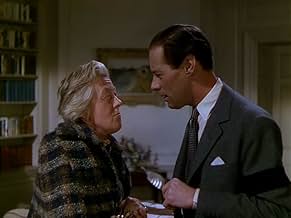
But in ’45, Margaret Rutherford reprised her antic stage portrayal of the “professional” medium Madame Arcati, and Kay Hammond repeated her droll and devious stage turn as the ghost of the first wife Elvira, even though Coward wanted Myrna Loy for the big screen version. The befuddled, rushed maid (Jacqueline Clarke) was a stand-out from the Broadway production of the play and came home to take the film role.
And the famed Coward wordplay crackles throughout, putting everyone on their toes, especially Harrison.
“If you’re trying to compile an inventory of my sex life, I feel it only fair to warn you that you’ve omitted several episodes. I shall consult my diary and give you a complete list after lunch.”
That line, censored from the American release of the film, was pretty racy stuff for 1945, as was the play, with its louche treatment of infidelity, the sexual attraction of one’s first wife and the like.
“Get me to bed, Charles. Then we can talk in peace.”
“A thoroughly immoral suggestion. You ought to be ashamed of yourself!”
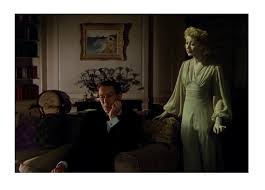
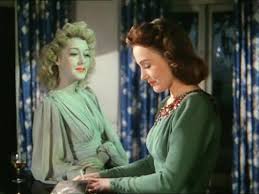
The ghost of a fondly-remembered but faithless ex-wife (Hammond) is summoned up in a seance arranged by novelist Charles (Harrison) looking for material for his new book. His second wife (Constance Cummings), their doctor friend (Hugh Wakefield of “The Man Who Knew Too Much”) and the doctor’s wife (Joyce Carey) are present as Madame Arcati (Rutherford) recites her incantations and makes the table they’re gathered around thump and rise.
But only Charles sees the spirit — a vision in green makeup and ethereal light. Only Charles hears her come-ons, insults and insinuations.
“I’m pained to observe that seven years in the echoing vaults of eternity have in no way pared your native vulgarity.”
That might derail his current marriage, and with Elvira considering other options — pranks and worse — to get her husband back and have a little “fun.”
All the extra care in production design and getting the color lighting right shows. “Blithe Spirit” is a beautiful film. The Oscar-winning effects (the film’s lone Academy Award) are state-of-the-art pre-digital in-camera trickery and hold up beautifully.
And truth be told, after a stodgy, stagey start, “Blithe Spirit” finds its footing, gets up a head of speed thanks to Rutherford, Hammond and Clarkes, and finishes with a flourish.
But one can’t help but figure Lean learned his lesson with this somewhat lumbering outing.
He moved on from Coward and made his mark in period pieces both intimate and on a grand scale. And if ever Lean felt his film needed a lighter touch, he’d cast Alec Guinness, even in blackface (“A Passage to India”), to achieve that effect.

Rating: “approved,” TV-PG (innuendo)
Cast: Rex Harrison, Constance Cummings, Kay Hammond, Hugh Wakefield, Jacqueline Clarke, Joyce Carey and Margaret Rutherford.
Credits: Directed by David Lean, scripted by David Lean, Ronald Neame and Anthony Havelock-Allan, based on the Noël Coward play. A General Film Distributors/United Artists release on Tubi, other streamers.
Running time: 1:38


 Movie Nation