



Epic-scale filmmaker Ridley Scott turns 87 on November 30. It’s safe to assume that, like Clint Eastwood, Scorsese, Almodovar or Bigelow, any film he makes could be his last.
But Scott’s still carrying on as if he has no laurels to rest on, that for every ambitious “Napoleon” or “The Last Duel,” every attempt ( (“House of Gucci”) to step out of historical epic or science fiction, he has to focus on serving up another “Alien” sequel or prequel, that some studio’s long-cherished wish for a “Gladiator” sequel must be fulfilled.
So if we ever want to see “You Should Be Dancing,” his Bee Gees biopic, the Western “Wraiths of the Broken Land,” or sci-fi dystopia “The Dog Stars,” we’ve got to line up for “Gladiator II” first.
Computer generated imagery (CGI) has transformed cinema since 2000’s “Gladiator.” Ancient Rome and its world is a lot easier to realize on the screen. Gladiator duels in the Roman Colosseum can cover even grander bloodsports that the enslaved fought to the death in — a simulated naval battle on the flooded arena’s floor, for instance.
But for all the expansions in scale, all the back-engineering a fresh plot onto the existing one — that of a great general politically purged and enslaved as a gladiator, forced to fight for change in a tyrannically corrupt regime and his chance to save his bloodline — “Gladiator II” has nothing fresh to say on the subject or the movie genre.
Hollywood’s already made four TV series out of the 1960 Kirk Douglas-and-Kubrick classic “Spartacus,” all of them coming out in the decades since the Oscar-winning Ridley Scott/Russell Crowe epic “Gladiator” arrived and revived the setting, subject and shirtless-duels-to-the-death genre.
But that doesn’t mean Sir Ridley can’t remake his version of a “Spartacus” gladiator-as-martyr tale.
Yes, CGI means that you can stage a naval battle on a budget and pit gladiators against a warhorse-saddled foe riding a rhino or fighting for their lives against CGI zombie baboons. That doesn’t mean you should.
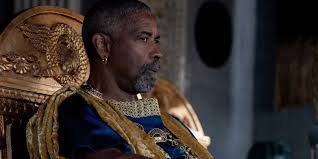
Everything else in “Gladiator II” has the ring of “Spartacus” about it. Soldiers (Pedro Pascal, Paul Mescal) are enslaved for the crime of defying Rome. They endure a montage of gladiator training led by a sadistic veteran (Lior Raz) of the “sport.” Their “owner” (Denzel Washington) is a sinister, vindictive operator angling for social, financial and political gain from their feats.
Mescal, last seen in “All of Us Strangers,” is Hanno, an officer in the army of Numidia, an African nation-state coveted by second century Rome. He sees his archer-wife (Yuval Gonen) ordered slain by the Roman general (Pascal of “The Mandalorian”) who conquers the city, his adoptive home.
Hanno is enslaved along with his Numidian commander (Peter Mensah of “300” and TV’s “Spartacus”). Only one of them is destined to survive to be a gladiator, not the one who sees slavery as “something I cannot endure.”
Hanno proves himself in the arena, but not with the aim of earning his freedom from Macrinus (Washington, berobed and venal). He wants his revenge on General Marcus Acacius (Pascal), who happens to have married the widowed daughter (Connie Nielsen) of the late emperor Marcus Aurelius. And she sees something she recognizes in this young fighter, a hint that he might be Lucius, her lost-long son with the late general turned gladiator Maximus.
We glimpse and hear Maximus (Russell Crowe) in flashbacks.
Rome is ruled by two pale inbred siblings, Caracalla (Fred Hechinger) and Geta (Joseph Quinn), each too inept and bloodthirsty to effectively run a nearly-exhausted empire they’re intent on expanding.
No, this “Gladiator” is no more historical than the first one. It’s all a bit of a bore, the sea of extras filling the stadium, the vast mob in the streets, the colorfully-adorned armies (and navy) marching and sailing under their SPQR banners, mere tools bent and used for political purposes.
We’re treated to a taste of the poet Virgil, quotes from the late Maximus, who has become lionized by a later generation of gladiators — “What we do in life echoes in eternity.” There’s even a twisting of a quote by non-Roman novelist Bernadine Evaristo — “When you’re a slave you don’t dream of freedom. You dream of owning your own slave.”
I enjoyed the spectacle of this about as much as I enjoyed “Ben-Hur” or “Napoleon” or “Gladiator.” But it’s hard to find the beating heart of this story because it doesn’t really have one. For all the talk of Hanno’s “rage,” the fury, fire and pathos of “Gladiator” is missing as well. That’s the price of killing off the hero’s wife too early.
A good cast is pretty much wasted in a story that struggles to give us reasons to root for this or that character and root against others. Nielsen can’t carry all the emotional baggage by herself, and Washington is more intent on playing a villain with his “reasons” for his actions than on showing us the character’s cards.
Making Tim McInnerny (“Notting Hill”) a cowardly, scheming senator, “Little Britain” vet Matt Lucas the tipsy Colosseum MC and and bringing back British legend Derek Jacobi (“Henry V,” TV’s “I, Claudius”), now an aged and ineffectual senator, adds nothing to the proceedings.
Avoiding humor and stripped of any semblance of heart, “Gladiator” is just buff men brawling and beheading each other and bemoaning the “violence” that was Rome. But if that’s what the populus craves, at least it gives the aging master Scott the cultural currency to bring back The Bee Gees in biopic form.

Rating: R, graphic, bloody violence
Cast: Paul Mescal, Pedro Pascal, Tim McInnerny, Matt Walsh, Fred Hechiner, Joseph Quinn, Peter Mensah, Yoval Gonen, Alexander Karim, Lior Raz, Connie Nielsen and Denzel Washington
Credits: Directed by Ridley Scott, scripted by David Scarpa, based on “Gladiator” and characters created by David Franzoni. A Paramount Pictures release.
Running time: 2:28


 Movie Nation