
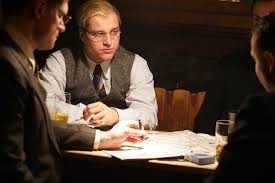
I highly recommend you pay a quick visit to the Wikipedia page dedicated to German theologian and resistance martyr Dietrch Bonhoeffer before taking on writer-director Todd Komarnicki’s film “Bonhoeffer.”
Otherwise, you might be as lost as I was thanks to the botched chronology acted-out by a little-known cast in a screen biography that does not live up to its over-reaching subtitle — “Pastor. Spy. Assassin.”
Komarnicki, who scripted “Sully” and “The Professor and the Madman,” and who wrote and directed a long forgotten Bill Paxton/Julia Ormond WWII misfire, “Resistance,” struggles to get this celebrated figure’s sprawling but short life into 132 minutes. All along the way, as he jumps from the formative events of Bonhoeffer’s theology and anti-Nazi beliefs to the end of his imprisonment in a concentration camp at the end of the war, Komarnicki too often leaves the viewer adrift.
Wait, this character talks about clergy being sent to the “Eastern Front” (with Russia)? Didn’t we just see the aftermath of “Kristallnacht?” The war hasn’t started yet, has it? Is Churchill the one the resistance would be begging for help at this juncture? Is his reason for not helping German resistors really that he fears “invasion” in (just guessing here) 1942-43?
The narrative gets lost and drags us along with it as it does. I’ve seen a documentary about Bonhoeffer and read a bit about him over the years, and I found it impossible to place most undated sequences in the film in any definite time frame.
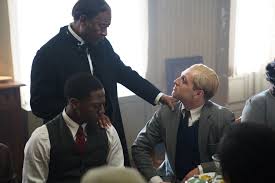
“Bonhoeffer” captures stirring sermons denouncing the cult of fascism and dwells, at length, on his formative months in America before Hitler came to power — renewing his faith through the sermons he hears in 1930s Black New York churches, discovering jazz.
We’ve already tasted his childhood, the pacifism that might have been born when he saw a beloved older brother march off “a hero” only to have his life wasted in The Great War (WWI).
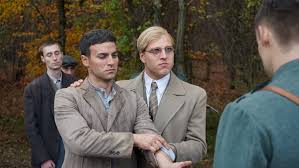
Jonas Dassler (“Never Look Away”) is a dead-ringer for the preacher acting out a script that tries to celebrate a major figure who was a whirlwind of activity unafraid of pursuing what he saw as a greater cause and a higher calling. We see him helping found the “Confessing Church” in reaction to the Christian Nationalist bent of mainline German Protestantism under the Nazis. And we follow Bonhoeffer into the “underground seminary” where he tries to raise young pastors like himself — on the move and out of reach of the Gestapo — who see the Almighty as the head of the church, not Adolf Hitler.
But we get little notion of the vast collection writings which made Bonhoeffer famous and which immortalized him after his death. In a time of moral crisis and fascist intolerance, the “devout pacifist” speaks, declaring that “Not to speak” in such a crisis “IS to speak.” Silence is compliance and compliance is collusion.
“God will not forgive us for this” criticism of persecution of the Jews, he is warned buy his peers. “He will not forgive us if we don’t!“
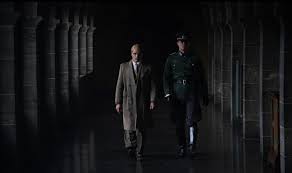
And when he’s asked by old friends and relatives “Can you give more than your voice to this cause?” Dietrich Bonhoeffer became a spy, joining the Abwehr (military intelligence) where plots were afoot to assassinate Hitler. He will risk “dirty hands” and go where churches and pastors rarely go in his efforts to combat a great corporeal evil that others are content to pray over.
The scheming is given short shrift, and Komarnicki choses to depict a different bomb plot than the one Bonhoeffer was charged with participating in recreating that sequence of events. That adds to the historical murk that this movie lives in.
There’s enough of the man and his words to make us wish the screenplay had been better organized, and good enough to attract a more star-studded supporting cast (August Diehl plays the heroic Bishop Martin Niemoller). Unfamiliar faces, unidentified by on-screen graphics, leave the viewer in the dark about who is related to whom and what their place in all of this might be. Casting familiar faces often fix such shortcomings.
Bonhoeffer spoke, in life and in the film, of putting “a stick in the very wheel of the (fascist, immoral) state until it stops.” That’s a message this Angel Studios (“Sound of Freedom,” and “Cabrini”) production would have been well-served getting out weeks before the last American election instead of weeks after Christian Nationalism and fascism triumphed at the polls.
The movie also strains to narrow its message to Anti-Semitism, when Bonhoeffer himself saw fascism as a broader evil and an immoral threat on many fronts, with many scapegoated victims.
Both that and this gutless “NOW you warn us about ‘fascism'” release date are acts of cowardice that Bonhoeffer himself would have condemned.

Rating: PG-13, violence, mild profanity
Cast: Jonas Dassler, August Diehl, David Jonsson, Flula Borg, Nadine Heidenreich, Lisa Hofer and
Moritz Bleibtreu
Credits: Scripted and directed by Todd Komarnicki. An Angel Studios release.
Running time: 2:12


 Movie Nation