
Some classic films can overwhelm you with the memories of when you saw them, of the era that created them and of the stars who gained their immortality in filming them.
“The Killing Fields” came out fresh enough on the heels of America’s long, tortured involvement in Southeast Asia’s Vietnam War to sting. But in sympathetically and skillfully telling a horrific story to come out of one corner of that conflict, it found hope and uplift, along with critical accolades and three Academy Awards.
The film’s editor (Jim Clark) and director of photography (Chris Menges) won Oscars, as did “amateur” supporting actor Dr. Haing S. Ngor. The Best Picture Oscar went to Milos Foreman’s film of “Amadeus.” Cinematic 1984 was a very good vintage.
British producer David Puttnam so embodied the “class” of that cinematic era — “Local Hero,” “The Mission,” and “Memphis Belle” were among his credits, and he won the Best Picture Oscar for producing “Chariots of Fire” — that he briefly became head of Columbia Pictures, emphasizing upscale, modest-budgeted and sometimes ambitious failures.
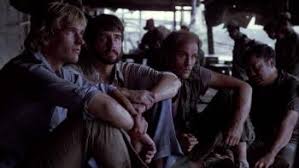
We’re treated to bristling performances by very young Sam Waterston and John Malkovich and fine work by Julian Sands (playing a journalist) and Craig T. Nelson, playing a true-believer military attaché determined to spin this debacle into a “win,” or at least a “not our fault” to the bitter end.
Supporting player Spalding Gray, a writer/actor playing a U.S. Consul in Phnom Penh, Cambodia, made a career out of his monologue/performance art piece “Swimming to Cambodia,” another version of a Cambodia/Vietnam/United States history lesson when it was made into a shockingly entertaining one-man show and film.
“Killing Fields” is a phrase coined by the subject of the saga — the interpreter, Cambodian in-country “fixer” and future photojournalist Dith Pran. It became worldwide, UN-sanctioned shorthand for genocide and the reactionary backwardness that drives it. Dith Pran came to the university I was attending to speak and gave a moving account of Cambodia’s fall to the Khmer Rouge. He was a man with a profound sense of mission about bearing witness and underlining the consequences of Superpower blundering in the Third World.
Forty years later, the film about his experience’s power to move is only slightly diminished. Producer Puttnam’s thing for solo artist electronic scores (partial, in this case) is the sole sour note here (unlike in “Chariot’s of Fire”) that dates the film, and not in a good way.
But the story is a true epic, a survival tale that can’t be trivialized by the cliche “a triumph of the human spirit.” Because “The Killing Fields” is all about mankind at its worst — dogmatic ideology callously applied to human populations and dogma enforced by callow, trigger-happy youth toting AK-47s and sporting red neckerchiefs.
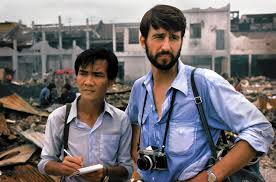
Waterston plays Sydney Schanberg, the award-winning New York Times journalist who as depicted here, took every government/military run-around personally and more fully understood the adversarial relationship between the press and those being covered than pretty much anybody on a similarly high profile beat today.
Sydney is arrogant and bullying, badgering his “fixer” Dith Pran to arrange transport to an “accidental” U.S. bombing, seemingly insisting that the man stick with him to the bitter end and beyond as Nixon’s “Cambodian incursion” becomes a culture-crushing disaster. Yes, he offered and planned to get Pran and his family out of the county. But with a story to grab as the capital falls, Pran is by Schanberg’s side, interpreting in French and Khmer, hands clasped in near prayer as he begs for information, a boat ride, a pass through a checkpoint or for their very lives.
The Khmer Rouge aren’t impressed.
The script’s three act structure introduces the scene, the relationship and the dilemma of Cambodia’s collapse in ’74 and ’75 even as Nixon was resigning. The second act has Dith Pran holed-up with photographer Rockoff (Malkovich) and other journalists (Bill Paterson is a piano-playing Scot, Sands a fellow Brit, with South African playwright/actor Athol Fugard playing a doctor) at the French embassy.
We hear Pran’s wife’s warnings about what is to come and see him eschew a risky escape from civil warriors at war with “progress” itself — the “Year Zero” fanatics of the Khmer Rouge. We hear Sydney’s pleas, expectations and (wrong, as it turns out) and guesses about “the end” and how they’ll all get out.
The foreigners have a chance. An educated, multi-lingual Cambodian employee of foreigners? Pran is sure to be arrested, if not shot on the spot by the hotheated teens who do leader Pol Pot’s dirty work.
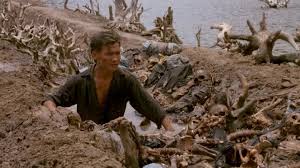
The third act covers Dith Pran’s enslavement by the new Cambodian order, hiding his education and street smarts, trying and trying again to escape across a forbidding, corpse-covered terrain (literal “Killing Fields”) under the cover of Vietnam’s brief war with Cambodia in the late ’70s.
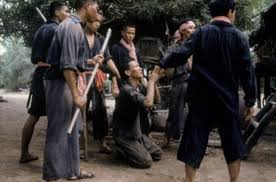
The film’s indelible images are of Pran (Ngor) giving us all a taste of what “real” survival requires — objectifying lizards and stolen sucks of cow blood as the protein needed to keep him alive while the regime tries to work him and starve him to death, the caginess it takes to fool your captors about your true nature while at the same time convincing them of your usefulness to them.
A first act summary execution has maybe the most explicit shot-in-the-face effect the movies have ever produced, before or since. The beautiful country torn asunder by conflict, and a sea of extras — city dwellers enslaved on a vast hill-moving project by the civilization-hating Khmer Rouge — adds weight to the label “epic.”
Waterston lets us see tinges of guilt in the blustery, self-serving Schanberg, who wins awards even as he’s writing letters and making calls trying to get his right-hand-man out of a country that literally went dark after its conquest.
Malkovich is as focused and as nimble as we’ve ever seen him, a combat photographer whose instincts kick-in as he clicks away within seconds of the streetside blast that could have killed him.
And Ngor, a real life “Killing Fields” survivor himself (his wife and child died before getting out), lets us see the amateur beneath the performance, a non-actor playacting something not that far removed from his own escape from his renamed homeland — Kampuchea.
It’s still easy to see, in the beautiful celluloid-preserved sunsets, the gritty combat-zone street scenes and intimate framing and alternately emphatic and empathetic editing, why Menges and Clark won their Oscars.
Oscar nominated director Roland Joffé went on to make the Colonial South America epic “The Mission” and the “Oppenheimer” of its day, “Fat Man and Little Boy,” before overreaching with the Indian-set poverty-fighting Patrick Swaynze romance “City of Joy” punctured his balloon. He still works, but even the attempts at high-mindedness (“The Forgiven”) fall flat and fail to register on film fandom’s radar these days.
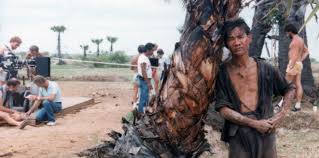
But he was at his very best on “The Killing Fields,” filming an epoch-defining cinematic classic that recreates that historic horror in “paradise” (Phuket, Thailand was where much of it was filmed) and making that Vietnam War allegory in three acts work — an American who “uses” whoever or whatever pawn is handy in that game of Cold War chess, who then “owes” something to someone he, like his country, used and then let fall to ruin.

Rating: R, graphic violence, profanity
Cast: Sam Waterston, Haing S. Ngor, John Malkovich, Craig T. Nelson, Athol Fugard, Bill Paterson, Spalding Gray and Julian Sands.
Credits: Directed by Roland S. Joffe, scripted by Bruce Robinson. A Warner Bros. release on Roku, Amazon, etc.
Running time: 2:21


 Movie Nation