


Sheer curiosity might be enough to lure the adventurous into “The Universal Theory,” a mysterious German-Swiss film noir that dabbles in alternate history and a confluence of events that might have triggered timeline shifts among those who were in its proximity.
Are black and white subtitled period pieces about alternate versions of people in jumbled-up differing realities are your thing?
But a jarring line of narration late in the film hints at the more ambitious, or at least coherent, movie this might have been. Our protagonist/author is said to have been unstirred by the student protests of the ’60s, and merely a spectator like the rest of us to “the Soviet moon landings.”
Our framework is the memory of a would-be physicist’s (Jan Bülow), jarred by an abortive 1974 German TV interview about his new “science fiction novel.” It’s not a “story,” not “science fiction,” Johannes Leinart insists. He stalks off the set without elaborating.
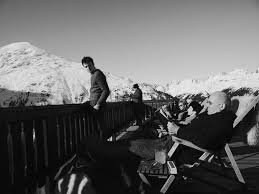
A dozen years earlier, Leinart was a physics student working on his dissertation with his grumpy, disapproving academic advisor (Hanns Zischler), traveling with him to an alpine physics summit where an Iranian researcher is set to announce a “universal theory.”
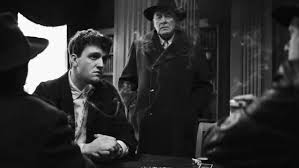
Leinart’s dissertation is dismissed by Dr. Strathen as “purely speculative” “esoteric nonsense” (in German and French with English subtitles). But a boorish rival of the grump’s, Professor Blumberg (Gottfried Breitfuss) sees this “parallel eigen status” multiverse speculation as possibly “ground-breaking,” “a Nobel Prize,” something that could upend and “wreck (famed physicist Niels) Bohr’s life’s work” in one fell swoop.
Or maybe Blumberg’s just having one over on his old rival. Whatever you do, don’t ask Blumberg what he did in “the war.” And try not to notice the ten year-old Swiss bellboy who hears German spoken and snaps off a salute and a “Heil Hitler!”
It turns out that this Swiss boy and a little girl stumbled into secret tunnels underneath this corner of the Alps. There’s talk of radiation and uranium mining. Leinart notices queer formations in the clouds.
But he also notices the pianist in the hotel bar. Karin (Olivia Ross) mesmerizes him, and hints at a long past association with perhaps a bit of childhood trauma. Leinart tries to have a conversation or at least slow her down as she briskly walks away from him. She’s also looking at the clouds, and in the company of Professor Blumberg and others in overcoats and hats. What’s up with that?
People die. Or disappear. Or age mysteriously. Two chain-smoking cops (Philippe Graber and David Bennent) try to get answers, or answers that they understand.
Are they even asking the right questions? Because Johannes Leinart and his “purely speculative” theories make him the one person there who might be able to figure out what’s going on. And it’ll take him years and a publisher who insists on putting out his book as “science fiction” for him to work what he say and believes transpired there.
He’s the one person to hear an existential edge in the query, “Where were you in ’62?”
“The Universal Theory” is too obscurant for most tastes, with the slow-to-unravel thread of the story as difficult to follow as the entirety of the “Spiderverse” timelines and the mad blur of “Everything Everywhere All at Once.” That goes for the performances, too — opaque.
It’s a modest but immersive film more interested in cryptic characters and plot lines and in period detail — minimal effects, mostly in the third act — and the idea that some sort of rift in reality might be possible, that it could happen, and why not in the Swiss Alps in 1962?
If only those Soviet moon landing cosmonauts could weigh in. I’m sure Buzz Aldrin has questions, too.

Rating: unrated, violence
Cast: Jan Bülow, Olivia Ross, Hanns Zischler, Gottfried Breitfuss,
Philippe Graber and David Bennent
Credits: Directed by Timm Kröger, scripted by Roderick Warich and Timm Kröger. An Oscilloscope Labs release.
Running time: 1:58


 Movie Nation