
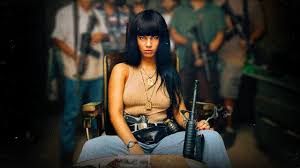
The Brazilian thriller “Bandida,” dully-retitled “Outlaw” for North American consumption, is a generic “How I became a criminal” bio-pic with lots of violence but few genuine surprises.
If it’s watchable — and it is — attribute that to a gritty, home-movies-of-the-notorious filming strategy and an earthy, immersive performance by Maria Bomani in the title role.
She plays Rebeca, a child of the hillside favela Rocinha sold into gang life before she’s of school age, raised in the drug trade. She grows up to become a ruthless, violent, cop-shooter “created” by the corruption that renders that country’s social inequities a permanent condition.
Adapted from the memoirs of Raquel de Oliveira, this story is framed within a half-stoned 1992 confession/”remember me” cassette recording of a young woman raised in violence. “Outlaw” sees Rebeca master that violence and learn her business as she comes to play a dominant part in the struggle for “territory” between rival gangs and gang leaders surfing the changing tastes of Brazil’s drug abusers.
“You made me,” she growls on the cassette (in Brazilian Portugeuse, or dubbed), lashing-out at the culture that discriminates based on race, class and neighborhood (favela) and condemns its “losers” to this life.
We see the child “sold” for grooming, only to have a lady witch doctor prophesy pieces of background that save her and force the purchaser, “Sweet Bookie” or Amaroso (Milhem Cortaz) to treat her as forever “hands off” to him sexually.
Instead, she’s made a runner, schoolground-dealer, street spy and collector for his mob, learning the drug trade inside and out.
“Being an outlaw was now my chance,” she narrates.
Over the course of her life, she will ally with the five friends of her favela childhood, sometimes to her advantage, sometimes to her detriment.
She will fall for the handsome future leader Para (Jean Amorim) and teach him how to use a gun. Revolvers were the weapon of choice of her childhood, Uzis and M4s are what the gang wars of the ’80s are fought with.
“Outlaw” is a strikingly-lurid piece of cinema, with many of the flashbacks scratched-up to look like “survivor” home movies, many interactions shot in extreme close-up and the jumpy action staged with almost amateurish gusto.
Director and co-writer João Wainer never deviates from formula or a story the movies have been showing us since “Little Caesar.” But the self-consciously arty filming and post-production effects give the story a lowdown and dirty feel, if never quite reaching the no-budget mythos of “El Mariachi” or big budget “saga” flavor of “American Gangster” or “Blow.”
A quartet of screenwriters contribute to the story’s sluggish forward momentum. It’s 84 minutes long and plays much longer, in between the firefights, anyway.
But Bomani is a fierce presence at the center. And those shootouts — street warfare in which the cops often lose — are epic. And if this isn’t close to being the best favela gang movie (“City of God”), it’s still an intentionally rough and tumble trip into Rio’s underbelly with a tour guide nobody would dare question.

Rating: TV-MA, graphic violence, drug abuse, sex, nudity, profanity
Cast: Maria Bomani, Jean Amorim, Paulo Guidelly, Jéssica Barbosa and Milhem Cortaz
Credits: Directed by João Wainer, scripted by Patrícia Andrade, Cesar Gananian, Thaís Nunes and João Wainer, based on the book by Raquel de Oliveira. A Netflix release.
Running time: 1:24


 Movie Nation