


It was “The Lavender Hill Mob” and “The Titfield Thunderbolt” that Monty Python’s John Cleese was remembering when he decided that well-past-70 Charles Critchon might be just the jolly sort to direct his screenplay for “A Fish Called Wanda.”
Those classic Ealing Comedies might date from another age, and the old rule about “old guys can’t do comedy” remains a hard prejudice to overcome. But Cleese, Jamie Lee, Palin, Kline & Co. turned out to be in the surest possible hands with 1988’s “Wanda,” one of the greatest screen comedies ever.
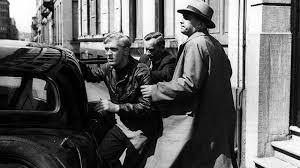
Yet the editor-turned-director was already making his mark in British cinema before comedies beckoned. World War II launched his directing career (“For Those in Peril”). And stumbling across “Against the Wind” on a streaming channel reveals this 1948 gem to be the “perfectionist” Critchon at his action-oriented best.
It’s a heist picture bent to fit the still-new commando thriller narrative, and as such it’s a jaunty, genre defining work.
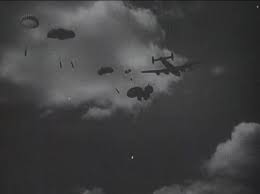
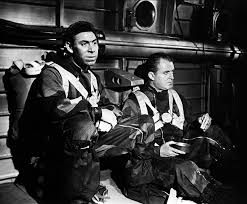
A “team” is assembled, trained to fight, parachute and hit the enemy with gadgets from a military movie prototype for James Bond’s Q-Division. The mission goes wrong from the first — accidents, betrayals, characters’ Achille heels’ exposed.
But with that “Keep calm and carry on” doggedness, these men and a woman don’t give up. And if the viewer isn’t won over by the twists, narrow escapes and sacrifices of the early acts and Critchton’s brilliant shooting and cutting, the filmmaker tosses young actors John Slater and Gordon Jackson onto a moving train, imperiling one and all in some seriously jaw-dropping “They did their OWN STUNTS” action for the climax.
An Urtext thriller becomes downright dazzling, and Crichton takes a giant step to making his name in British cinema in the process.
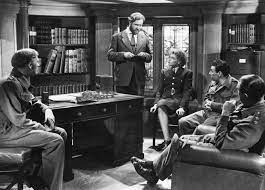
A priest (Robert Beatty) with a gift for languages and experience on The Continent is recruited by Ackman (James Robertson Justice of course, later of “Guns of Navarone”) to an asymettrical warfare unit specializing in “sabotage” behind enemy lines.
Future Oscar winner and “Diabolique” icon Simone Signoret, still in her ’20s and making her first English language film, is Michèle, bridling at desk duty, longing to return to Nazi Occupied Europe for revenge against a turncoat lover. Bomb-gadget guru Duncan (Jackson) will have to hide his feelings for Michèle – — “Once you start mixing duty and affection, you start digging graves!” — and his Scots-accent and iffy French from the authorities if he’s ever sent on a mission. Show dancer turned radio operator Julie (Gisèle Préville) will have to get over her crush on Father Philip (Beatty). Hulking man without a country Cronk (Jack Warner) could come in handy. Emile (John Slater) will undergo plastic surgery so convincing his own wife won’t recognize him on this assignment.
And Picquart (Paul Dupuis of “Passport to Pimlico”) will have to have a fascist image makeover before making his way back to Brussels. Because that’s where they’re bound. Their former instructor, master saboteur Andrew (Peter Illing) may have masterminded the work records office fire that threw a wrench into Nazi foreign labor impressment. But he was caught, and By Jove, they’re going in to get him.
Everything that can go wrong does when you’re dealing with parachute jumps, espionage, explosives, agents of mixed allegiances and locals you may not wholly trust. But the mission endures, with “suicide pills” a final out for those captured.
The deaths here are dramatic, sometimes to the point of shocking, and each has meaning and consequences. Signoret is the standout in the cast, but Dupuis, Slater and Jackson have some great moments.
Jackson, later immortalized as the fusty, traditionalist butler in “Upstairs Downstairs,” an early hit for PBS in the US and the template for “Downtown Abbey,” is most impressive as the sexist Scot who swoons for the jaded, loveless Michèle, only to have to depend on her professionalism to save his life.
But watching him cling to rolling rail-stock in the film’s climactic rail chase (much of the movie was filmed on location in Belgium) we don’t see “performing” “as if my life depended on it.” The actor, and Slater as Emil, are white-knuckling onto couplings and other parts of rolling freight cars because one false move and they’re dead or at the very least badly injured.
Ealing Studios would make its true mark on film history via the comedies to come — “Whisky Galore,” “The Ladykillers,” “Kind Hearts and Coronets” — a couple of them directed by Crichton.
But with the sentimental, sad and sometimes thrilling “Against the Wind,” one and all proved that it wasn’t just twee, quaint and distinctly British charm and wit that made Ealing a revered institution. Definitive genre pictures about “Their Finest Hour” did Ealing and Crichton & Co. credit, too.

Rating: TV-PG, combat violence
Cast: Robert Beatty, Simone Signoret, Gordon Jackson,
Gisèle Préville, John Slater, Paul Dupuis, Peter Illing and James Robertson Justice.
Credits: Directed by Charles Crichton, scripted by T.E.B. Clarke and Michael Pertwee, based on a short story by J. Elder Willis. An Ealing Studios/J.Arthur Rank release on Tubi, Amazon, etc.
Running time: 1:36


 Movie Nation