


If you didn’t live through the ’70s, you can still pick up a pretty good idea of what the decade looked and felt like through the movies released and set then.
The working class grime, paranoia and diminished expectations wasn’t just a feature of urban thrillers such as “Three Days of the Condor.” You can feel it in “Alice Doesn’t Live Here Anymore” just as much as you can in “Mean Streets” or “One Flew Over the Cuckoo’s Nest.”
Looking back on all the grey-sky classics of the day, it could feel like the prevailing season was fall into winter, the mood of the nation was cynicism and a different breed of movie stars were our voices for that loss of faith.
You can hear paranoia in the overheard whispers captured on tape in “The Conversation,” and the distraction that thumping disco pumped into “Saturday Night Fever.”
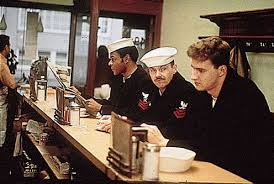
But you can smell 1973 in “The Last Detail” — cheap stogeys and Schlitz, dank taxis running on leaded gas, smoke-filled rail cars and down-market brothels, simple burger-with-onion diner fare and sailors in salty pea coats, shivering on liberty between “orders” to board a new ship.
Hal Ashby’s film — a Robert Towne script adapted from Darryl Ponsican’s novel — is rightly regarded as one of the movies that made Jack Nicholson “JACK Nicholson.” The sarcastic cynic, amusing blowhard and bluff, even bullying everyman at war with his times and his station in life was a vital part of the Nicholson brand.
He’d been a dopey grown-ass-dropout in “Easy Rider,” a pianist from privilege who rejects that upbringing in “Five Easy Pieces,” the stable and responsible sibling of “The King of Marvin Gardens” and a sexual revolutionary who doesn’t know there’s a war on in “Carnal Knowlege.”
In this sentimental service comedy that plays as tragedy, he’s a Naval chief petty officer all but adrift on the land — waiting for a ship –in a Vietnam War era film that barely mentions Vietnam.
What’s striking about “The Last Detail” 50 years later isn’t the “service comedy” tropes — boozing up New York and chasing skirts on “liberty” (leave), a near meltdown in a D.C. bar and a brawl with Marines — but the easy camraderie that’s been one of Nicholson’s gifts.
He’d play loners, Lotharios, amusingly manipulative jerks, brooding artists and head-cases. But for his era, he came to embody an idea of a man among men, a hale fellow of sorts. He settles into this Naval milieu, a CPO assigned to the company of two strangers, as easily as he mastered the fox in the mental ward henhouse of “One Flew Over the Cuckoo’s Nest,” the veteran detective/cock-of-the-walk of “Chinatown” or a horse thief trying to stay alive in “The Missouri Breaks.”
Ensembles just formed around Nicholson, and larger-than-life or not, in his best pictures, there’s plenty of room for others to shine in his magnanimous company.
Buddusky is just one of the petty officers assigned to wear the SP (shore patrol) arm band and side-arm required to escort a sailor who has been convicted of a crime to Portsmouth Naval Prison in Maine. His partner “chaser” on this “s–t detail” is Mulhall. And once Buddosky gets past his teasing mispronunciations — “Mulehead…Mule House” — they’re practically old shipmates, each at ease in their shared rank and not thrilled about their shared duty and shared contempt for “The Old Man” in charge of their corner of Naval Station Norfolk (Va.).
That’s significant because the Navy was just a couple of decades into true integration. And while the bluff Master at Arms (Clifton James, who played a good ol’boy sheriff in a couple of James Bond films of the day) might default to putting Buddusky in charge, he barely acts like it, always treating the more sensible, by-the-book and Black Mulhall (Otis Young) as an equal, with the odd “shine” joke never meant to jab.
In a different era, Young — terrific, testy, droll and wholly empathatic — might have enjoyed a much bigger career based on this performance.
“I don’t know what I would’a done without the Navy,” the Louisana native Mulhall declares. We, like Buddusky, get it. Getting out of Louisiana was the thing the service offered.
Young holds his own with Nicholson, and the “star” shares the spotlight like a movie icon just now realizing he’s made it and feeling generous.
Randy Quaid benefits from this as well. As the 18 year-old pathological shoplifter facing eight years in the brig, Quaid leans into tall, wide-eyed and dumb so hard it’s no wonder that first Buddusky and then Mulhall soften towards him and decide to make this last few days of freedom memorable.
They’ll stretch a two-day trip to the fully-allotted five they’re allowed to get Meadows from Norfolk to Richmond, Washington, New York, Boston and then Portsmouth.
They’ll have the luxury of missing a train or a bus, holing up in cheap per diem hotels, drinking Schlitz from a can and PBR out of the old fat bottles, watching black and white movies on TV and taking their sweet time.
“Is your word worth anything,” Buddusky wants to know of the kid? Can he take off the handcuffs, treat him like a shipmate and not embarass him in transit? Maybe. Maybe not.
But as Buddusky’s efforts to give this boy a taste of the world before he’s locked out of it for eight years extend to threatening a D.C. barman reluctant to serve Mulhall who will flatly NOT serve an underage sailor, and finding Meadows “a woman,” Mulhall recognizes the threat to both their careers, long time service be damned.
“I consider myself in jeopardy with you, man, understand? In jeopardy. This ain’t no farewell party an’ he ain’t retirin’. Understand? He’s a prisoner an’ we’re takin’ ‘im to the jailhouse. An’ you have a tendency to forget that. You’re a menace, man.”
How much of a menace and just how much “jeopardy” is what “The Last Detail” is about.
Director Ashby had “Harold & Maude” behind him, “Shampoo” and “Being There” ahead of him, as well as drug addiction that would kill him and seriously damage his reputation. Some of us learned the hard way not to mention his name in front of “Jinxed” star Bette Midler.
The upper class fustiness Ashby upended in “Harold & Maude,” the gauche and shallow sexual commerce of Hollywood of “Shampoo” and the hollow gravitas of the old men running Washington of “Being There” is joined by a post-60s “Detail” America where the youth are into chanting cults (“SNL” legend Gilda Radner and “Carrie/Dressed to Kill/Blowout” star Nancy Allen among them), hippies quizzing servicemen about Vietnam and a working class that, in or out of uniform, could be cohesive or at odds if the wrong buttons are punched.
There’s a quirky absurdity to Ashby’s best films balanced with a keen eye for humanity at that moment. His Woody Guthrie biopic “Bound for Glory” was a misfire, if sweet and well-intentioned. Some filmmakers aren’t great at period pieces or capturing larger than life figures and events.
Here, he’s just another top director of his era whose reputation is further burnished by capturing Nicholson at his peak.
The film’s jaunty, Naval anthem-laced Johnny Mandel score (“Anchor’s Aweigh,” etc.) belies the darkness of this odyssey. The weight of what they’re doing wears on Buddusky and Mulhall, and the actors playing them. They realize, as we do, that this harsh judgement has fallen upon a barely-shaving kid, somebody even viewers back then would have recognized as needing psychological help, not hard time under the thumb of Marine “grunts.”
The simmering sentimentality allows us to assume we’re about to meet the “Hooker with a Heart of Gold” when Carol Kane — in her first attention-grabbing role — shows up as the New York sex worker about to teach “the kid” about the birds and the bees.
But the jaded screenwriter Towne — best known for “Chinatown” — would never let the not-as-cynical Ashby get away with that, even if he gave Nicholson’s Buddusky the film’s most humanizing line for just this moment.
“They got feelings just like everybody else, kid.”

Rating: R, violence, nudity, sex, pot use and alcohol abuse, profanity
Cast: Jack Nicholson, Otis Young, Randy Quaid, Michael Moriarty, Clifton James and Carol Kane.
Credits: Directed by Hal Ashby, scripted by Robert Towne, based on a novel by Darryl Ponsican. A Columbia Pictures release on Tubi, Amazon, etc.
Running time: 1:44


 Movie Nation