


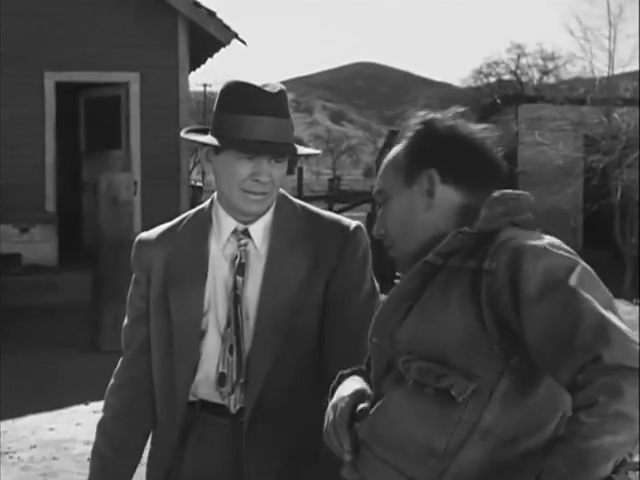
Historically, “Machine Gun Kelly” is about as accurate as the proverbial “two dollar watch.”
The movie about the infamous 1930s Memphis gangster was shot on the cheap in Southern California, with nothing that looks like Tennessee, not a trace of any Southern accent and a lot more violence than was ever attributed to the real George Kelly Barnes.
But 1958’s “Machine Gun Kelly” captures filmmaker and “indie” icon Roger Corman at his breakthrough moment, a screen story told — at least in the early scenes — in brisk brush strokes, ominous shadows and bursts of violence, a film acted with real heat and a screenplay — by R. Wright Campbell (“Man of a Thousand Faces,” “The Night Fighters”) — that plays up the cowardly sadism of its hero and features some of the flintiest dialogue of its day.
“I’m gonna carve a map of Hell right across your kisser!”
“You know, Kitten. I’m gonna get you a nice little white mouse for you to play with.”
“He’s awfully cocky for a man who can’t even crack a hick town bank.”
“Tell your old lady to keep her wise cracks behind her teeth or she’s gonna be wearing false ones!”
“I already do, smart aleck!”
The jazz score by Gerald Fried (“Killer’s Kiss,” “The Killing,” TV’s “Roots”) swings and sizzles so insistently that it carries the picture right up to the point the movie bogs down with a fictionalized version of the kidnapping that put Kelly behind bars.
Charles Bronson pops off the screen in the title role, a star-to-be playing up the sadism and woman-slapping bullying of this character, built up in history thanks to the “machine gun” moniker he wore and F.B.I. chief hypeman J. Edgar Hoover’s exaggerations, a mobster turned in the movie into a craven coward who fears anything to do with death — coffins, floral arrangements, etc.
If there’s anything this “Untouchables” era gangster picture has to say to the modern viewer, it might be that it takes a special kind of warped fraidy cat to covet the no-skills “power” of a machine gun.
But I have to say the picture promises more than it delivers. A bravura dialogue-free five minute opening shows us an early heist in quick, sure strokes. The robberies here are perfunctory, but beautifully framed and shot — shadows of gunplay, etc. It is the getaways that are elaborate, with Kelly and gang (Wally Campo, Jack Lambert, etc.) breaking down his Thompson Submachine Gun, tossing clothes and pistols, handing off the loot, splitting up and swapping cars.
Susan Cabot is the sexy, malevolent manipulator Flo, who shames her beau’s phobias, nags him into jobs, builds his myth and can take a punch or slap herself, because she has to.
Frank DeKova plays Harry, a “big game hunter” accomplice who keeps a menagerie of dangerous critters at his gas station, including a mountain lion he’s trapped. The comic Morey Amsterdam, later to gain fame via “The Dick Van Dyke Show,” is the treacherous weasel Fandango, aka “Fanny,” a weakling Kelly pushes around, tortures and costs an arm.
But Bronson and Cabot set off the real sparks, and even as the story shifts from bank robbing to kidnapping, our anti-hero’s undoing, they keep it watchable as the action subsides and the settings become various interior hideouts, with cops and the parents of a kidnapped little girl (never happened) working with the Feds (Michael Fox) to ensure that the world closes in around Machine Gun Kelly & Co.
The future mentor to generations of film folk, Nicholson and Coppola among them, Corman was supposedly fascinated by the gutless way Kelly went down, and built this film’s psychological portrait around that. He learned that timeless lesson from “Destry Rides Again,” that bullying monsters look awfully small when trapped, stuck in court, trying to stay awake, lying and lying about their exploits until no one believes they’re anything but what they really are — cowards without an audience, a gang or a machine gun to compensate for all the toughness they lack.

Rating: “approved,” violence
Cast: Charles Bronson, Susan Cabot, Morey Amsterdam, Connie Gilchrist, Richard Devon, Frank DeKova, Jack Lambert. Wally Campo and Michael Fox.
Credits: Directed by Roger Corman, scripted by R. Wright Campbell. An American International Pictures release on Tubi, Youtube, Amazon, etc.
Running time: 1:23


 Movie Nation