


Don Siegel won a couple of Oscars for short films early on, did a lot of 1950s and ’60s TV, directed Elvis and John Wayne and the original “Invasion of the Body Snatchers.” He was behind the camera for enough Clint Eastwood movies that he became Clint’s film school.
Hard boiled? You bet. “Dirty Harry,” “The Shootist,” “Charlie Varrick,” “Riot in Cell Block 11,” the guy turned-out a steady line-up of unsentimental, sometimes downright sadistic action.
“The Lineup” (1958) wasn’t one of his best, but it’s tough, brutal and kind of kinky, with a finish that packs a punch.
The idea behind it was, if the LAPD’s “Dragnet” could begin as a hit radio series, transition to a hit TV series and become a movie, why couldn’t the same thing happen with the San Francisco-based “The Lineup?”
A “taken from real case files” police procedural set in The City by the Bay, “The Lineup” featured fairly colorless cops — like “Dragnet” — chasing more colorful criminals than “Dragnet” ever managed.
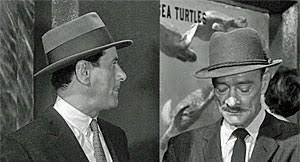
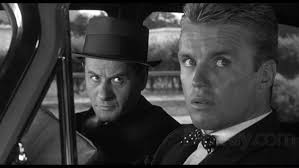
Siegel’s workmanlike 1958 film takes us into a killing spree over drugs being smuggled into the city by tourists returning from Asia, and lets us see the pursuit through the eyes of the police chasing the killer, and inside the car with a door-to-door murderer-for-hire named Dancer, played with his usual relish by Eli Wallach.
Richard Jaeckel is the short blond punk assigned by The Man behind the scenes to drive our no-nonsense drug-retriever from destination to destination. And Robert Keith plays Julian, the demonic dandy correcting Dancer’s English usage and grammar, a misogynistic muse sitting on his shoulder urging him to collect “famous last words” from the poor saps he’s killing.
“For the book.”
Julian tells the driver who’s been sent to take them to the various unsuspecting “carriers” whom Dancer will collect from that the trigger man is “a wonderful, pure pathological study, a psychopath with no inhibitions.”
Julian seems to relish this. Julian is a Hollywood “type” all his own, the homocidal homosexual whose connection to Dancer isn’t so much homoerotic as sadistically co-dependent, a tough-talking but spineless sidekick with a fey obsession for mentoring in the social graces.
The first hint the cops have of drugs flooding into town this way comes when a San Francisco opera swell (Raymond Bailey) has his luggage grabbed in a handoff that gets a cop killed.
Bailey’s innate highborn shiftiness — he went on to player the banker Mr. Drysdale on “The Beverly Hillbillies” — makes him suspect one as Detectives Asher (Marshall Reed from the TV series) and Quine (Emile Meyer) start pulling together clues, visiting the 1950s medical examiner and tossing the cop killer’s apartment, so wrecked it looks a Halloween party got out of hand there.
“No self-respecting witch would bring a broom into this trap!”
Dancer and Julian roll into town and Dancer makes his demands on the wheelman brought in to work for them.
“I like my wheels stored in a prepared drop…I want my plates snatched not more than one hour before I move.”
Sure, those demands fall by the wayside. But a merchant seaman, a society swell and a mother and daughter have no idea who is about to pay them a “friendly visit.”
The direction is quick, cheap and unfussy, with Siegel forced to use low-heat TV actors as cops, early mornings for his exteriors and a lot of rear projection in the still-nerve-rattling chase scenes.
But he and the crew make great use of San Francisco locations, with the climax taking in the famous Sutro Museum and Skating Rink, and the elevated freeway, still under construction as the movie was being filmed, that would famously collapse during the 1989 World Series earthquake.
One thing that grabbed me right away was Siegel’s confidence that the camera could show you things dialogue and the lazy intertitles modern filmmakers use to set the scene. We can SEE it’s San Francisco. We don’t need to be spoon-fed that information.
Whatever the low-risk/pre-sold reasons for putting this TV-tailored tale on the screen, there’s no doubt Siegel went to school on the city and some of the Stirling Silliphant script’s sharper edges while making it. He’d return to the Bay Area several times in the future, most famously for “Dirty Harry” with Eastwood in 1971.
And even if that killer was to be even sicker than ever, this time, the sadist would be the fellow with the badge.

Rating: TV-14, violence, drug content
Cast: Eli Wallach, Robert Keith, Richard Jaeckel, Marshall Reed, Mary LaRoche, Emile Meyer, Raymond Bailey and Vaughan Taylor.
Credits: Directed by Don Siegel, scripted by Stirling Silliphant, based on the TV series created by Lawrence M. Klee. A Columbia release on Tubi, Amazon, etc.
Running time: 1:26


 Movie Nation