

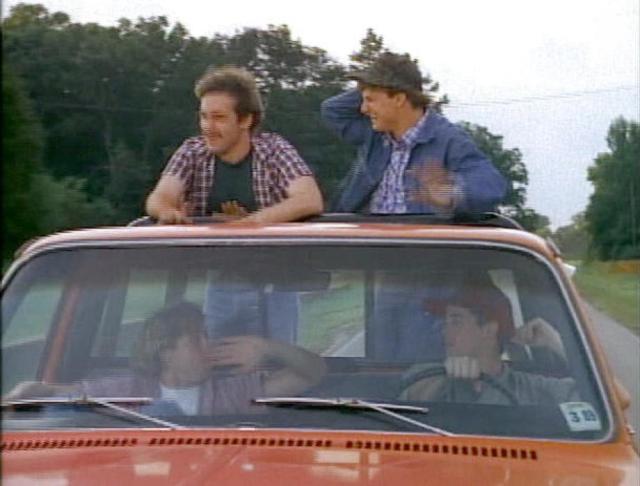


You can look at the young actors playing four redneck teens accused of throwing rocks at an Amish buggy and killing a baby and tell which one of them might have become a star in “A Stoning in Fulham County.” And not just because Brad Pitt’s the most classically handsome of the lot.
Pitt brings a lovely sensitivity to his few scenes in this 1988 TV movie, first aired on NBC. He generates pity, which considering how loathsome what he and his pals did, is saying something. “Stoning” was his first credited role on screen.
The term “TV movie” was, for much of its history, a pejorative label in Hollywood. Shot speedily and on the cheap, usually in between broadcast seasons of network programs and often featuring network series stars or supporting cast members, they generally feature perfunctory direction, adequate acting and just a little more polish than your average indie film.
I used to cover them in the same part of the country that “Fulham County” is set in — central North Carolina — and saw actors like M. Emmet Walsh, William Daniels, David Ogden Steirs, a very young Keri Russell, Jesse Borrego and others bring a little flash and a lot of professionalism to these two-takes-and-done projects.
These days, not many are produced as TV has migrated to the streaming series model, although you can find lots of them on The Hallmark Channel, especially around the holidays, and on Netflix, which has offered players like Lindsay Lohan a new lease on life in these B-movies for the boob tube.
But Steven Spielberg launched his career with “Duel,” Elizabeth Montgomery discovered life after “Bewitched” with her fierce turn in “The Legend of Lizzie Borden,” Cicely Tyson immortalized herself in “The Autobiography of Miss Jane Pittman” and Andy Griffith left his “Aw, shucks” sheriff behind with TV films like “Savages” and “Murder in Coweta County.”
“Fulham County” is better than your average TV movie, if not one of the exemplars of the genre. It was scripted by writers with “Quincy, M.E.,””Murder She Wrote” and “Columbo” credits and directed by a make-your-“day” and make-the-trains-run-on time filmmaker who worked on “Remington Steele,” and did “Mendez: A Killing in Beverly Hills” and the excellent “Tecumseh: The Last Warrior,” which I watched him film near Winston Salem.
It’s a courtroom drama based on a real case of local harassment of the Amish that led to a death in 1979 Indiana. The film came out three years after the classic murderers-among-the-Amish romantic thriller “Witness,” and squares off “thirtysomething” star Ken Olin against “Beauty and the Beast” (the series) star Ron Perlman, and features Jill Eichenberry (“L.A. Law”) as prosecutor Olin’s wife, big city folk who have moved to rural N.C. (Statesville was the primary filming location).
Well-known character players Peter Michael Goetz, Nicholas Pryor and Noble Willingham (as the judge) flesh out the cast. And one of the greatest character actors of his era, Theodore Bikel, is cast as the Amish elder Abe, classing-up the entire enterprise with his fluid mastery of German (he was a villain in “The African Queen”), his soulful singing (he was a folk music star) and gravitas, joining Perlman’s grieving father Jacob in explaining “our ways” to the city slicker, and to the TV viewing audience.
When the punks harass and hurl rocks in their “claping” prank on Jacob and his family (Maureen Mueller plays his with Sarah), they’re engaging in a local rite of passage, to scare and even injure the folks who are “different” from them, whose values and traditions that eschew many of the conveniences and temptations of modern life.
The new “finishing out the year” prosecutor has hopes of just doing his time and opening his private practice there until this horrific injustice lands in his lap.
As the locals start with “They’re just boys” and move into full-on harassment of the prosecutor, as Jacob declines to testify or allow any of his family to because “Vengeance is mine, sayeth the Lord,” prosecutor Jim has to ask, “What the hell have we gotten into?”
The film resembles many a “Matlock” episode (my elderly mother was an addict, before moving on to the hard stuff — “Blue Bloods”), and has barely a whiff of “To Kill a Mockingbird” or “Inherit the Wind” in it, despite the drawls, the desperate appeal for witnesses, a biased local judge and the organized, ingrained ignorance they’re fighting against.
“Turn the other cheek,” the go-along-to-get-along Sheriff (Greg Henry) says of The Amish Way. “Not a bad way to live.”
“Unless you’re the only ones who do,” Jim snarls back.
Olin was an early adapter of the empathetic vocal fry school of near-whispered TV acting of the era, and is less convincing in the fiery appeals for justice that are necessary for this button-pushing melodrama to close the deal.
Mueller doesn’t give us much, as a mother struggling with grief and to not lose her faith at this severest test.
But Perlman and Bikel are outstanding, and they do things the generic, sappy “TV movie” score and pedestrian shot selection and editing don’t. They make us invest in this story, move us and infuriate us, and in no way prep us for the formula-breaking finale that shows up and almost cheats us of what we’ve always comes to expect out of such courtroom tales.
That’s TV movies for you. Future “superstar in the making” or not, we’ve got 94 minutes to tell a story, with commercial breaks. And by God, that train’s got to arrive and leave on time, no matter what.

Rating: TV-14, violence
Cast: Ken Olin, Ron Perlman, Jill Eichenberry, Noble Willingham, Maureen Mueller, Greg Henry, Peter Michael Goetz, Nicholas Pryor, Brad Pitt and Theodore Bikel.
Credits: Directed by Larry Elikann, scripted by Jackson Gillis and Jud Kinberg. A Landsburg Co. production first aired on NBC. Now on Netflix.
Running time:


 Movie Nation