
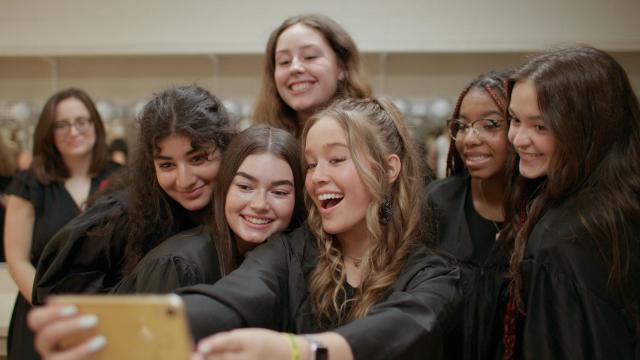
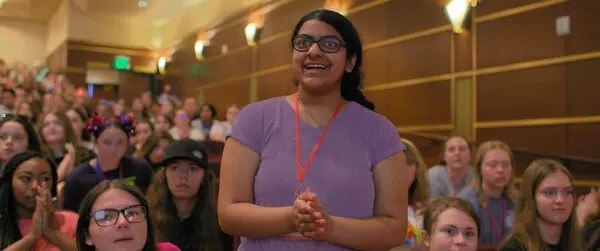
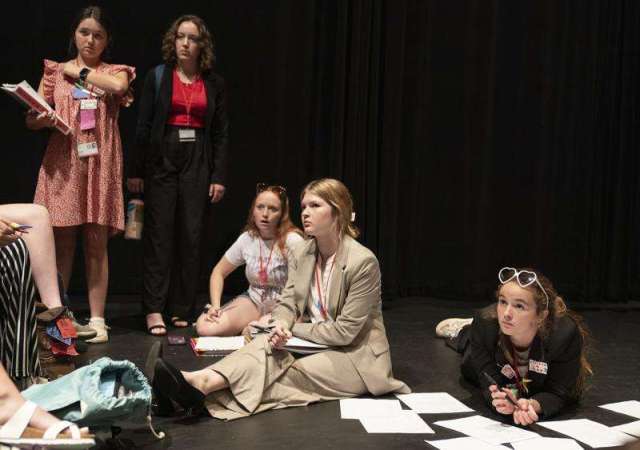
They gather, boarded for a week at college campuses in all 50 states — smart, bright competitive teenage girls selected to participate in one of America’s oldest mock-government institutions.
The young women of each state’s “Girls State” debate issues, campaign for their version of statewide elected offices and state supreme court seats in a microcosm of American democracy, one sponsored for both boys (Boys State) and girls by the conservative veteran’s organization The American Legion since before World War II.
The filmmakers behind the 2020 documentary about a new generation (of Texas boys) embracing America’s political divide, “Boys State,” found another flashpoint political moment at their feet when they rolled camera in Saint Charles, Missouri, where Missouri’s boys gathered for their Boy’s State and the girls of Missouri’s “Girls State” convened.
Because on the cusp of summer, 2022, America was roiled over the “leaked” upcoming Supreme Court ruling that took overturned the Roe vs. Wade decision and stripped women of a hard-won privacy/bodily-autonomy right they’d enjoyed for 50 years.
Filmmakers Amanda McBaine and Jesse Moss were on campus — at Lindenwood University — and in a position to document a “Big Change a’Coming” moment. Girls State, with its matching t-shirt teens, group cheers, “Girls State Song” and “fake” campaigns that amount to contests about “good public speaking” and a relatability popularity contest, would be a deep Red State test of just what the next generation of voters would be talking about and how they’d react.
We meet Emily Worthmore, a hyper-focused go-getter with three goals — “President of the United States in 2040,” “broadcast journalist” or rock stardom — on her agenda. The willowy blonde comes off as pleasant, confident, smart and calculating.
Maybe this isn’t the best year to run for Girls State governor as a “conservative” who talks up her “Christian” upbringing and values. So Emily soft sells that.
Tochi Ihekona, the daughter of Nigerian immgrants, acknowedges that she might be “the first Black person” many of these mostly small-town white girls “have any interaction with,” but hopes for the best.
Faith Glasgow talks about her political conversion and passion. Big city (St. Louis) teen Cecilia Bartin seems even more outspoken about the Big Issue, and relishing the chance to talk about it with similarly-engaged peers.
Nisha Murali longs to land a supreme court seat because whatever legislators and governors cannot manage to do, “They (justices) make the decisions” that impact everyone.
McBaine and Moss interview their chosen subjects (out of 500 girls) and still manage to come close to “fly on the wall” cinema verite documentary filmmaking as they work the convention and track the interactions of seven girls there.
They overhear one argument that ends with “I’m not going to dislike you for your political beliefs.” We hear the just-met you “I’m gay” — “I’m bi, but I have a boyfriend” chatter that has tested a generation of parents, especially in conservative states like Missouri.
And they see a learning curve. Boys State is assembled on the same campus at the same time. The girls can’t help but note that the boys don’t have to have a “buddy” to walk around campus with, that the governor swears in the Boys State winner, and “THEY have no dress code.”
“Last time I checked,” firebrand Cecilia thunders, “women knew how to dress themselves!“
The girls have been kept in “traditional” stereotypical roles, with “public health” and other non-controversial “issues” as the source of their debates, thanks to supervision by an ever-shrinking, ever-more-reactionary veteran’s organization. And even the conservative Emily notices it.
With Roe about to go down, bubbles of outrage and passionately-held opinions will be expressed. And just wait until they find out the budgetary difference between the two separate and unequal “states.”
I like the way Moss and McBaine set us up to accept stereotypes — about teenage girls and their priorities, about conservative Emily or confident liberal Faith — and then upend those expectations.
They visit the Missouri Boys State just enough to underscore the militaristic, GOP convention, sanctioned by the political status quo differences between the two.
We’re bowled-over by the confidence and confidence-building these girls exude, some here to compete, perform and win, some to challenge themselves on a more modest scale. These Girls States have been going on for 80+ years, now. But for the young women signing-up for them, the stakes seem higher than usual, at least in part because of culture shifts in the country.
Emily notes she expects to be in the minority here, no matter how “red” Missouri is. She has no idea, but maybe she’s shaken a bit as she writes a Girls State newspaper story on the disparity, the still-lower expectations that patriarchal Missouri lays on young women.
When the election day speeches come around, expect to be inspired, moved, and fired-up. Well, not “everyone” should expect that.
If you’re a teenaged girl, or have a daughter or granddaughter, find somebody in the family who has Apple TV+ and watch it. And if you’ve got ultra conservative relatives, you might want to suggest they tune in, too.
Otherwise, they may have no idea what’s coming.

Rating: TV-14, adult subject matter
Cast: Faith Glasgow, Tochi Ihekona, Emily Worthmore, Maddie Rowan, Cecilia Bartin, Nisha Murali, and the girls of Missouri Girls State, 2022.
Credits: Scripted and directed by Amanda McBaine and Jesse Moss. An Apple TV+ release.
Running time: 1:38


 Movie Nation