


There’s a mesmerizing tranquility to German director Wim Wenders’ homage to Japan and the cinema of Japanese icon Ozu Yasujiro.
The filmmaker who gave us “Wings of Desire” and a pretty good documentary on Ozu (“Tokyo-Ga”) loses himself in a Westernized interpretation of Japanese minimalism in the style of the “everyday Japanese life” filmmaker who gave us understated meditations such as “An Autumn Afternoon,” “Late Autumn,” “Early Spring,” “Early Summer” and most famously, “Toyko Story.”
Wenders’ Oscar-nominated Tokyo reverie “Perfect Days” might better be titled “Zen and the Art of Tokyo Public Toilet Maintenance,” because that’s what it’s man-of-few-words antagonist does for a living, and “zen” is the best word for describing his approach to this “untouchable” career.
We may wonder how Hirayama, played by “Shall We Dance” hearthrob Koji Yakusho, came to be an exacting 50-60something scrubbing public restrooms for The Tokyo Toilet contractors. But Wenders gives us more a collection of intriguing details than anything resembling an answer.
Hirayama is a man of rigid routine. He eats the same things and covers the same route on a daily and weekly basis. And he is a worker with high standards. He takes out a mirror to examine what needs to be scrubbed off the bottom of the urinals in “the cleanest public bathrooms on Earth.”
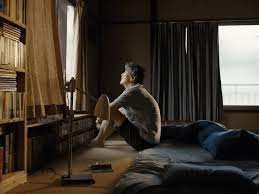
Hirayama is a loner, but he has hints of a poetic soul, taking photos of shadows of leaves against the sky with his cheap Olympus film camera, listening to “House of the Rising Sun” or “Sittin’ on the Dock of the Bay” on vintage cassettes in his self-owned work truck, taking his lunches in the open air, reading Faulkner, Patricia Highsmith and others by the light of the sole lamp in his spartan apartment.
What, we wonder, will interrupt this routine and form the basis for the drama here? Will it be his amusingly doltish, slacker Millennial “junior” cleaner, Takashi (Tokio Emoto)? Takashi’s efforts to woo bar woman (kyabajō) Aya (Aoi Yamada), a blonde pixie plainly out of Takashi’s league?
She is so moved by Hirayama’s cassette of Patti Smith’s “Horses” that she pockets it after the lazy and always-imposing Takashi gives her a lift in Hirayama’s truck.
Then there’s the long-estranged niece (Arisa Nakano) who shows up, stays with Hirayama and shadows him on his job, anything to get away from her mother (Yumi Asô).
There’s a strange woman Hirayama smiles at in the park every day, with only a dead-eyed stare sent in return. Maybe the bar owner nicknamed “Mama” (Sayuri Ishikawa) who regularly flirts with Hirayama is singing her heartbreaking Japanese version of “House of the Rising Sun” directly to him.
Wenders layers details on top of details, obsessively focusing on Hirayama’s holy reverance for seedlings that he takes — with permission — from a shrine to raise in his own mini teacup planter forest, his nightly trips to a public bath, weekends of laundry, bike rides to bars as he runs errands and his morning ritual of rolling up his futon, donning his coveralls with a fresh towel around his neck, looking up to check out the morning sky, and exult in it, buying a canned iced coffee from the vending machine conveniently right out in front of his flat and then selecting a vintage cassette — “Feeling Good” by Nina Simone? — to ride to work by.
It’s more a film of feelings, subtle emotions, and a fascinatingly committed lead performance than it is a straightforward narrative. Things happen, but the arc of a life this myopic won’t be broad. When these slight things do roll up, they can be life affirming, but only in the broadest “quiet desperation” sense, and even then there’s more “quiet” than “desperation.
The title, “Perfect Days,” would be an unkept promise if it weren’t taken from one of several (mostly) Western pop songs that do a lot of the heavy lifting in the film — “Brown-Eyed Girl” and Patti Smith album tracks to Nina Simone and Otis Redding and The Animals (“House of the Rising Sun” is almost a pun here) warhorses. The title tune, as it were, is Lou Reed’s “Perfect Day.”
“Oh, it’s such a perfect day
I’m glad I spent it with you
Oh, such a perfect day
You just keep me hanging on
You just keep me hanging on…”
Seeing as how the tune is about being in a heroin-narcotized state, even that’s a functional dead end, ironic and nothing more.
But the slice of Tokyo life is lovely and arresting. It’s as if Japanophile Wenders noticed the spotless restrooms that other visitors to the land of the rising sun rave about and pondered “How do they get that way?”
Your appreciation of “Perfect Days” hangs on how fascinating you think a toilet cleaner would be, and how much interior life you’re willing to add to Wenders’ repetitive and superficial “meditation” on such a character.

Rating: PG, smoking, some nudity
Cast: Koji Yakusho, Arisa Nakano, Sayuri Ishikawa, Inuko Inuyama, Yumi Asô and Tokio Emoto
Credits: Directed by Wim Wenders, scripted by Takuma Takasaki and Wim Wenders. A Neon release.
Running time: 2:03


 Movie Nation