
Watching any mainstream Hollywood film of the mid-to-late ’60s is like wading into The Land of the Lost. A half century after the annointing of that corner of the Left Coast as the cinema’s capital and global arbiter of “cool,” and the old men in charge had utterly lost the plot.
Demographics, the “youth culture” that exploded in the ’50s with the rise of rock’n roll finished off the “star system” and broke filmdom’s ability to cater to an audience that expected their leading men and action icons to be in their 40s, their leading ladies to be in their 30s and their stories more adult.
Steve McQueen found TV stardom in his late ’20s, and became an enduring icon of cool in the movies for much of the decade. Sidney Poitier was also a new kind of cool — Black — and achieved the same icon status in his ’30s.
Tall James Garner and lanky James Coburn were only slightly older, but seemed to appeal to a more traditional audience — more Greatest Generation than Baby Boomer, more “square” than hip.
Garner made that pay off, on TV and on the big screen. Coburn? He didn’t take that “your parents’ generation” stuff lying down.
In ensemble films like “The Great Escape” and “The Magnificent Seven,” he couldn’t outshine, out “rebel” McQueen. Even in his own star vehicles, Coburn could seem to be trying too hard, dropping “groovy” and “hip” and “cool” entirely too often in “The President’s Analyst” or the Bond-lite “In Like Flynt” movies. Eastwood and everybody else in Hollywood might have spoken the same way. They just didn’t do it on the screen, where it sounded a tad desperate and instantly-dated the movie you heard it in.
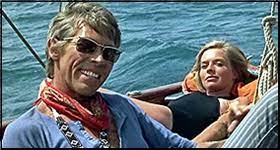
“Duffy” (1968) is a European-shot caper comedy and star vehicle that passes Coburn off as a master criminal sort of “retired” (Coburn had just turned 40) in Tangier, Morocco. Here’s how he’s described by the rich Brit-bro played by James Fox.
“That old tangerine hipster.”
Yeah, Coburn worn brownish-reddish highlights before “highlights” were a thing.
The caper in this film from Oscar-winning editor turned director Robert Parrish is pretty clever, with some solid stunts and decent analog effects. The movie around it? Like Coburn, it tries entirely too hard to be “hip.”
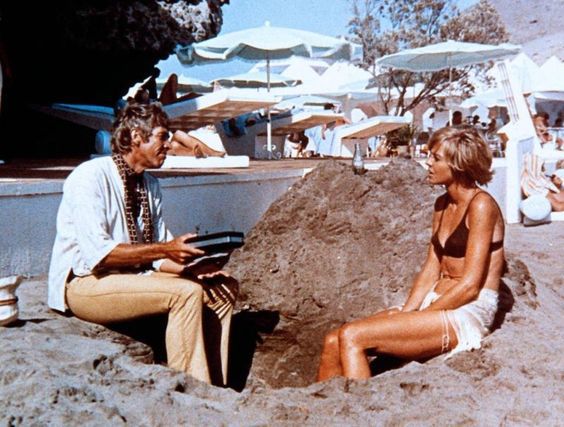
But “Duffy” has JC and Susannah York and Fox and James Mason, lots of Technicolor footage of 1960s coastal Almeria, Spain, substituting for Tangier and coastal Morocco, a swinging jazz score (Lou Rawls sings the theme song, “I’m Satisfied”) and lots of baggy bikinis for the tourists and York’s character and billowing kaftans for the men, for when they “go native.” It’s light enough to get by up to the moment the caper is cued up and things don’t go exactly as planned.
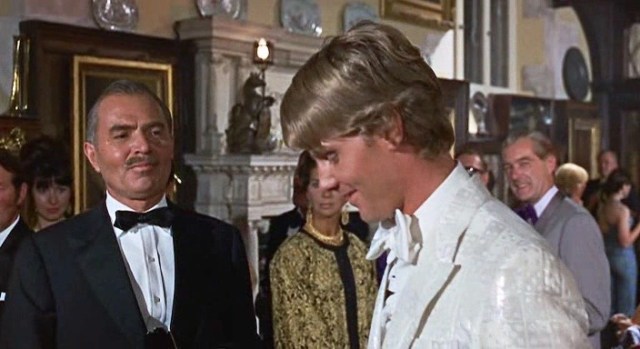
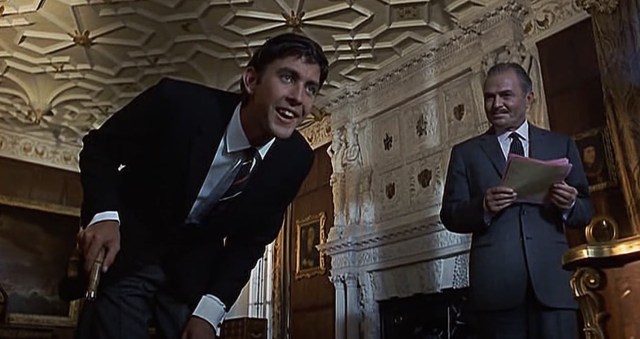
Fox, who really found himself after coming back from a years-long sabbatical to star in “A Passage to India” over a decade later, and John Alderton (later of “Calendar Girls” and TV’s “Little Dorrit”) are Stefane and Antony, disaffected sons of a sketchy British millionaire (Mason) who holds both of his sons by different mothers in contempt.
Stefane is wily and cunning, but a slacker in a Mick Jagger mop of hair and all the latest Mod London fashions. Antony?
“You’re a moron, aren’t you?”
They get wind of a shady money-moving transaction from Tangier to Geneva via Marseilles, a debt the hated old (not that old) man isn’t in a hurry to pay, so he’s sending it via a small passenger vessel his shipping company owns.
A little “piracy” is in order. But it’s Stefane’s free-love “bird” Segolene (York) who suggests this character “Duffy” they once crossed paths with. There’s nothing for it but to fly to Tangier, lounge on the beach and let Segolene bait the “wilder, cooler, more mentholated” retiree with the big toothy grin into joining their scheme.
“Gonna be a groovy little happening, man,” Stefane promises.
Duffy warns them they “might have to shoot people,” but he’ll be the only one with a Luger. The ploy Stefane cooks up will entail a purpose-built Moroccan getaway boat, scouting trips, lots of disguises and a whole lot of Segolene bouncing from Stefane to Duffy and back again.
The older man doesn’t take this well, calling her every sex worker name in the book.
“I may be a hooker; I am absolutely not a slut.”
Coburn’s “trying too hard to be hip” runs through his ’60s action comedies, and this film has him in a khaftan, reflecting on the Muslim call to prayer, disguised as an Arab shiek, taking hits off a joint and saying “groovy” about seven times too many.
Parrish wrote a wonderful memoir about growing up in Hollywood, and got his start as a child actor in the ’30s, moved into editing and won the Oscar for the boxing classic “Body and Soul.” But he was never any great shakes as a director. He did a lesser Peter Sellers comedy, the bullfighter/lover farce “The Bobo,” and he a hand in the magnificent debacle “Casino Royale” (1967), sort of the ultimate “Hollywood trying too hard to be hip” comedy of the age.
Under Parrish, “Duffy” doesn’t really find its groove until we swing into the caper, which the under-whelming screenwriters deliver without a lot of detail in the “case the joint/plan-the-heist” scenes. That works to the film’s advantage, as that act of piracy has some amusing surprises.
Whatever their excesses and failings, the cinema of the ’60s produced lots of caper films — from “Ocean’s Eleven” to “Gambit” to “The Italian Job.” And while “Duffy” isn’t “Topkapi” or “How to Steal a Million,” it’s close enough to the latter to almost get by, held in higher regard than Coburn’s “Dead Heat on a Merry Go Round”
And Coburn? For all his character’s try-to-sound-young banter, he gets into a fine, toothy dudgeon over these rich dilettantes, sending coffin builders and “caucasian” corpses to his Tangier address, taking risks in their carefree way, grooving to whatever it is they’re grooving to as they use Duffy’s expertise to pull off a £million job on the Mediterranean in that more innocent but about to turn cynical time.

Rating: TV-PG
Cast: James Coburn, Susannah York, James Fox, John Alderton and James Mason.
Credits: Directed by Robert Parrish, scripted by Donald Cammell and Harry Joe Brown. A Columbia release on Tubi.
Running time: 1:40


 Movie Nation