
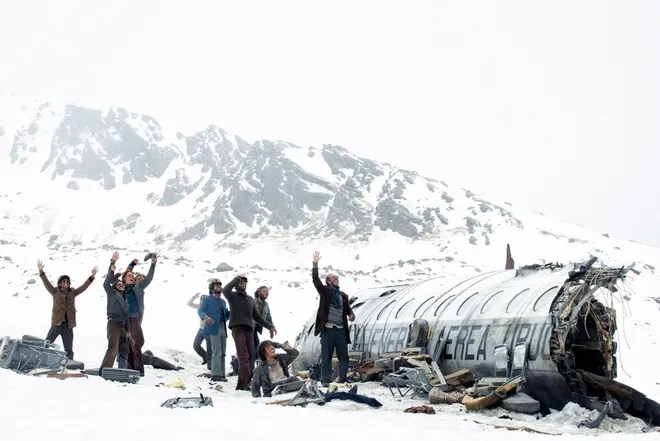
Perhaps you run into the same reservation I do when considering Netflix’s latest version of the Andean survival epic “Society of the Snow,” a new retelling of the harrowing survival story immortalized in the non-fiction book “Alive,” the terrific 1993 film of that title, as well as good documentaries including 2007’s “Stranded” and 2010’s “I Am Alive.”
We’ve seen it. We know the story. It’s pretty grim. What could any new version of it accomplish, beyond improvements in “realistic” plane crash effects, more gruesome versions of butchering and consuming human flesh, and re-rationalizing what the young Uruguayan rugby players resorted to in order to survive their ordeal? Cannibalism?
Some of those reservations are warranted. Director and co-writer J.A. (Juan Antonio García) Bayona made his big break with the Spanish horror film “The Orphanage,” and the crash depicted here is so jarring and realistic that it’s a relief one doesn’t have to sit through it in a theater. We see bones and necks snap, hear the screams and share a horrific hint of the terror of that Oct. 1972 moment when a Uruguayan Fairchild turboprop airliner clipped an Andean mountain.
“Alive” did a better job of depicting the grim gravity of eating human flesh.
Facts are changed, lies are ignored and the female victims and non-rugby-players among the 45 passengers have no voice, no backstory.
But Bayona also made one of the most visceral and moving survival epics in film history, the tsunami story “The Impossible.” He tells this tale of battling impossible odds with compassion and an empathy that make it quite moving at times.
Bayona hangs his narrative upon the connection between two 20something players, team “star” Roberto (Matías Recalt), a med student, and his best friend and teammate, Numa (Enzo Vogrincic), in law school, reluctant to skip exam prep and make this team trip from Montevideo, Uruguay to Santiago, Chile.
Roberto talks Numa into making the trip, “our last chance” before college and careers tear them apart, he argues.
Numa is our narrator.
“This a place where life is impossible,” he narrates (in Spanish with subtitles, or dubbed into English), after the shock of the crash has abated, the stunned realiztion of their plight has set in and the trauma of those already dead or grievously-injured hangs over their every action.
Some insist help is “coming, tomorrow.” Others wonder “How many are going to die tonight?” after their frigid first night in subzero cold further thins their ranks.
Graphics memorialize those killed in the crash, others who die in the cold or bleed out from their injuries and those who perish in an avalanche that consumes the wingless, gutted fuselage days later. Every few days, the toll grows.
And as the food and drink (but not the cigarettes) run out, they consider “the rule of three.” One can survive “three minutes without air, three days without water, three weeks without food.”
The last “three” is troubling to some as they recognize the calories they’re burning in extreme cold, the way that impacts the brain, and how that will determine how long they survive if they aren’t rescued. They will never have the strength or mental sharpness to rescue themselves by walking out of this frozen, high altitude hell.
“If I die,” first one and then others say, “I give you my permission to feed on my body.”
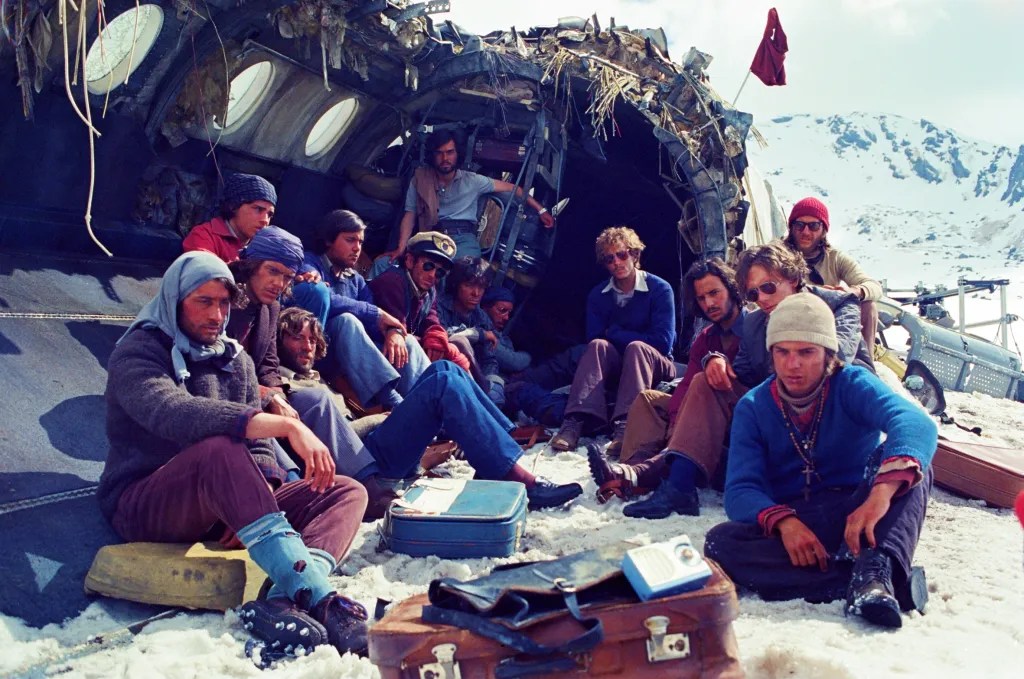

Bayona does a great job of demonstrating the helplessness of their situation. The youngest are the most likely to survive, and they’re the least experienced at life or anything remotely like “working the problem” such a dilemma presents.
The duress they’re under even as they try to start saving themselves can’t be overstated. As the great historian David McCullough always said of figures from the past, “They don’t know how this is going to turn out.”
The geography of their plight — a high plateau, boxed-in by towering mountain peaks, any “valley” taking them to safety many days of grueling hiking away — has never been more stark than it is here.
That limits one of the chief appeals of such survival stories, second-guessing those who lived through it. I’ve attended survival courses (in Alaska) as a journalist, and I was as stumped as these 20somethings must have been about what they could or should do. Not knowing if help might come, they don’t act quickly to set out for safety. Not acting quickly weakens one and all. By the time that fateful decision has been made, they’ve already resorted to cannibalism just to keep their strength up.
That titilating taboo is why filmmakers and writers keep coming back to this story, and explains the public’s appetite (sorry) for it. But in previous eras, shipwrecked sailors would rely upon “the custom of the sea” as their rationale for doing whatever it takes to live long enough to tell the tale. It’s long been shocking, but it’s not unheard of.
Aside from, you know, realizing that the lighters that lit their many cigarettes could also burn whatever was burnable in an effort to create warmth and smoke that might alert rescuers where they were, there isn’t much that readily suggests itself as a “Why didn’t they” solution to altering their fate.
As Old Christian Rugby Club characters try to extract “meaning” from their suffering and the deaths of their friends and family, Bayona makes his case that collective decisions, “brotherhood” and accepting what they had to do was what saved those who lived through this 1972 tragedy.
That’s a novel take on the subject, one that might have been better served had some of the pertinent facts from their group response to how they survived been included in this still-quite-good dramatic recreation. No they didn’t want to admit how they didn’t starve to death, and being under mass media assault after their rescue didn’t help.
Bayona reminds us that a half century of remembrances of an event that still draws our attention, and darkly comic punchlines, tells us that as awful as most of what happened was, some deeper bond was in play here as well, one that “You had to be there” to wholly understand.

Rating: R, violence, subject matter, profanity, smoking
Cast: Enzo Vogrincic, Agustín Pardella, Matías Recalt, Esteban Bigliardi, Diego Vegezzi, Esteban Kukuriczka, Andy Pruss, Francisco Romero and Rafael Federman
Credits: Directed by J.A. Bayona, scripted by J.A. Bayona, Bernat Vilaplana, Jaime Marques, Nicolás Casariego, based on the book “Society of the Snow” by Pablo Vierci. A Netflix release.
Running time: 2:24


 Movie Nation