
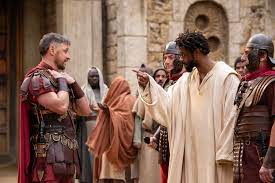


“The Book of Clarence” is no mere lampoon of the belief system based on a persecution, blood sacrifice and murder by the state origin story.
It’s a retelling, resetting and often amusing examination of “knowledge” vs. “faith,” the nobility of a religion with “kindness,” “charity” and love folded into its teaching, and the inability to “know” what went down 2000 years ago in a place with no cell phones to record and stream events as they actually happened.
It is distinctly British and univerally Black. And in a time of open and “quiet-part-out-loud” white racist Christian-Nationalism, it’s downright bracing.
It’s no accident that British writer-director Jeymes Samuel opens his film with a crucifixion, a nod to Britain’s most infamous and hilarious send-up of Christianity, “Monty Python’s Life of Brian,” which ended with a comical take on that gruesome form of execution. Samuel treats it dead seriously, if not as piously as Mel Gibson — who allegedly filmed his own hands driving in the spikes — in “The Passion of the Christ.”
That sets the tone for the movie. “Clarence” is sometime silly, but just as serious-minded as can be, irreverant, but never really what any serious person would describe as “blasphemous.”
LaKeith Stanfield has the title role, that of a hustler, a chancer and seller of smokeable “herbs” in the Lower Jerusalem of 33 C.E. We meet he and his running mate Elijah (RJ Cyler of “Me and Earl and the Dying Girl”) as they’re chariot racing that resident badass, Mary Magdelene (singer/choreographer/actress Teyona Taylor) along the cliffside, cobbled streets of Jerusalem (Italy), and losing.
A blow-dart armed gang calling itself The Gypsies, led by a runt (Chase W. Dillon) proves their undoing.
Facing their financial back, the loan shark and gang leader Jedidiah the Terrible (Eric Kofi-Abrefa) is too much to bear, at the moment. His sister, Clarence’s crush (Anna Diop) can’t help. Perhaps all these insults from Clarence’s twin brother and his mother (Marianne Jean-Baptiste, stunning here, famous for “Secrets & Lies” and “Without a Trace”) have some advice he can actually use.
This “nobody,” as his twin, the Apostle Thomas, follower of Jesus of Nazareth labels him, needs to “Be the body, not the shadow,” his mother tells him. Do SOMETHING of note and noble import.
That’s how Clarence, “the village mischief maker” decides to become “the 13th Apostle.” First problem? He doesn’t know how to pronounce “apostle.” The “T” is silent, mate. But there’s a bigger issue.
“God doesn’t exist,” Clarence insists. This “Jesus” fellow is a “false prophet” who does “tricks.”
As that kind of rules out his inclusion in the crew that includes “doubting” Thomas and Judas Iscariat (Michael Ward, slick and sinister), perhaps Clarence should study this “messiah” hustle and set himself up as one. He will sell his version of a holy creed.
“Knowledge is greater than belief.”
And as he’s seen “all the MONEY they (Jesus & Co.)” take in, he will settle his debts by fleecing the gullible.
“I’m just playin’ the cards I was dealt.”
Writer-director Samuel, no longer going by his nom-de-music “The Bullits,” gave us the mixed-bag Black Western “The Harder They Fall.” “Clarence” similarly sends-up Biblical epics (titles and credits resemble “The Ten Commandments” — the movie, not the tablets). But Samuel’s aim is higher and more sure this time, a parody that turns to satire as it speaks to Greater Truths and comments on the Black experience in the White Western world today.
When a Black mother wails that brutish white Romans (Tom Glynn-Carney, Thomas Vaughan-Lawlor and most venomous of all James McAvoy) are “always taking our babies,” she isn’t just talking about ancient Romans.
“Clarence” is a flippant film of group dances and herb-peddling on the streets, of stonings and smokers floating into the ether at the hookah joint, of everybody complaining about everybody else’s “smell,” and of a hero who resents just how many people he knows pronounce his name as “one syllable.” “Clairnce.”
Omar Sy is ferocious as Barabbas, a figure spared crucifixion while Jesus is sacrificed in the Bible, here an enslaved gladiator who considers himself “immortal” save for a particularly vulnerable “heel” (Wonder where he, or writer-director Samuel, got that idea?).
David Oyelowo is hilarious as a slap-happy John the Baptist, who will drown a “Negro” disbeliever, especially if he really needs a bath.
Alfre Woodard makes a warm, wise and wry Mother Mother, whom Clarence consults to see just how her boy Jesus does his “tricks.”
“My dear child, find faith and you will find all of the answers you need.”
Samuel’s film is an embarassment of acting riches, laugh-out-loud funny when it wants to be and thought-provoking when it dares to be. It tests “faith” and forces us to consider the Black experience of Christianity even as it embraces a more rational approach to belief than one offered by the Black church, and indeed the white one.
And Stanfield, by turns droll, wry, thoughtful and soulful, makes a grand tour guide for this satire and study of a value system — kindness, compassion, charity — that has more value for its true believers than dogmatic demands of “belief.”
He may be a “false prophet.” But this Clarence fellow and his “Book” are well worth mulling over.

Rating: PG-13 for strong violence, drug use, strong language, some suggestive material, and smoking.
Cast: LaKeith Stanfield, Omar Sy, RJ Cyler, Alfre Woodard, David Oyelowo, Anna Diop, James McAvoy, Marianne Jean Baptiste, Michael Ward, Teyana Taylor, Eric Kofi-Abrefa and Benedict Cumberbatch.
Credits: Scripted and directed by Jeymes Samuel. A Sony Tristar release.
Running time: 2:16


 Movie Nation