



Steven Spielberg mentioned in interviews over the years how a Cecil B. DeMille epic from the early 1950s changed his life. The spectacle, the larger-than-life presentation and the special effects of “The Greatest Show on Earth” turned little Steven into a kid who wanted to do his own effects and make his own epics, something recounted in his autobiographical drama “The Fabelmans.”
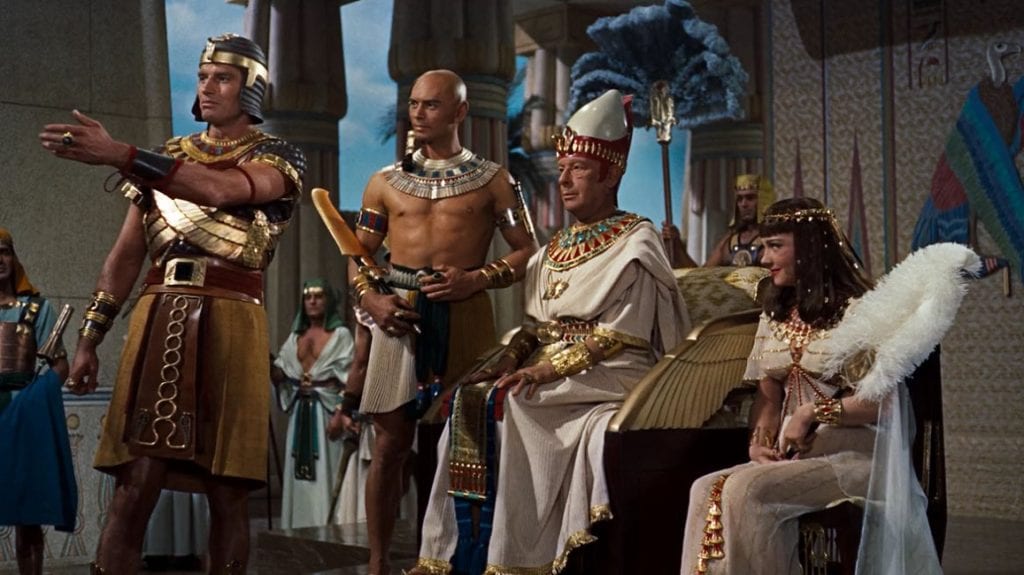
I was reminded of that this Sunday morning as I caught a rural Southern Baptist church’s pastor relate how DeMille’s “The Ten Commandments” was his idea of “The Greatest Show on Earth,” the greatest film of his youth, never challenged or “topped,” in his mind since.
These church services are the Sunday AM background noise on my monthly visits to my aged mother in North Carolina’s piedmont, which used to be tobacco farming and textile manufacturing country, and hasn’t entirely emptied out despite that cash crop and that factory work shrinking or disappearing, sending ensuing generations away to find work, college and different lives in cities near and far.
Shrunken towns all over this corner of the South point to how rural America has aged and in many cases curdled politically as the best, brightest and youngest moved away.
A college job I had was working Sundays at a college town radio station that broadcast a collection of (paid promotion) church services, and I learned way back then that not all “fundamentalist” rural Southern pastors are the same. One that sticks out in my mind was an Apartheid-backing racist, who made me cringe Sunday after Sunday. Another was a young, passionate “spirit-filled” lay preacher who’d come into the studios with a few of his flock, who’d be moved to tears by his sincere exhortatations.
I’ve been moved a couple of times to post on Pastor G. Barry Chambers’ Mount Harmony Baptist Church of Rougement, N.C. Facebook page about some obvious lie or propagandistic nonsense he was spouting on a given Sunday. “Conservative” doesn’t quite do justice to his politics.
But this Sunday, he moved me to fact-check him. Here.
In his “Ten Commandments” recommendation, Pastor Chambers tossed in an aside about the Southern Protestant saint, Billy Graham.
“Billy Graham was offered the part of Moses,” Chambers said. “Blank check,” name his price to play the part, Chambers added. “Turned’em down, flat.”
I apologize to my elderly mother, who may have overheard my epithet in response to that load of codswallop.
But considering the politics of Graham — an anti-communist zealot, “fluffed” into prominence by reactionary newspaper publisher William Randolph Hearst — and those of ultra-right-wing DeMille, whose 1956 “Ten Commandments” is laced with anti-communist messaging, it is within the realm of possibility.
Graham, as those who covered him most closely (newspapers in Charlotte, near his birthplace) noted, kept his nose clean and his ministry above reproach financially and morally (Mike Pence got his “never be alone in a room with a woman not your wife” thing from a Graham ministry edict). But he was, as the late columnist Frye Galliard noted in a profile, a “star-f—-r” of the first magnitude. He loved rubbing shoulders with the powerful, most of them reactionary, one of the most infamous of whom was Richard Nixon.
I interviewed several folks from a famous protest of a Graham/Nixon joint appearance at the University of Tennessee when that notorious event’s anniversary came up while working at a Knoxville newspaper some years back. Graham, to his credit, seemed to learn from that experience, when an amoral politician used him to legitimize his crimes with “the silent majority.” He kept most politicians, save for Reagan,at arm’s length after that.
More recently, I had to study up on Graham before interviewing Armie Hammer, who before he got famous as an actor played young Billy as a student at Bob Jones U. or whatever the school was called back in the ’40s. Hammer later got a shot at “The Lone Ranger,” “The Man from U.N.C.L. E.” and “Call Me by your Name” before his kinkiness got him “canceled.”
DeMille, you might remember from John Ford biographies and the memoirs of Hollywood editor turned director Robert Parrish, famously pushed loyalty oaths and efforts to blacklist Hollywood stars and filmmakers, aiming for some sort of right wing “coup” overturning the Hollywood heirarchy, which rarely gave him his due. His zeal to back up the infamous U.S. House of Representatives’ “Unamerican Activities Committee” efforts to censor, silence and render unemployable pretty much all of Progressive Hollywood was petty and personal in that regard. John Wayne and his lacky/sidekick Ward Bond were in on this, a form of “revenge” against their Hollywood “betters” reminiscent of a certain treasonous ex-president and his cult.
Ford, Wayne’s favorite director and mentor, famously stood up to DeMille’s “anti-American” witch hunt in a 1950 meeting of Director’s Guild of America members.
But was DeMille interested in casting Graham as Moses the Lawgiver? DeMille allegedly considered a lot of people, Burt Lancaster among them. He wanted William Boyd, who had acted in the DeMille silent epic “King of Kings” decades before he became Saturday morning movie serial and later TV cowboy (when those serial films were televised) Hopalong Cassidy.
Billy Graham’s name never came up.
But Pastor G. Barry Chambers didn’t invent this out of whole cloth. What he appears to have exaggerated was related to this reference in Graham’s autobiography, as reported in the L.A. Times in the 1990s. DeMille DID meet with Graham, but to suggest some sort of business collaboration, as Graham was starting up his own film production company at the same time.
Graham was a pioneer in faith-based movies in the ’50s into (at least) the ’80s. There were times that my rural Virginia Boy Scout troop was called in to act as voluntary ushers for these “crusade” based films. The stories were often modern parables of a struggling life made better by answering an altar call at a Billy Graham crusade (in the third act).
The Graham-as-Moses notion could be a simple mistake, but feels like “lore” and a fact-based message muddying over time, conveniently bent to fit a small town pastor’s agenda.
As no movie-lover in the good reverend’s flock was able to fact-check him in real time (a LOT of preachers could use that, from my experience), the least a film fan can do is provide that service, with links — “receipts,” as the kids say — here on the Internet.


 Movie Nation