



Ernest Hemingway was famously grumpy about film adaptations of his novels, and the mere brevity of the first screen version of “A Farewell to Arms” must have raised his ire.
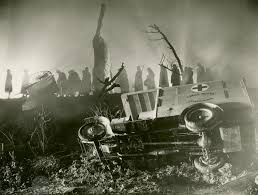
But Frank Borzage, the first two-time Best Director Oscar winner, gives us an Expressionist montage for the ages in the film’s third act, five solid minutes of Lt. Frederic Henry’s AWOL escape through the northern Italian combat zone.
The newly-restored film serves up smoke and fog, wounded men in close-up and silhouette stumbling towards through the dark towards the rear, armored cars and wrecked ambulances and bodies and stylized horrors, air raids and the like. This black and white nightmare has a chilling immediacy and it adds credibility and an artistic touch to what feels, from the very start, like one of the most adult, uncluttered and spare Hemingway adaptations.
Borzage, an actor’s director who did “Bad Girl,” “Seventh Heaven,” the terrific anti-Nazi thriller “The Mortal Storm” and the jolly stars entertaining the troops “Stage Door Canteen,” doesn’t do much to keep the incongruous pairing of the towering Gary Cooper with the petite, 15 inches shorter Helen Hayes from looking like a sight gag in a couple of walking and talking scenes.
But we don’t mind because Borzage and the screenwriters give us a streamlined plot that zeroes in on the characters. The film was also based on an uncredited 1930 stage adaptation that narrowed the tale’s focus. Building on that, Borzage lets the cast give this romance set against the epic tableaux of war an intimacy that allows Cooper and Hayes to just break your heart.
The story has a pre-Production Code edge to it, with pregnancy out of wedlock, an English nurse (Hayes) who “gets in trouble” thanks to a handsome young American ambulance officer (Cooper) who impulsively seduces her, impulsively tells her he loves her, impulsively turns his ambulance around on the way to the Front to come back to reassure her it wasn’t just a “conquest,” and impulsively goes AWOL from a combat zone to track her down after she’s gone to Switzerland to have their baby.
There’s a live-for-the-moment immediacy and resignation to the story and the performances that gets at the fatalism of life and love in a war, where promises that “I’ll never get hurt” ring hollow, where Catherine’s jaded friend Fergy (Mary Philips) has a better grasp of what’s happening here, this nurse’s creed that “we must bring solace to the men who fight” that’s perhaps gotten out of hand.
“You’ll never get married. Fight or die, that’s what people do” in places like this.
Taking its inspiration from Hemingway’s own experiences driving ambulances in the Italian/Austrian campaign, the film gives us just enough combat sequences — barrages and bombardments, hospitals, advances and retreats — to be credible. The story’s really about a young man’s first real love and a (slightly) older woman’s touching, reluctant acceptance of that at face value, because of the combat crucible this romance comes to life in.
Hayes makes us believe Catherine’s leeriness of Lt. Henry, her sad love-in-wartime recognition of what’s happening and her grim embrace of this man and this affair, because losing a fiance at the Somme taught her that life is as impermanent as it gets in war.
Cooper, very young (just a year younger than Hayes) and not yet settled into his relaxed, folky persona or the stoic hero he became in his 40s, was never more vulnerable than he comes off here. The smitten earnestness feels real, the irresponsibility that has him abandon his duty seems almost heroice.
Adolphe Menjou, who’d make his greatest mark on screen in another World War I film, Kubrick’s “Paths of Glory” twenty-five years later, plays Capitano Rinaldo, a rakish Italian surgeon who loves having the American along as his wingman, comically calling himself “your best friend and your war brother” right up to the moment Henry steals the fetching Catherine away from him.
Rinaldi’s reaction to their love affair is masked in nobility, looking out for his cannot-afford-to-be-distracted “war brother,” but has a sinister romantic sabotage feel.
The film’s simplified plot and cast of characters, coupled with all the information, symbolism and emotion Borzage gets across in that epic combat zone montage allowed the director to manage something few other filmmakers did — make a movie as spare, stark and moving as Hemingway’s prose, not so much the definitive “A Farewell to Arms” as a movie that “gets” the novel and delivers it without a single minute of screen clutter getting in the way.

Rating: unrated, fairly adult for its time
Cast: Gary Cooper, Helen Hayes, Mary Philips, Jack La Rue and Adolfe Menjou
Credits: Directed by Frank Borzage, scripted by Benjamin Glazer and Oliver H.P. Garrett, based on the novel by Ernest Hemingway. A Paramount release on Roku, Tubi, Plex, etc.
Running time: 1:28


 Movie Nation