

What a curiosity Bogart’s “Sirocco” is, a “bizarro” “Casablanca” that mirrors Humphrey Bogart’s definitive romantic lead performance, but sees this American meddling in the Middle East as an amoral cad, precisely the way noble cafe owner Rick Blaine described himself in covering up his past and not “getting involved” back at the Cafe Americain.
It’s so much like “Casablanca” that it could be a prequel to it — it’s set in 1925 Damascus, not Occupied Morocco on the cusp of Pearl Harbor — or a sequel, with an older, even more jaded Rick smoking through his bitter years, running guns to the Arab revolutionaries in French colonial Syria.
“Conspicuously lacking in charm,” a critic of the day called it.
But German-expat Curtis Bernhardt directed it and “All the King’s Men” and “A Lonely Place (later “From Here to Eternity” and “Bonnie and Clyde”) cinematographer Burnett Guffrey bathed the casbah, clubs and catacombs of Damascus in “Third Man” gloom and shadows.
And the cast, the mere fact that Bogart is in it just before his “African Queen” triumph, make this not-quite-a-classic worth a look.
After “The Great War,” the European Powers and Japan gobbled up German colonies and divvied up the former Ottoman Empire. That’s how France came to control Lebanon and Syria, with its ancient capital of Damascus not just a destination of the prophet Paul, but of Lawrence of Arabia.
But the Arabs who fought alongside Lawrence to free themselves from Turkish domination weren’t having this “mandate.” They fought it.
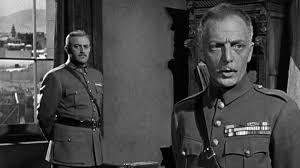
Everett Sloane of “Citizen Kane” plays Gen. LaSalle, the embattled officer in charge, struggling to keep the city under curfew — restricting goods from getting in or out, including guns.
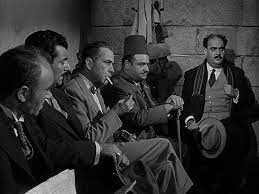
Lee J. Cobb is Col Feroud, his intelligence chief, who summons the major traders — above and below board — to his office for a little persuasion. That’s how we meet such “businessmen” as Balukjiaan (a very young Zero Mostel) and this name-changed American, Harry Smith, a doughboy who went AWOL, went wrong and went underground after The Great War.
Harry (Bogart) is “an American in Damascus with no morals, no political commitments,” Feroud notes. Harry won’t give him any trouble.
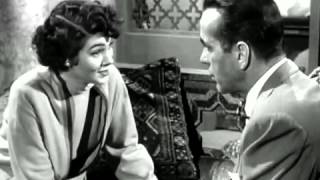
But there’s this dame, see? Feroud’s “girl” (Märta Torén) was brought here from Cairo with him, and we’d assume she’s his wife, except well, they are French. Violette wants out, and in the worst way. Harry, being a chancer, spies that in an instant.
“How can a man so ugly be so handsome,” Miss Half his Age wants to know?
When he “saves” her after a terror bombing at the hot club in town, Moulin Rouge, she remembers. And he takes liberties. He’ll get her and himself out, no matter what her “ceasefire” preaching, high-minded negotiator, woman-slapping beau says.
“I’ll KILL you if you try to leave me!”
Harry finds himself making bribes, dodging the French and scrambling underground, trying to play all the angles between the revolutionary Emir (Onslow Stevens) and those “murdering” French.
Bogart had just turned 52 when the film came out and he and his Santana production company produced “Sirocco.” As the new biography “Bogie & Bacall” lays out, he was straddling the tail end of his romantic lead years, trying to cash in before character leads (“Treasure of the Sierra Madre” was a triumph a couple of years before) were all that was left to him.
He needed an easy hit, but no matter how redolent of “Casablanca” this was, this wasn’t it.
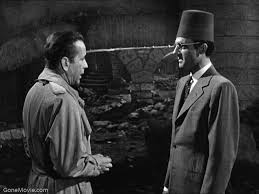
With every cigarette, every time he dons a trench coat, every exchange with shifty characters in fezes, Bogart leaned into what was already his iconic image — shaped by “Casablanca.”
The whole playing against Rick turn of the plot remains fascinating. Rick is noble, sacrificing love for doing the right thing. Harry is Rick’s cynicism cut loose, his opportunism mirroring America’s in the Korean years of the Cold War. He’ll do what he pleases, whatever is expedient. He’s take the Frenchman’s “girl” in a heartbeat, cash in when he can and flee, leaving the Middle East a bigger mess than he found it.
I got a kick out of Mostel’s kvetching and kvelling his way out of a jam, of reliable Greek-American character actor Nick Dennis as Harry’s rough and tumble partner and out of soon-to-be-veteran character actor Jeff Corey (“True Grit” decades later) showing up as an Arab middle man pricing out safe passage for Harry and “the girl.”
Yuma, Arizona, and some convincing Columbia Pictures soundstage “Roman catacombs” give the picture a whiff of authenticity, but only a whiff.
The film’s darkness and fence-straddling cynicism make it an interesting companion piece to “Casablanca,” whose villains were clear cut, whose desperation was palpable and whose romance was one for the ages. A lighter touch may have been called for here. But nobody involved, especially not Bogart, just past his peak and starting to notice it, was in the mood.

Rating: “approved”
Cast: Humphrey Bogart, Lee J. Cobb, Märta Torén, Nick Dennis, Zero Mostel and Everett Sloane
Credits: Directed by Curtis Bernhardt, scripted by A.I. Bezzerides and Hans Jacoby, based on a novel by Joseph Kessel. A Columbia Pictures release on Tubi, Youtube, Amazon etc.
Running time: 1:38


 Movie Nation