

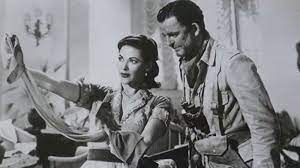
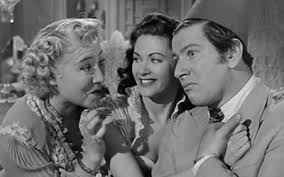

Decades of “Munsters” reruns may have become Yvonne De Carlo‘s legacy in the public eye. But there was a lot more to her and her career than the comic timing and exotic, too-beautiful-for-this-lot pigeon-hole that television stuffed her into.
They lady was a bonafide triple threat. a singer and dancer who could act, “Salome, Where She Danced” on screen and the defiant lady of a certain age who introduced Sondheim’s defiant “I Am Still Here” (“Follies”) on Broadway.
Historians call her supporting role in “The Ten Commandments” her most celebrated film performance. Others may remember her for providing a sexy romantic rival to Maureen O’Hara in John Wayne’s “McLintock.”
But one of her best showcases has to be “Hotel Sahara,” a rare film venture overseas, a British WWII comedy she filmed in 1951.
De Carlo sings! De Carlo dances with the veils! De Carlo FLIRTS! With Germans, Brits, French and Italians!
The Hotel Sahara is a Libyan hostelry owned and operated by the rakish opportunist Emad (Peter Ustinov), who sees part of his duties as keeping the lady visitors “entertained” — even the married ones.
His fiance, Yasmin (De Carlo) barely puts up with this. But she’s got her mother (Mireille Perrey) with her, and a nice place for both of them to stay. Her fury at this philandering will have to wait.
The darkest day for the sandy oasis hotel comes in June of 1940. Italy joins the war, which causes the guests to flee in a panic and Emad to despair of losing all he has invested in this remote resort in Italian-annexed Libya.
He has no idea. OK, he has SOME idea. He is a native and a hotelier, after all.
First come Italian soldiers and their love of chianti, spaghetti bolognese, and their lust for Yasmin.
Then come the Brits, who at least share their yen for Yasmin with the Italians they’ve chased out. They’re followed by the Germans, officious but also smitten by the singing belly dancer in their midst. And on it goes.
The sound-stage-bound comedy — supposedly there was location shooting of cars and trucks and armored personnel carriers and camels indoors in Egypt — is all about switching the allegiances and decor and dining in the skeleton-staffed hotel for every new arrival.
The lobby photo is changed from Il duce to Der Fuhrer to Churchill, etc. A fresh flag is run up the flagpole. The menu and the nature of the flattery and music is tailored to each new conquereror.
Emad kvetches. He grumps at the turnabout that has fhis fiance coming on to the customers to save “the business.” That’s exactly what he told her way back when.
“We are hostages of fate!” he complains.
The Italian capitano (Guido Lorraine) explains the nature of war to the hotelier as that of dogs fighting over a bone.
“One snatches it. He does not want it, but he snatches it for fear the other will get it first.”
Emad has to defeat efforts to blow the place up when one occupier flees as another is seen on the horizon. And he has to try to maintain some semblence of a business. Every hasty departure sees him rushing up to the loaded-up commanders and their troops as they start to leave.
“Please, please!” He pauses for a dramatic beat, handing over a slip of paper. “The bill!”
The Brits (David Tomlinson, most famous for “Mary Poppins” and “Bedknobs and Broomsticks,” and Roland Culver of “Thunderball”) and the Germans (Albert Lieven of “The Guns of Navarone”) scheme for advantage with the locals.
“Ze Arabs in zis part of ze desert, are they friendly?” the German asks the Arabic major domo Yusef (Ferdy Mayne, a hoot).
“Oh, very friendly” the Arabic Yusef effuses to the “effendi.” “They only kill Christians!”
The entire enterprise, bent on keeping the various warring parties from actually “meeting” at the hotel (and fighting over it and destroying it) descends into door-slamming, pistol-shooting, booby-trapping farce by the third act.
World War II was still fresh enough in the British mind to make “Hotel Sahara” almost daring (check out the opening credit, meant to allay anyone taking a offense) in its comic take on the North African campaign.
It’s a dated comedy, with the Arabs played by British actors in blackface and as trigger-happy stereotypes. But those extend to national/European “types” as well, in a sort of equal opportunity insult. Brits, Italians, German and French get backhanded a bit a well.
At some point, opposing sides will dress up in Arab garb (more Saudi than Sahara) to “reconnoiter” the other.
“Tell Emad NOT to use that washroom,” the various racists commanders insist as they flee The joyless Germans fuss that the sexy Yasmin wear a “more modest costume,” etc.
Each conqueror arrives to culturally appropriate music — “Ride of the Valkyries” for the Germans, “Funiculì, Funiculà” for the Italians, etc.
And each fresh intruder earns an “Ooo can they be this time?” lament from Emad, who frets over surviving with his hotel, his finances and his fiance intact.
The Germans, let it be noted, are the only “guests” to ASK for the bill. Not that they pay it with anything but a swastika rubber stamp. Nazi deadbeats. They never change.
And through it all, the Canadian-born De Carlo schemes and sings and swims (in the oasis, silly) and dances in a comedy that jauntily skips by, one of the first films to treat the deadliest conflict in history as “Just a spot of sport, old sport.”
Director Ken Annakin would go on to contribute direction to the D-Day epic “The Longest Day,” but is best remembered for the all star farces of the ’60s, “Those Magnificent Men in their Flying Machines” and “Those Daring Young Men in their Jaunty Jalopies.”
Ustinov would enjoy a grand career as stereotypical bon vivant in films from “Spartacus” and the 1970s Agatha Christie Poirot adaptations that predeced Sir Kenneth Branagh’s recent remakes.
And Yvonne De Carlo would work steadily on stage, screen and most famously, on the tube as Lily Munster, an exotic vamp finally given the fangs and the sense of fun that Golden Age Hollywood almost never would.

Rating: TV-14
Cast: Yvonne De Carlo, Peter Ustinov, David Tomlinson, Albert Lieven, Mireille Perrey, Roland Culver, Bill Owen, Guido Lorraine, Anton Diffring and Ferdy Mayne.
Credits: Directed by Ken Annakin, scripted by Patrick Kirwn and George H Brown. A United Artists, GFD and J. Arthur Rank release, now with Cohen Media Group on Tubi, Amazon, etc.
Running time: 1:27


 Movie Nation