
For a filmmaker who came from the world of editing to create a string of visually striking films, several of them epics and more than a couple regarded as masterpieces, “Madeleine” stands out as a venture that wasn’t as “David Lean” as one might like.
It’s a period piece, and a 1950 melodrama that evolves into a courtroom drama, based on an original script that set it firmly in the era Lean had proven most comfortable — Dickensian/Victorian Britain.
One can’t help but notice its Hickcockian touches — a suspicious death, a desperate suspect who could have been a Hitchcock blonde, incomplete visual evidence of her connection to the crime and a trial that serves up a surprise or two amidst its sometimes tedious details.
“Madeleine” feels like lesser Hitchcock in the viewing, though the visuals manage a Lean touch, here and there. But for a Lean completist, it’s fascinating to see him try to match “The Master of Suspense” in a dry, intimate romance-gone-wrong tale.
Ann Todd, fresh from Hitchcock’s “The Paradine Case,” has the title role, that of a pretty young woman of middle class affluence in 1850s Glasgow. Her father (Leslie Banks) has some notion she’ll marry a suitor of her station, preferably the kind and patient and monied Mr. Minnoch (Leslie Banks).
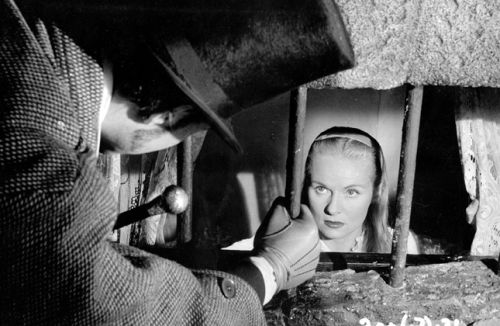
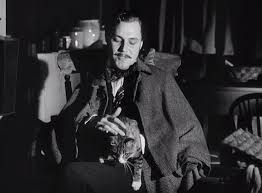
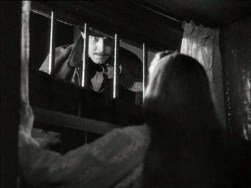
But being a headstrong (not really) lass, Madeleine Smith fancies this rakish, mustachio’d Frenchman. L’Angelier (Ivan Desny, preening and controlling) sees her after the rest of the family has gone to bed. We don’t know how they met, only that he swept her off her feet. A dandy with a cane that he rattles across the bars of her basement window, he is a wage worker who dresses well with an idea of marrying well.
We figure this out long before poor Madeleine. He is a seducer, an advocate of a secret “engagement” and of her thinking of herself as already his “wife.” If only she’ll broach the subject with her father.
She won’t. She even comes to Emile and begs him to take her away, and that’s where he lays it all out for her, as she’s the last one to get a clue.
“If we marry, we marry into YOUR life, not mine.”
When she makes the break, which she must, he has letters of proof of their affair, a framed photograph. She’d like to get them back and be rid of him once and for all.
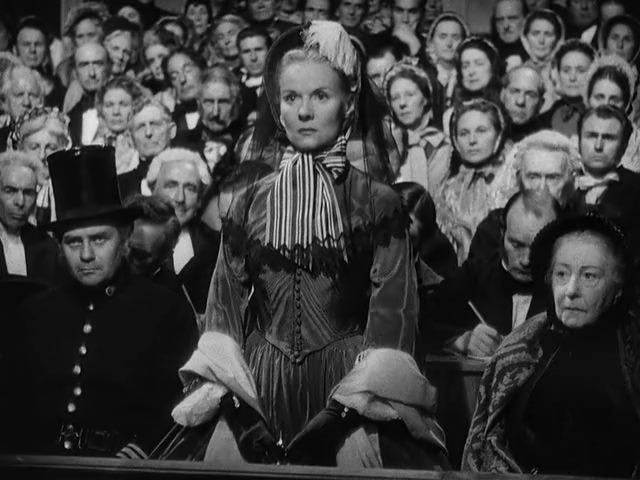
Which is why when he dies, she falls under suspicion and becomes Suspect One.
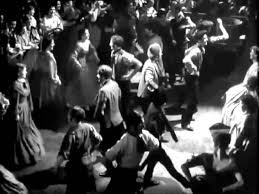
Lean handles all this as deftly as anything this action-starved can manage. There’s a ponderous Scots-accented narration that frames the picture, with a couple of moments of Scottish piping and Scottish dancing to give us a parallel “highland fling” going on across the way as Madeleine and Emile have their own highland fling.
The story’s Glasgow Scottishness is mostly an afterthought, unless you take into account the highlands’ mistrust of the French.
There are some arresting images, but not enough to think of this as one of Lean’s black-and-white beauties. One striking moment has a street preacher inveighing against the sins of the wealthy during Madeleine’s trial. It stands out because much around it is so staid and stale.
One never loses the feeling that subtexts and psychology — personal and Scottish — aside, this is lesser Lean.
But it’s fun watching Lean take one last step in Dickensia — pale imitation though it may be — before turning towards more modern fare. Glory came later in the ’50s with “The Bridge Over the River Kwai” and basically ended only with the great editor and director’s death, preparing a version of Joseph Conrad’s “Nostromo” as a follow-up to “A Passage to India” some thirty years later.

Rating: passed
Cast: Ann Todd, Norman Wooland, Ivan Desny, Leslie Banks and André Morell
Credits: Directed by David Lean, scripted by Stanley Haynes and Nicholas Phipps. A Rank Org. release on Tubi, Amazon, Youtube etc.
Running time: 1:54


 Movie Nation