



On December 17, 2010, a Tunisian street vendor set himself on fire, in protest, and changed the Arab world. Mohamed Bouazizi’s desperate, despairing act started the Arab Spring, which didn’t quite upend the socio-political order of the Islamic Middle East and North Africa. But it gave people there hope, even if that turned to ashes in hellish dictatorships like Syria.
“Ashkal: The Tunisian Investigation” is a grim and cryptic parable about the return of self-immolation in the country where they re-emerged as protests. But the police are baffled as to motive this time around, and just who is “inspiring” these ultimate acts of self-destruction.
And as a new government and a long-delayed high-end/high-rise housing development tries to sweep these incidents under the rug with a hasty “case closed,” a lone cop (Fatma Oussaifi) seeks to piece together the puzzle, and tries to convince just one person — her partner (Mohamed Grayaâ) — that there’s a connection. And it just might be supernatural.
A “witch” or a “sorceror” is “manipulating” lower level employees of the Carthage Gardens complex to torch themselves? He’s not buying it. Will we?
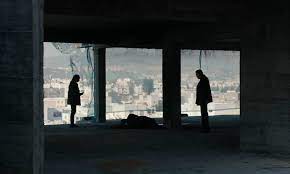
Director Youssef Chebbi (“Black Medusa” was his) keeps the viewer in the dark, literally and figuratively — setting much of the story at night, not showing his cards, not even telling us who Fatma the cop’s controversial father was (Some sort of regime-disrupting reformer?). That’s a big reason other police and the sketchy manager of the revived construction project (Nabil Trabelsi) distrust and despise her, with the manager insisting the first burn victim, a watchman in the “wastelands” of these unfinished towers ,”was depressed” (in Arabic with English subtitles), the second — a young maid, “raped and burned” to cover up the crime.
Fatma isn’t buying it.
The victims don’t scream. They don’t leave notes, listing their despair, their demands or whatever. And the fire that they “surrender” to doesn’t appear to be lit by natural or chemical means. There might be a cowled, masked stranger luring these people to their doom.
As an “Investigation,” “Ashkal” leaves questions unanswered, allowing us to speculate on what’s happening. The symbolism of a high-end building project starting up again in a country which impoverished people are fleeing, along with climate and conflict refugees from the rest of Africa, isn’t lost in the mystery.
Then there’s the fact that we glimpse hearings of a “Truth and Dignity” commission, airing the nation’s shame that led to so many arrested and tortured or killed citizens by earlier regimes.
Chebbi uses his burning-human fire effect in darkness to chilling effect, and his set — vast unfinished acres of towering, empty buildings — is a Kafka/Pirandello manipulation of existing emptiness twisted into something sinister the way Orson Welles used an abandoned Paris train station to give us his Kafka-esque nightmare, “The Trial.”
The bright, flickering light of another sacrifice sends Fatma racing through the darkness, scrambling up flights of exposed stairs, her flashlight’s dance the one way we can track her progress in the distance.
Usually I like a few more answers before endorsing a mystery like this one, no matter how striking it sometimes is. The “villain” here might be “the system,” which only new protests can displace. Those are manifested in the mysterious fire-starter (we never see fires start) who could be a symbol, a villain, or the conscious of the nation.
But in any event, “Ashkal” manages to pique our interest and burn itself into the memory by being one of the most opaque horror thrillers to come along, one from a part of the world better known for real challenges and horrors, not ones faked for the movies.

Rating: unrated, violence
Cast: Fatma Oussaifi, Mohamed Grayaâ, Hichem Riahi, Bahri Rahali and Nabil Trabelsi
Credits: Directed by Youssef Chebbi, scripted by Youssef Chebbi, François-Michel Allegrini . A Yellow Veil release.
Running time: 1:32


 Movie Nation