


That warhorse genre “the police procedural” earns a fresh look with the French drama “The Night of the 12th,” an uncommonly sensitive inside-view of a grim case and its toll on the friends and family of the victim and the increasingly frustrated detectives working it.
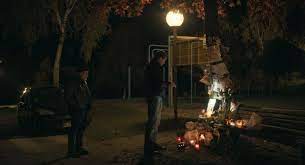
The crime is extraordinarily awful. A young woman (Lula Cotton-Frapier) leaves a party in a resort town outside of Grenoble and sends an affectionate good night video to her best friend as she walks home. A man in a hoodie approaches, calls her by name, and when he gets close enough, douses her with gasoline.
It was the night of October 12th, off-season. But the nature of the crime is such that detectives from the city are called in, with forensics, the works, when the body is discovered.
Yohan (Bastien Bouillon), their young, solitary captain, and his crew had celebrated the retirement of a colleague the night before. Now he, his senior man Marceau (Bouli Lanners), a rookie and others with plenty of years pile into two cars, drive over and go to work.
They’re all men, mostly in their 40s, seasoned veterans who can tease the new guy but put on their game faces when they see the body, the-contamation-concious forensics teams going over it the crime scene and the ugliness of the crime.
Their work is by-the-book, but it starts with a phone call — on the victim’s phone. Nobody in town save for the gendarmes and themselves know this happened. Answering that phone is the first evidence they gather.
Some will start the work of going door to door. Yohan and Marceau, the most experienced, must tell her family. Yohan confesses to being traumatized by this part of the job and when her mother (Charline Paul) loses it and must be restrained — a perfectly human response — we see why. The 21 year-old victim’s father must be summoned home from work.
The sadness of the early scenes — and as shocking as seeing the crime is, that’s the reaction filmmaker Dominik Moll evokes — is replaced by the painstaking gathering of names, Clara’s circle of friends, acquaintances and lovers. Interrogations are aimed at tripping up this boyfriend who says “We weren’t that close,” that snickering young punk who describes them as “sex friends,” and the slightly-older rapper who rapped an angry break-up song when she discarded him.
None of her exes and beaus seems all that put out that this terible thing happened to Clara Every guy they question seems somehow capable of this. Every chat with her shattered best friend (Pauline Serieys) pulls up details the young woman has left out, and tears.
The cops talk about the case in the field, at lunch and in the office, ruling out this or that motive. We start to pick up on the insular monoculture of that unit and this job, of how they narrow field of experience hampers the case, of the routine that drives them nuts when a case turns up few solid leads.
“We fight evil by filing reports.”
One has a marriage about to break up. Another is planning a wedding. The captain clears his head by cycling endless laps in the local velodrome.
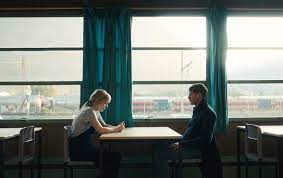
And when they’re not otherwise distracted, little moments of insensitivity creep into their treatment of the victim and handling of the case. Only Yohan’s frequent updates and re-interviews with Nanie, the best friend, keep him centered.
Clara was “joyful,” “loved fun.” She “fell in love easily.” She “fell in love recently.” But asking about her “double dating,” while seemingly fair game, is judging her, blaming her for a psychopath’s actions. Young Nanie sees it. Yohan is the only cop evolved enough to understand that.
Moll’s film, co-written with Pauline Guéna and Gilles Marchand, is structured to frustrate the cops and baffle the viewer. Some of that comes from the strange workings of French justice, the way a new judge — a woman (Camille Rutherford) — can come in, see how the case has moved to the back-burner, and order it re-opened.
Differences in wiretap laws and slight deviations in the standard cop operating procedure in interrogations — busting in and handcuffing one suspect and interrogating him like that in front of his girlfriend — isn’t very “C.S.I.” or “Law & Order.”
Moll, director of “The French Fargo,” “Only the Animals,” teases out details and tells this tale through the wearing way it eats at the increasingly impatient and frustrated cops, who get testy with each other and pushy with assorted suspects the longer this goes on.”La Nuit du 12,” in French with English subtitles, tests one’s patience the way the case weighs on and tests the detectives.
Bouillon gives a sympathetic edge to Yohan, our on-the-scene observer. Nobody would want to tell a mother her beautiful 21 year-old has been murdered, especially like that. Taking a moment to step back and put yourself in others’ shoes can’t be taught at police academies, and more’s the pity.
But as the police chase longer and longer shots, Serieys’ Nanie brings Yohan and us back to the tragedy of it all, the shocking loss and the grieving that won’t end even if they all find “closure.”
We and Yohan don’t need a new judge to come in to realize Clara “deserved better” than this crime, and this perfunctory, judgmental treattment of it by the folks who are supposed to figure out who did it.

Rating: unrated, graphic violence, profanity
Cast: Bastien Bouillon, Bouli Lanners, Pauline Serieys, Charline Paul, Camille Rutherford and Lula Cotton-Frapier
Credits: Directed by Dominik Moll, scripted by Pauline Guéna, Gilles Marchand and Dominik Moll. A Film Movement+ release.
Running time: 1:55


 Movie Nation