


By the late 1960s, John le Carré was just coming into his own as the the new Graham Greene, a sophsticated, subtle “thinking person’s spy novelist.” “The Spy Who Came in from the Cold” had shown the former MI5/MI6 insider to be a writer whose work was in sharp contrast to the pulp fiction of most everybody else in the genre.
“The Spy Who Came in from the Cold” had already been turned into a pretty good film, sort of an “anti-Bond” dose of the cold realities of this deadly business.
His tales were unsentimental, not particularly sexy and generally quite cynical about the Cold War and the spy game.
Frank Pierson was a two-time Oscar-nominated screenwriter (“Cool Hand Luke,””Cat Ballou”) who had a little TV directing on his resume.
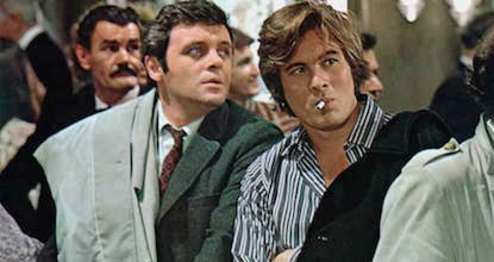
But the future Oscar winner and soon-to-be-lionized novelist weren’t a good fit on “The Looking Glass War,” a “send a man over the border” Iron Curtain thriller built around the estimable Ralph Richardson, rising-star Anthony Hopkins, blonde-du-jour Susan George and hunk-of-the-moment Christopher Jones.
It’s dark and cynical enough — wheezing old men playing old-fashioned, even by 1960s standards, spy games, gambling with a new recruit’s life. But the film is so choppy, uneven and abrupt in its shifts of focus and truncated ending as to make one wonder if they didn’t leave a reel out here and there in uploading it to stream.
The problem begins with the novel, widely regarded as one of John le Carré’s weakest. He even changed the ending of it in later editions just to get the damned thing to make sense.
Jones, a mop top in the Peter Fonda/Michael Sarrazin mold, makes a passable lead, and Richardson and Hopkins and most of the supporting cast are up to snuff.
But whatever le Carré was getting at, it’s pretty obvious Pierson had his sights set on Bond, James Bond — sending him up in a bloody account of a bungled bit of spycraft gone wrong. The picture is too serious to hit that shaken, not stirred target in this story of a brutish, catnip-to-the-chicks Polish sailor blackmailed into taking on a job of espionage to determine where the Soviets are parking their latest missiles, “700 miles from London.”
An agent (Timothy West) in Finland picks up a roll of film shot by an airline pilot he’s bribed to drift low and off course to get film of mobile “Sandal” missiles and where they’re being deployed, we later gather.
I’ve never read anywhere that this sort of spy flight really happened. If so, one can almost understand the Soviet attacks on commercial flights like the Korean Airlines flight 902 and KAL 007 shootdowns. If this sort of surveillance never took place via civilian airliners, le Carré may have very well put that idea in the Russians’ heads via this book.
Their tradecraft at the airport bar is laughable, an open conversation and public exchange. And we get our first hints of the impoverished state of British Intelligence after the spy scandals that its inbred, classist culture produced in the Guy Burgess era. The agent makes the pilot pick up the bar tab, and gripes about not having car-fare provided by his employers.
It’s on his ludicrous snowy trek home on a deserted road that he is run down. But his killers don’t get the film.
That murder is treated somberly by the junior man (Hopkins) at HQ. But it’s a confirming clue to his boss, LeClerc, given an old man’s gravitas by Richardson. The killing, added to grainy, blurry photos they got from a photographer in East Germany point to the deployment of these new missiles within range of London.
Memories of the fiery assaults of German V-2s of WWII have old men like LeClerc and and Haldane (Paul Rogers) waxing gravely about a terrible threat. For certain?
“I don’t deal in certainties, I deal in doubts,” LeClerc snaps.
That’s when they turn the screws on an impudent Polish drifter (Jones, of “Wild in the Streets” and “Ryan’s Daughter”) who jumped ship to be with this English lass he fancies and apparently impregnated. If he wants to stay in Britain to be with her (Susan George) and his child, he needs to do this little job for them.
“I think that heroes are only happy in parks, with pigeons sitting on them,” sailor Leiser sneers at his elders.
But he agrees. Why?
“Biology,” LeClerc says with the certainty of someone who’s done this scores of times. “Men change their politics. But sex? Sex is something you can depend upon.”
They get him out of immigration detention, set him up in a safe house and drill him on spycraft, radio protocols and self-defense.
The “never trust anyone” training includes Hopkins’ Avery jumping him, “Pink Panther” Kato style, for brutal punch-outs that have the feel of DIY fights to the death.
It’s all very old OLD school — the backpack Morse code “wireless,” shuttling this guy across the border by literally cutting through a fence and dodging a minefield, the limited training.
But Leiser, the multi-lingual ladies’ man of 23, can’t take a gun across a foreign border because “that would be an act of war,” you see. James Bond’s Walther must be left behind.
With a guy this green, this insolent, this hotheaded and careless, the “mission” goes wrong, pretty much from the start.
The juicy le Carré details here aren’t the misadventures of a Pole in Soviet-controlled East Germany. It’s the domestic disasters facing the married men of the spy agency — secretive workaholic and maybe alcoholic agents married to bitter, mistrustful women.
“Don’t try and RUN me like one of your wretched agents!”
The disastrously faithless marriage of George Smiley in “Tinker Tailor Soldier Spy” is prefigured here.
“I’m a patriot,” Avery declares to his snappish wife. “We’re fighting a war. We’re in the dark.“
Leiser and Avery are equally mercurial, taking their training fights to very personal extremes, cheerfully knocking back indiscrete drinks in the pub after Leiser busts out to see his girl, and slap her bloody for getting an abortion.
Yes, the movie is head-snapping like that. A truck-driver is killed and his body stuffed in the back, with his barking, whimpering dog. When the truck is stopped by man-hunting East German troops, the body’s gone. And the dog.
Another compliant blonde (Pia Degermark) throws herself at Leiser in Germany. Is she a spy sent to trap him? Is it all just a big Russian fake-out?
Perhaps that explains why the Brits rely on a method of gathering information so old fashioned it predates the first World War. The WWII “wireless” set, the cypher hidden in a tube of toothpaste, “it’s the last thing” the Russians would expect. And it’s cheap, the sort of thing you try when you’re not sure if your enemy is pulling one over on you.
The behavior of the communists once they first tussle with Leiser should provide us with our answers. As to the old men pulling the strings, who’s going to miss one more Polish hippy? They give up on him before they have any reason to.
“We never really knew him, did we? Like a waiter at one’s club. ‘Good morning.’ ‘Good evening.’ And a guinea at Christmas.”
The choppiness and lapses in logic, even if by design, ruin “The Looking Glass War.” But the tone, the cast, the cynicism and the deathly personal business of kill-or-be-killed spying tell us the movie this might have been.
The novel wasn’t great, but looking at the film and the way Leiser takes to violence and thinking of James Dickey’s marvelous American-airman-downed-in-1945-Japan thriller “To the White Sea,” one can imagine other changes le Carré might have considered for the book, or that Pierson, who’d go on to win an Oscar for scripting “Dog Day Afternoon” and be a guiding light in famous TV movies and the Emmy-honored “Mad Men,” could have added.
If only an under-funded, disgraced agency of tired old men had underestimated their Pole and dropped a pitless murderer behind the Iron Curtain. That would’ve been a lot more exciting than this.

Rating: PG for its day, violent
Cast: Christopher Jones, Ralph Richardson, Anthony Hopkins, Pia Degermark, Paul Rogers, Cyril Shaps, Timothy West, Paul Swanick and Susan George.
Credits: Scripted and directed by Frank Pierson, based on the novel by John le Carré. A Columbia release on Tubi, Amazon, Youtube, etc.
Running time: 1:


 Movie Nation
For me, the 1979 Tinker Tailor with Alec Guinness was the masterpiece. The Burlington Files gives a fascinating insight into just how little agents in the field know about what they are doing whether in London or Port au Prince maybe as a prelude to a Haitien equivalent to the Bay of Pigs. Also, remember it’s written by an agent not a professional writer like JleC so don’t expect JleC delicate diction et al.
If you dig into the backgrounds of Pemberton’s People in MI6 you will understand so much more and be rewarded when reading Beyond Enkription. I suggest you read the brief News Articles in TheBurlingtonFiles website dated 31 October 2022, 26 September 2021 and 7 January 2020. One critic described Beyond Enkription as ”up there with My Silent War by Kim Philby and No Other Choice by George Blake”. He wasn’t that far wrong, indeed arguably spot on.