


“For a number of reasons, film buffs have long harbored the feeling that Orson Welles had a hand in directing some of — perhaps his own scenes — Carol Reed’s film noir masterpiece “The Third Man.”
The best arguments for that are Welles’ performance, his crackling good lines and big “cuckoo clock” speech, and the Wellesian camera placement and shot-framing of the inky-black post-war Viennese streets in that classic.
The best argument against Welles “co-directing” that film has to be “Odd Man Out,” made two years before “Third Man” by Reed, the first-ever BAFTA Best Picture winner and a film noir classic in its own right.
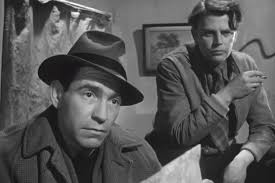
It’s another man-on-the-lam thriller and stars James Mason as a weary and wounded IRA section chief on the run after killing a clerk in a payroll robbery. Over the course of a day and a very long night, Johnny McQueen will drop in and out of consciousness, struggle to hide, meet a lot of folks on the fence about him and what he does, fans and friends hoping to help, bystanders fearful of IRA reprisals if they turn him in and those coveting the reward the authorities have slapped on his head to keep him from slipping out of Belfast.
Meanwhile his confederates, led by Denis (Robert Beatty) and egged on by Kathleen (Kathleen Ryan), who loves Johnny, are trying to find him, debating how to manage that, arguing over what went wrong in the heist and how to get Johnny — already a wanted escaped convict — out of town.
Neither the “IRA” nor “Belfast” are mentioned, mainly to avoid U.K. censorship. John Ford’s “The Informer” had also skirted the murky-bloody politics of rebellion against British occupation and colonization. But Reed’s film has a definite Brit-centric bias, one that mirrors the F.L. Green novel it is based on, with even Johnny questioning his and his accomplices’ actions.
“I believe in everything we’re trying to do. But this violence isn’t getting us anywhere.”
Johnny’s mention of winning “at the ballot box” is a glib bit of British propaganda that ignores how they’d colonized the northern Irish counties with generations of loyal Scots to “pacify” the Irish, rendering such electoral hopes futile, something any IRA man would have known.
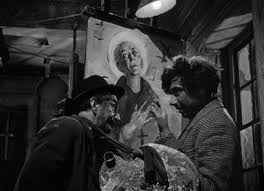
Johnny hides in a neighborhood air raid shelter, in a horse-drawn hansom cab, is taken in by strangers who think he’s been hit by a truck (he’s been shot in the arm and is bleeding out), holes up in a “snug” in a pub and falls under the control of a demented painter (Robert Newton) and his failed-surgeon (tumbledown) flatmate (Elwyn Brook-Jones).
All night, as the rain changes to snow and the police inspector (Denis O’Dea) turns the screws on Kathleen, she implores the IRA-friendly priest (W.G. Fay) and Dennis to get her to Johnny.
“Sooner or later, the police will get to him,” she pleads. “Let me have him until then!”
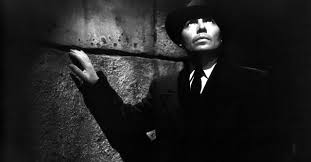
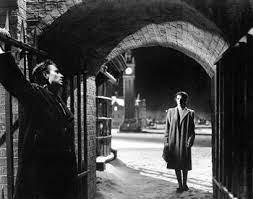
It is a beautiful black and white film of lovely, tight compositions, nervy hand-held shots mimicking Johnny’s frame of mind and gloomy, damply-lit and narrow West Belfast (and some London exteriors) streets, flats and factories.
No, it’s not as gorgeous as “The Third Man.”
The chases are well-handled even as Mason’s place in the film — he has few lines to start with, and recedes into the background in the middle acts — means that most of those chases will involve those in on the robbery with him — men played by Cyril Cusack, Dan O’Herlihy and Roy Irving — and his comrade Dennis.
Those scenes have a polished competence and brio to them, but the action beats of “The Third Man” are next-level thrilling.
Reed’s use of natural sound — streets, bar scenes, crowded tram, etc. — adds to the reality of it all, something replicated with “Third Man,” which also leaned on “The Third Man Theme,” that unforgettable piece of zither music, to place the film in its locale and heighten emotions.
But the “Odd Man” narrative loses much of its urgency in the melodramatic middle acts as Johnny slips into the background and assorted folks — two sisters (Fay Compton and Beryl Measer), the priest, the cabbie (Joseph Tomelty), and a barman (William Hartnell) ponder what to do with him or about him.
The most vivid characters in these scenes are the cynical brothel madam and “chancer” (Maureen Delaney) and greedy, broke barfly Shell (F.J. McCormick), the one fellow willing to admit he’d love to have the reward, IRA reprisals be damned.
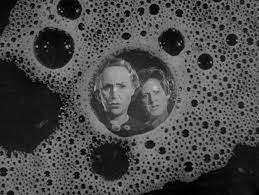
But it’s Shell’s stumbling across Johnny that invites the mad painter and his never-quite-a-surgeon friend in. And Newton, raving and ranting, trashing a bar and wild about capturing on canvas “the eyes” of a “doomed man” before he perishes, ensures the finale is both action-packed and layered with pathos.
Mason, despite his fumbled efforts to tone down the posh Received Pronunciation accent to sound like an Irish Catholic ex-con, would call this his favorite role and go on to decades of greater glory as a great character actor and leading man.
Reed was already a veteran filmmaker with a dozen years of directing credits on his CV. He’d made some prestige pictures (“Night Train to Munich,” “The Young Mr. Pitt”) before, but “Odd Man Out” heralded his arrival on the pantheon of his generation of British directors.
“The Fallen Idol” would be his next film, followed by “The Third Man.” But after this brief peak, his work fell off until he got to make Graham Green’s “Our Man in Havana” in 1960, after which he took big checks for the epic “The Agony and the Ecstacy” and the blockbuster musical “Oliver!”
Watching “Odd Man Out” now, it’s easy to see that discounting Reed at his peak artistry is unfair, even as the superior writing, acting, pacing and production values of “The Third Man” still make it the best film Orson Welles didn’t direct. But pretending Welles didn’t make that movie what it’s become is just as incorrect.
Reed lifted his game and plainly took suggestions on set. Welles must have camera-blocked and scripted some of his scenes.
And “Odd Man Out,” if not Reed’s very best film, certainly shows us that “The Third Man,” “Fallen Idol,” Our Man in Havana” and the Technicolor glories of “Oliver!” were produced by a singular talent who only suffers when he’s compared to the greatest directors of his era — Welles, Ford and Lean among them.

Rating: “approved”
Cast: James Mason, Robert Newton, Kathleen Ryan, Cyril Cusack, Denis O’Dea, Dan O’Herlihy, Robert Beatty, W.G. Fay, F.J. McCormick, Kitty Kirwan, Ann Clery, Joseph Tomelty, William Hartnell and Elwyn Brook-Jones.
Credits: Directed by Carol Reed, scripted by R.C. Sheriff. based on a novel by F.L. Green. A Two Cities/Univeral release available on Tubi, Amazon, Youtube, etc.
Running time: 1:56


 Movie Nation