

Christopher Nolan turns his considerable talents back to World War II era history for “Oppenheimer,” a biography that plumbs the genius, foibles and moral and ethical dilemmas faced by “The Father of the Atomic Bomb.”
It’s an all-star revisiting of an epic undertaking, the race to build a bomb “before the Germans get one,” envisioned as a cinematic whirlwind of science, history, intrigues and tragedy. Riding on the shoulders of a haunted performance by Cillian Murphy in the title role, a subtly-shaded turn by Robert Downey Jr., the bluff, blunt and funny presence of Matt Damon and a brilliantly brittle interpretation of Oppenheimer’s wife by Emily Blunt, it’s a magnificent film, head-and-shoulders above every other movie of the summer, and not just in its ambition.
Nolan’s script, based on the book “American Prometheus: The Triumph and Tragedy of J. Robert Oppenheimer,” sweeps us through the genius physicist’s academic achievements as the “man who brought quantum mechanics to America,” his mastery of any subject that entered his field of vision, his masterly management of The Manhattan Project, a very smart man’s dalliance in liberal-to-left-wing politics, his humanism and his womanizing.
Murphy’s Oppenheimer has the faraway eyes of a dreamer, with Nolan slipping vivid imaginings of what that mind was “seeing” when he pondered black holes and the physics that runs the universe. And this “Oppie” has the cocksure quick wit and swagger of a someone who knew he was the Smartest Man in the Room, and acted — sometimes recklessly, sometimes humorously — on that confidence.
“Why don’t you have a Nobel Prize?” Army officer/West Point-and-MIT-educated engineer Leslie Groves (Damon) bluntly asks the man he wants to manage the “Manhattan” project when they meet.
“Why aren’t you a general?”
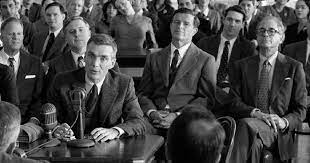
The story is framed within Oppenheimer’s closed-hearing “trial” which revoked his security clearance in 1954, with his critics and defenders facing judgement from the likes of Gordon Gray (Tony Goldwyn) and grilling from judge/prosecutor, Roger Robb (Jason Clark).
And that frame is tucked within another, the Senate hearings of a former Oppenheimer champion and 1950s Eisenhower administration cabinet nominee, Lewis Strauss (Downey).
The thread that runs through those scenes and spreads into the flashbacks that recreate Oppenhimer’s much-documented life story is “Who’d want to justify their whole life?” He can dismiss ill-informed questions about why he didn’t attend the finest physics program in America, at Berkeley, with “Because I hadn’t built” that program yet. But studying in Britain and especially the world’s enemy, Germany, was seen as a red flag in his life story.
Oppenheimer’s attraction to the mercurial, unromantic communist Jean Tatlock (Florence Pugh) is shown, and when this “questionable association” is revisited in his security clearance hearing, their sexual encounters migrate from hotel rooms to his chair in the hearing chambers, both of them naked before his accusers.
The story of Oppenheimer’s life is reflected in the great figures who were his peers — Kenneth Branagh is somberly playful as the great Danish physicist Niels Bohr, Tom Conti is the weary, elderly Einstein, Josh Hartnett is Nobel prize-winner Ernest Lawrence, Benny Safdie is an always-sweaty H-bomb champion Edward Teller.
Through it all, the politics of the era pass by outside the halls of academia and later the hastily-built city of Los Alamos. Oppenheimer knows Marxism and its limitations because he read “Das Kapital” in “the original German.” He supported the Republicans in the Spanish Civil War, because only fascists didn’t, and his brother and sister-in-law became “card carrying communists” and he wouldn’t distance himself from them because they were his brother and sister-in-law.
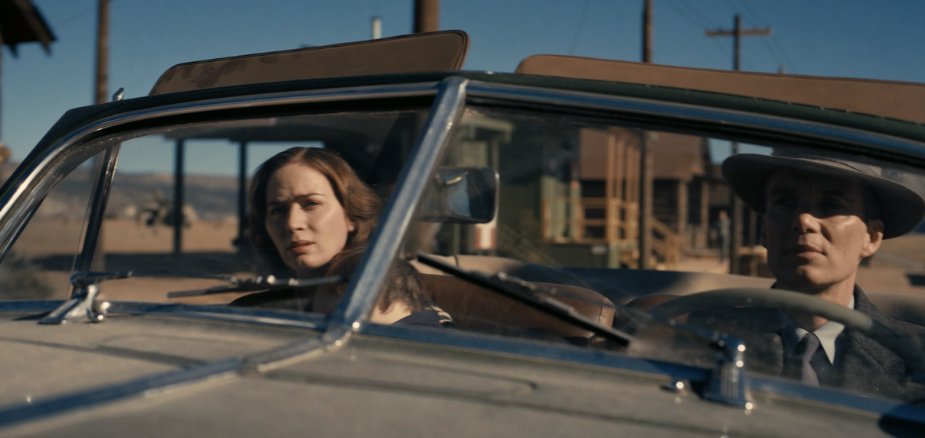
He loved women, and impregnated and married Kitty (Blunt), whom he met at a cocktail party with her significant other.
“You’re married to Dr. Harrison?”
“Not very.”
And he learned Sanskrit to read the “Bhagavad Gita,” and when the “Trinity” nuclear test blast succeeded in July of 1945, he quoted it.
“I am become death, the destroyer of worlds.”
Nolan shot Congressional hearings and media scrums surrounding the Oppenheimer of the 1950s in the black and white of TV memory, and the epic story of Los Alamos and the life that led up to it in vivid color, folded into flashbacks within these frames.
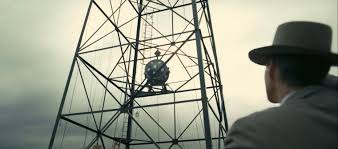
Nolan’s films are famous for their sound design, and here that’s most impressive in the Trinity sequence, stunning silence underscoring the (non digital) pillar of boiling fire created by the world’s first atomic bomb, shattering noise erupting not just when the shock-wave of the blast passes over the scientists and soldiers, but when the shock of what they’ve achieved and what he’s wrought rattles Oppenheimer.
This brisk but long film’s third act delivers a clever echo of that shock, when Oppenheimer plays to the crowd at a celebratory gathering of those who worked on the project, stunned by their noisy enthusiasm even as he is almost as conflicted about this achievement as colleagues like Isidor Rabi (David Krumholtz, terrific) about the carnage their bombs wrought.
The film balances the much-debated moral quandary of the fateful decision to drop bombs on a fanatical enemy whose war-criminal leadership would have never surrendered via characters and character studies. Oppenheimer is parked on the fence while Groves and others march on in a panicked rush and sensitive colleagues question how much “blood” they will have on their hands.
Nolan leaves no doubt in where the “plain-speaking” American president at that moment sits on that scale.
When the movie makes points about what Hitler disdained as “Jewish science,” it hints at what might have played a role in Oppenheimer’s fall, an outspoken man in an era when America proved itself willing to remember anti-Semitism and forget the many Jewish scientists involved in bringing World War II to an abrupt end.
The filmmaker sees Oppenheimer as a war hero torn by his place in history, martyred by McCarthy Era politics, which isn’t necessarily a new or fresh take. There was a memorable BBC/PBS TV series — 1980’s “Oppenheimer” starred Sam Waterston — a good TV movie (1989’s “Day One” film David Strathairn as Oppenheimer, with Brian Dennehy as General Groves) and the ambitious but not-quite-epic 1989 feature “Fat Man & Little Boy,” which starred Paul Newman as Groves and Dwight Schultz as Oppenheimer.
But Nolan gives us something like a definitive take on the man, his work and the times he lived in, a film with the science and scientists of “The Theory of Everything,” the tortured/martyred genius of “The Imitation Game” and the mad scramble headiness of America in a race against history’s villains of “The Right Stuff.”
The only time this latest film on this controversial figure feels too long is the third act, which makes its “decline and fall” points, and then labors on to the point of belaboring.
In “Oppenheimer,” Nolan tells an epic story tacked onto an introspective, multi-faceted life, a hero in the Greek tragedy mold — brilliant and focused, but a man who knew his flaws and conflicted enough about his work that he all but accepted his fate as just deserts for all the “blood on my hands.”

Rating: R, sex, nudity, profanity
Cast: Cillian Murphy, Emily Blunt, Robert Downey, Jr., Florence Pugh, Matt Damon, Mattew Modine, Kenneth Branagh, Josh Hartnett, Jason Clarke, Benny Safdie, Rami Malek, Olivia Thirlby, Dane DeHaan, Tom Conti and Gary Oldman.
Credits: Scripted and directed by Christopher Nolan, based on the book by Kai Bird and Martin Sherwin. A Universal release.
Running time: 3:00


 Movie Nation