


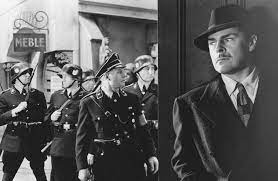
There is a superbly-detailed, thrillingly-pitched and well-acted film account of the 1942 Czech assassination of “Reichsprotektor” Reinhard Heidrich, the murderous Nazi nicknamed “The Hangman” during his military rule of occupied Czechoslovakia during World War II. It’s titled “Anthropoid,” and it stars Cillian Murphy (the upcoming “Oppenheimer”) and came out a few years back.
Exiles Fritz Lang, the celebrated playwright Bertolt Brecht and composer Hanns Eisler turned the story of the Nazi hunt for the assassin into a film noir, “Hangmen Also Die!” that came out less than a year after the actual events depicted, in the middle of World War II. The director and the screenwriters got almost everything historic wrong in this 1943 thriller.
But the filmmaker who gave us the prototype for the “hunted man” thriller with “M” still gets a stylish, tense and crackling picture out of events no one outside of Nazi Germany, Czechoslovakia, the Czech government in exile or the London planners and trainers of the assassins had any details about at the time. Two trained Czech soldiers were airdropped into the country to kill Heydrich and “prove” Czechoslovakia’s resistance to German domination.
Lang (“Fury,” “The Ministry of Fear”) and Brecht (“The Threepenny Opera”) don’t show us the killing, just the hunt for the man (Brian Donley) who carried it out, an underground made up mostly of communist resisters and a country that does its damnedest to ensure the killer is never caught, even at the cost of the lives of hundreds of their countrymen.
As Nazis chase off the getaway-cab driver (Lionel Stander), a bystander, Mascha (Anna Lee of “How Green Was My Valley,” “Fort Apache” and “The Ghost and Mrs. Muir”) sees the culprit, and misdirects the Nazis in their hot pursuit.
When our assailant can find no safe house in Prague to hide in, he tracks his benefactor down and lays low in the apartment she shares with her family, including her history professor/father (Walter Brennan) who figures out who this stranger his engaged-daughter lets in must be.
“Dont let yourselves be snowed under at Valley Forge,” he advises his family.
A dozen famous character actor faces adorn the cast of Czech patriots (Byron Foulger) or traitors (Gene Lockhart), with Lang showing a real flair for casting mostly expats to play the assorted heinous Nazis, including Tonio Stewart and “The Cabinet of Dr. Caligari” veteran Hans Heinrich von Twardowski as a vulpine and venomous Heidrich.
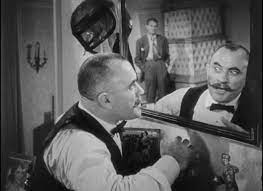
But the player who stands out here is the Austrian ex-pat Alexander Granach, deftly getting across cunning, efficiency and a comically-Bavarian addiction to beer as the Gestapo Inspector Gruber, who runs informants, reads clues and grills suspects in his pursuit of the man the locals label a heroic “executioner” but whom the German occupiers tar as an “assassin,” with a “blood debt” to be paid by hundreds of Czechs rounded up as hostages for execution if the people don’t turn in the real killer.
Over the course of the narrative, the assassin, Dr. Sovboda (Donlevy, best-known for playing heavies) feels the guilt of a man whose act will cause the deaths of many innocents and Mascha will journey from a woman frantic to save her hostage father to someone who is peer-pressured into understanding that this is bigger than her or her father or any Nazi reprisals


The screenplay, which has come to be thought as more and more the work of Brecht by Brecht scholars and less attributable to his collaborators, has tiny hints and writ-large examples of his communist politics, something that got past studio editing and censorship during World War II, when the Soviet Russians were the West’s allies in the fight to crush fascism.
Group scenes of “the resistence” and street scenes of The People badgering and threatening Mascha as they would anybody who wants to go to “Gestapo Headquarters” of her own free will have a proleterian agitprop feel. And the mobs’ way of flinging the “V-for-victory” salute is a lot more chilling now that we’re far enough removed from that era to see this as Brecht and Lang’s equating one “mob” with another.
Brecht, credited co-writer John Wexley and actor Stander were among those later blacklisted for having communist sympathies during the Hollywood “witch hunt,” and witchhunter Sen. Joseph McCarthy labeled this film subversive in the 1950s, which caused it to disappear from public showings until the mid-70s.
But at the time of release, the film was premiered in mid-America to some fanfare and nominated for a couple of Academy Awards. Composer Hanns Eisler, an expat who often scored Brecht’s plays in Europe, grabbed one of those nominations for his score, which folds Czech composer Bedřich Smetana’s patriotic tone poem “The Mouldau” into a few scenes.
The best reason for a film buff to dive into “Hangmen Also Die!” is that it’s quintessentially Fritz Lang, first shadow to its “NOT” “The End” finale.
Shadows and silhouttes abound, with a production design that almost seamlessly incorporates stock footage of Prague’s skyline, churches and clock towers into the gloomy, oppressed streets created on studio backlots.
The Austrian Lang wasn’t shy about leaning hard into war-era stereotypes of Germans, the sadistic officer classes empowered by the Swastika to be the beasts the world had come to believe they were in 1914-1918.
But the “heroes” here and the rather lax way the film treats the manhunt in the early acts don’t fall into the normal parameters of film noir, and truthfully, despite jumping right into the immediate aftermath of an assassination, “Hangmen Also Die!” takes a while to get going.
Only Granach’s scenes where he closes the net on the doctor, Mascha and their enablers have much in the way of suspense in them.
“Sorry sir. Once you work for the Gestapo you work for the Gestapo!”
But when the third act kicks in as one trap closes and then opens and another is sprung, Lang’s craft and skill transcend the “look” of a Fritz Lang film and pull us into the the nervous energy of a showdown, a double-cross and “a big frame-up.”
It might not be one of Lang’s very best, but the only script Brecht ever got filmed in Hollywood and the usual Lang flourishes make “Hangman” — which was almost titled “No Surrender,” a running theme of the film and an exclamation point in its finale — a must-see movie for any true cinephile.

Rating: “approved,” violent and “racy.”
Cast: Brian Donlevy, Anna Lee, Walter Brennan, Gene Lockhart, Alexander Granach, Lionel Stander and Hans Heinrich von Twardowski.
Credits: Directed by Fritz Lang, scripted by Bertolt “Bert” Brecht, Fritz Lang and John Wexley. A United Artists release on Tubi, Amazon, Youtube, etc.
Running time: 2:14


 Movie Nation