
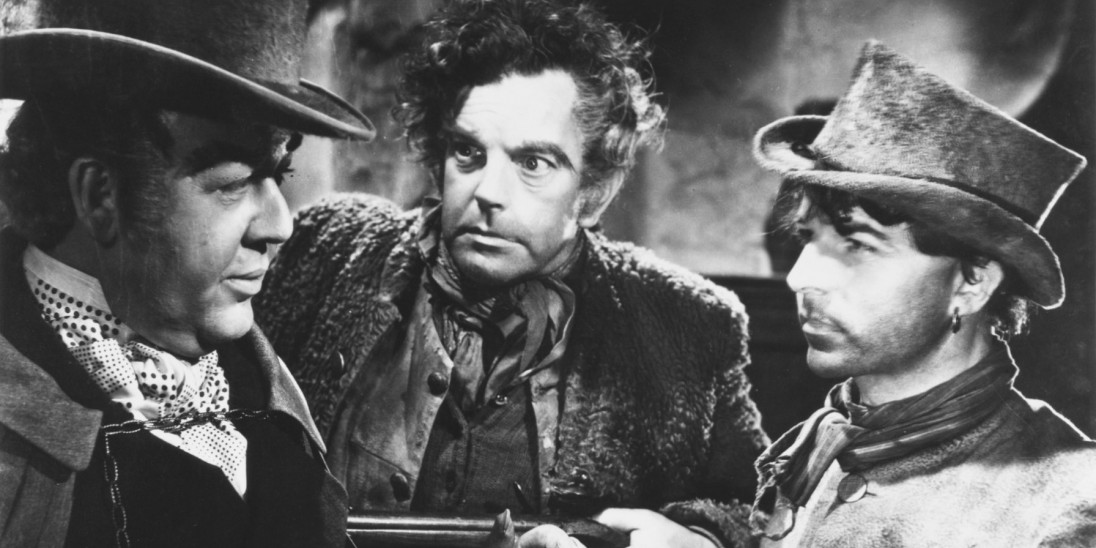
It’s all-too-telling that “Jamaica Inn” is left out of the summary of the career of “The Master of Suspense” on that font of all crowdsourced knowledge, Wikipedia.
Let’s all skip from “The Lady Vanishes” (1938) to “Rebecca” (1940). Hitch certainly wanted us to.
“Jamaica Inn” (1939) is a rare Alfred Hitchcock period piece and rare misfire, his first-ever adaptation of a Daphne Du Maurier novel and last film before “Going Hollywood,” under contract to David O. Selznick, which would spread his fame even further and ensure his legend through decades of hits and an iconic TV series to boot.
This film has never enjoyed a great reputation, and occasional attempts to paint it as better than its repute are but Hitchcockian clickbait. It’s far from terrible, thanks to the overbearing villainous turn by Charles Laughton, a first-ever starring role for Maureen O’Hara, and reliable support led by Robert Newton.
But it plants its first shipwreck early in the opening act, one of the clumsiest model toy boat effects of its day, intercut with shots of a captain and mate at the wheel, blasted by water plainly emanating from a fire hose.
Things don’t improve markedly during the course of the film, which due to its titular inn, comes to resemble a violent, melodramatic door-slamming farce, with only that fine English ham Laughton providing laughs in between the door-slams.
The spooky real-life Jamaica Inn in coastal Cornwall inspired Du Maurier, destined to be the popular novelist for whom the term “middle-brow” was seemingly invented. Historical fiction based on real history — the Inn was infamous for smugglers — the story concerned the murderous locals, who don’t wait for storms and troubled vessels to founder on their rocky shore. Like their unscrupulous peers in Key West and other dangerous sailing passages, they are “wreckers,” willing to manipulate signal lanterns and navigation aids to lure mariners to their doom.
Those who don’t perish in the wrecks and done in to ensure no witnesses survive.
The newly-renamed O’Hara — she’d appeared as a Maureen Fitzsimmons in a couple of little-seen Irish pictures — stars as Mary Yellan, a young Irish woman who has lost her mother and come to stay with her Aunt Patience (Marie Ney) and her husband, the innkeeper Joss.
We’ve seen what a brute he (Leslie Banks) is, the ringleader of the wreckers, cutthroat ensurer of the “no witnesses” policy. The loutish way he comes on to the strange young Irishwoman who comes to his door doesn’t end even after his loyal but long-suffering wife intervenes.
Mary was warned away from the place by passengers and the driver of the coach she arrived in, who refused to deposit her at such a disreputable establishment. She got there through the good offices of Squire Pelgallan, the spendthrift Sir Humphrey (Laughton) entertaining his fellow poshes at the manor up the road. He gallantly takes her to her destination, but not without a lot of leering.
Mary’s arrival at Jamaica Inn comes as the wreckers are starting to gripe about their shares of the loot they take in for all that treachery and murder. She secretly spies the summary judgment of Joss and the leaders about the “troublemaker” who’s causing that unrest, the newest wrecker, Jem Trehearne, played by the great Robert Newton.
When Mary interferes with his hanging, she and Jem flee the rough justice of the murderous mob. But there’s a leader they don’t know about, a puppetmaster arranging the wrecking. He is the aloof, posh magistrate, Sir Humphrey himself.
Running to him with their news of an awful scandal does them no good at all. They’re trapped between a murderous mob, a violent sea and a “protector” who is nothing of the sort.
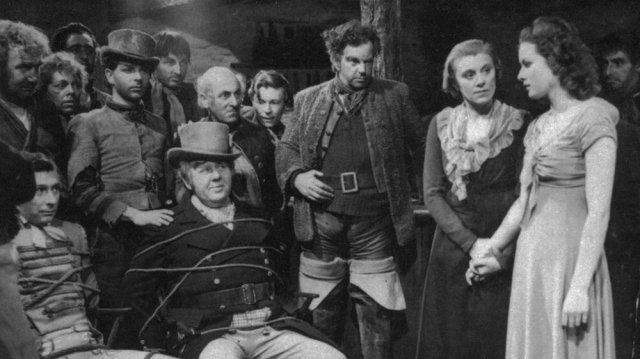
This adaptation doesn’t entirely founder on the rocks. But the viewer is a couple of steps ahead of the action, start to finish. The innocents take forever to figure out the obvious.
Sometimes, it seems only the many doors on the many rooms of the multi-floor (split level) inn and the need to stretch the screenplay out to 100 minutes are keeping our intrepid (reluctant) couple from doing the math and outsmarting their pursuers and their sea of troubles.
In adapting the film, the villainous vicar of the novel is folded into the character of the local squire and magistrate, who is renamed here. Apparently, you couldn’t criticize clergy in films intended for the American market pre Monty Python.
The limited settings and time frame make one wonder how all this “action” can be confined to so small a space, with seemingly everyone on the moors in cahoots on the wrecking scam, and willing to kill to keep their secrets.
But this being a middle-brow melodrama, there’s a lot of wholly illogical “tie’em up” until later when he or she or they should be dispatched and dumped over a cliff at one’s earliest convenience.
Still, Laughton is a stitch as Sir Humphrey, a riot of foppish menace and upper class airs delivered in comically contemptuous dialogue.
“All fine fellows,” Sir Humphrey says of his “wrecking crew.” “A trifle dessicated, but one can’t have everything.”
That grandiloquent time Laughton was having apparently ruined the experience and the film for Hitchcock, who described it as miserable shoot, a director overwhelmed by an overbearing star and the producers.
Whatever glory he’d earned with the dark yet comedic “The Lady Vanishes” was a year behind him, and after realizing that tone wasn’t going to work here, that this was never going to be dark door-slamming thriller, Hitch couldn’t wait to be done with “Jamaica” and flee to the arms of the control freak Selznick.
That tells you something. So does the fact that Hitchcock eschewed his already-established cameo for this film.
The novel was adapted for other film versions, and a mini-series, which considering the place’s notoriety, seems its proper medium.
Watching “Jamaica Inn” now, when we no longer have “The prints are in terrible shape” and the like to excuse it, a Hitchcock fan can marvel over the crowded compositions, the sound-stagey look of it all and the performances that can be its saving grace and say, “Oh, it’s not all that bad” with a straight face.
But even declining to consider its source and thus compare it to the rest of the Hitchcock canon, it’s not all that good either.

Rating: “approved”
Cast: Charles Laughton, Maureen O’Hara, Robert Newton, Marie Ney, Leslie Banks, Wylie Watson, Basil Radford and Emlyn Williams
Credits: Directed by Alfred Hitchcock, scripted by Sidney Gilliat and Joan Harrison, based on the novel by Daphne Du Maurier. A Paramount release, a Cohen Media Group restoration now on Tubi, Amazon, youtube etc.
Running time: 1:44


 Movie Nation