Movie Review: “Wild About Harry,” formerly “American Primitive,” a re-issued “Dad’s coming out” period piece

I wasn’t going to review this damned movie.

It was pitched as “streaming” and “coming out” this week, but it turns out it dates from 2009 and some distributor decided it’d try to wring some more cash out of it under a new title. Even in the dubious ethics of PR and movie marketing, that’s not cricket.

“American Primitive” it used to be called, an apt title for a a period piece about the Everybody’s in the Closet era of North American homosexuality.

“Wild About Harry” is not just a classic pub sing-along tune, it’s what his lover pounds out at the piano to his “American Primitive” (pre-“shabby chic”) furniture business partner and other half in the film. Not subtle.

This is the sort of LGBT arcana that belongs on Netflix and Tubi and perhaps that’s where it’ll be soon. It’s too sweet to be discarded, too quaint and dated (even in 2009, when it made the festival rounds) to pull in prospective ticket buyers. But it’s well cast and charmingly-set on Cape Cod in 1973.

Tate Donovan has the title role, a widowed father of two daughters — Maddie (Danielle Savre, who went on to “Grey’s Anatomy” and “Station 19” on TV) and her bouncy, naive little sister Daisy (Skye McCole Bartusiak, who tragically died five years after this was made).

An animated prologue has Dad narrating the “fraternity prank” that led him to their late mother. But when we meet them, they’re moving to a Cape Cod cottage that has a workshop and retail space built into it.

Harry Goodheart is starting over. For the girls, that means trying to fit in at a new high school. For Harry, that means a new business with his new “partner,” Mr. Gibb (Adam Pascal), who will live in the bedroom out behind the workshop.

Maddie is a little curious about this sudden development/arrangement. . Daisy doesn’t give it a second thought on her way out the door to catch the bus.

“Have fun with Mister Gibb!”

The new school adjustment tropes play out according to formula. Maddie catches the eye of school hunk Sam (Corey Sevier), who suggests she go out for the tennis team, even though she didn’t bring a racket or the right clothes. Scorching the team’s star rich girl and cheer captain in bell bottoms and clogs isn’t going to make her many friends, and what that says about Cape Cod tennis in 1973 speaks volumes.

Maddie also catches the eye of the stubble-bearded, stocking-capped rebel Spoke (Josh Peck, a bit old for this part, even in 2009).

But no hard feelings. We’ll pick you up tonight. Let’s all go to The Atlantic House!

Damned if these teens aren’t hitting the best place to dance in much of America at the time, a local gay bar. Damned if Maddie doesn’t see Dad and Mr. Gibb working it on the crowded dance floor. She flips out, but quietly.

Researching gay “conversion/aversion” therapy in the library, leaning into the flirtatious, “Let’s help you meet someone nice” neighbor, Mrs. Brown (Anne Ramsey, the funniest player on TV’s “Mad About You”), dropping hints and throwing up obstacles to Dad and his beau being together becomes Maddie’s life.

Daisy? She has no more of a clue than Mrs. Brown, whose party full of “available” women loses itself in a sing-along with Mr. Gibb, who shows up and leads the house in a rousing “I’m just wild about HA-rrrrrry.”

One of the “prospects” is a local newspaper reporter, played with a pre-Trumpist verve by Stacey Dash. She’s determined to do a profile of the new neighbors/new business, even as her questions get “That’s a bit PERSONAL” from Harry. So he dates and kisses her just to throw her off the scent.

Ok, that’s funny. As is the song, every time it comes back up.

And there’s a light touch to Daisy’s naivete that is nicely contrasted to Maddie’s increasingly shrill campaign, worried about what “people will say.” Maddie even summons her late mother’s parents (Susan Anspach and James Sikking). But they can’t resist Mr. Gibb’s piano playing any more than anyone else.

Donovan, who’d get a modest career bounce out of “Argo” a few years later, beautifully channels the ’70s “gay and in hiding” vibe, a man who hisses “Don’t SAY that WORD” to Gibb when he refers to them as “homosexuals.”

“A homosexual is a man who goes around having anonymous sex in bathhouses,” which was certainly the image attached to gay men in the era. Any TV show of the day, from “All in the Family” to “Taxi,” that had episodes touching on this subject covered it in the same serio-comic way.

“Who knew?” was kind of a punchline in TV and film back then, an improvement over the “tragedy” that hung over homosexuals on film and TV in the ’60s, but still a long way from Ellen DeGeneres, Pete Buttigieg and today.

“Wild About Harry,” co-written by Mary Beth Fielder and director Gwen Wynne, does a decent job at capturing a moment in time and being entertaining about it.

Maybe gay “bad old closeted days” nostalgia could become a thing, even though it hadn’t in 2009, when “Wild About Harry” was an “American Primitive” that no one was buying.

Rating: PG-13 for thematic elements, sexual material and language

Cast: Tate Donovan, Danielle Savre, Skye McCole Bartusiak, Adam Pascal, Josh Peck and Anne Ramsey

Credits: Directed by Gwen Wynne, scripted by Mary Beth Fielder and Gwen Wynne. A Global Digital/Freestyle release.

Running time: 1″@3

Posted in Reviews, previews, profiles and movie news | Comments Off on Movie Review: “Wild About Harry,” formerly “American Primitive,” a re-issued “Dad’s coming out” period piece

Netflixable? A tetchy mother takes stock of her life in “The Lost Daughter,” one of the year’s best films

It takes a while for someone to ask the vacationing literary professor Leda the obvious question.

“Are you angry? You seem angry.”

Leda may be on a long vacation on a seemingly idyllic Italian isle. But she always seems on the edge of something — a testy rebuff, a huff, maybe tears or at the very least an inappropriate sexual double entendre.

As played by Oscar-winner Olivia Colman in Maggie Gyllenhaal’s film, “The Lost Daughter,” Leda is a kindred spirit to a lot of Gyllenhaal characters over the years — a woman capable of things. Leda is smart and sexual, aloof and tetchy, not the sort to take kindly to an imposition or thoughtless request from the mob of Italian and New York Italian-American boors who noisily bowl onto “her” beach, her walk or her night at the cinema.

In Gyllenhaal’s directing debut, adapting Elena Ferrante’s novel, we fear Leda and fear for her. Because she has a hard edge — very hard. And these interlopers? They’re “bad people.” They don’t flinch at her furious professorial dismissals or profane working-class Leeds bark.

That’s not what “The Lost Daughter” is about, but it’s the subtext, a general unease that this subtle and unsettling film’s story unfolds against.

Proust’s narrator in “Remembrance of Thing’s Past” is triggered by a Madeleine cake. For Leda, it’s the sight of a beautiful, distracted and overwhelmed young mother from Queens (Dakota Johnson) whose needy, clingy toddler wanders off, throwing her entire Jersey-Shore-ready entourage into a panic.

Leda finds the child, and the wincing reveries that seeing Nina frantic or bickering profanely with her sinister lout of a husband (Oliver Jackson-Cohen) take her back to a time she lost her own daughter at the beach.

In flashbacks, we see young Leda (Jessie Buckley of “Wild Rose” and “I’m Thinking of Ending Things”), struggling to make time for herself, master Italian and write, with two young daughters who will not give her a moment’s peace. Leda didn’t handle that gracefully, and we wonder how this not-exactly-“instinctual” mother made out with them and what might have happened.

When present day Leda finds the little girl and returns her to her mother, we piece together more of her state of mind. She’s already noted “Children are a crushing responsibility” to a pregnant Queens queen (Dagmara Dominczyk). Now when Nina tells her she’s grappling with “something I just can’t handle,” Leda’s pithy response speaks volumes, two words of harsh judgment and naked confession.

“I know.

Nina doesn’t see Leda make off with her little girl’s prized doll. That brittle exterior doesn’t so much hide the cruel streak we suspect lies beneath as make us anticipate it.

Gyllenhaal skillfully tracks Leda through this world, keeping her “I’d like to get back to my dinner now” distance from the friendly old caretaker of her rental house (Ed Harris), cozying up to beach cabana employee Will (Paul Mescal) to obtain a little adult literary conversation, with the odd sexual innuendo, from a college boy.

Colman gives an edge to almost every moment she’s on screen. Something about the nature of her chats with Will suggests this is standard operating procedure for our Boston professor.

We can’t know what her intentions are for that doll, but taking it doesn’t seem “normal” in any way, even as simple revenge for these cretins ruining her tranquility.

Johnson and especially Dominiczyk (TV’s “Succession”) have an element of danger about them that makes them seem at home in their rough extended family. Their questions of Leda have an interrogatory quality — part mother (or prospective mother) to mother bonding, part “What kind of mother are you?” judgement, with a hint of implied threat.

And as the flashbacks progress, Buckley skillfully gives us more and more of the young mother who became this often mean middle-aged woman.

Events play out in ways that can seem random, the “puzzle” of the picture is that cryptic.

“The Lost Daughter” isn’t melodramatic. But it uses the threat of melodrama — a touch of menace, glimpses of past callousness and cruelty, a flirtation in the present day, an affair (Gyllenhaal’s husband Peter Sarsgaard plays a bearded, vivacious fellow professor) — to keep us on our heels, on tenterhooks as we fret over all the bad things that might happen or terrible things that must have happened.

Colman’s performance is the film’s marvel. But Gyllenhaal’s brilliant, subtle manipulations make hers one of the most auspicious directing debuts in years, a veteran, intimidating cinematic “bad girl” who turns her withering gaze on us and strings us along, wondering what became of “The Lost Daughter.”

Rating:  R for sexual content/nudity and language

Cast: Olivia Colman, Dakota Johnson, Jessie Buckley, Dagmara Dominczyk, Oliver Jackson-Cohen, Ed Harris and Peter Sarsgaard

Credits: Scripted and directed by Maggie Gyllenhaal, based on a novel by Elena Ferrante. A Netflix (Dec. 31) release.

Running time: 2:01

Posted in Reviews, previews, profiles and movie news | Comments Off on Netflixable? A tetchy mother takes stock of her life in “The Lost Daughter,” one of the year’s best films

Movie Review: An Afghan refugee remembers his escape, “Flee”

There have been legions of compelling documentaries about the harrowing nature of the refugee experience, fleeing conflict and persecution from the world’s most dangerous places.

One excellent real-people/real footage film that follows a family through all it takes to escape Afghanistan and get into Europe was “Midnight Traveler.” But one thing most such films lack is a way of capturing the back story, letting us see lives that weren’t being documented, dangerous encounters with soldiers or police and the like.

Filmmaker Jonas Poher Rasmussen gets around that rather ingeniously with “Flee,” a “Waltzes with Bashir” animated documentary built on the filmmaker’s interviews with his subject, a man who fled Afghanistan as a child, who made it to Denmark and who gives a guarded audio memoir in response to Rasmussen’s questions.

A team of animators artfully sketch in the world the man who goes by “Amin” in the film remembers, the ordeals he and his family endures, the trauma that left him guarded, almost paranoid, but a survivor, now an academic, able to tell his story to the world.

The “Amin” we hear from in the film, in sessions depicted as almost psychotherapeutic — he lies on a sofa, at times — is a 40ish man with survivor’s guilt, a lingering sense of a refugee’s desperation and an almost primal sense of self-preservation.

He was told to lie to get out, to escape the “sanctuary” of Russia after his family escaped Afghanistan, told to lie by the human traffickers who took multiple shots at getting him and his family to freedom in the West.

You can’t help but notice how selective he is about his background. His father was singled out by the communist regime for arrest during the years when the Soviets fought in the middle of the civil war there. He disappeared. But Amin’s family was obviously well-connected and well-off enough to get out, allowed into the former U.S.S.R., and then by hook and by crook, to make their way to Sweden and in his case, Denmark.

There are moments when Rasmussen, who has gotten to know the man and heard versions of his tale before, gently gets Amin to own up to lying, and explain why he did. We get it.

And right from the start, we know other truths from this Muslim man from the most dangerous place in the world. Even as a little boy, “I wasn’t afraid of wearing my sister’s dresses, her nightgown.”

From the time he was old enough to develop crushes on movie stars via their posters and trading cards, Amin knew he was different. He was really gone for Jean-Claude Van Damme, he says.

So here was a gay tween flown out of Afghanistan when the Mujahadeen, later to give way to the Taliban, took over. He and his family arrive in a Soviet Union that is collapsing, and face the shakedowns of the corrupt police and the hopeless dream of getting to Sweden, where an older brother has settled.

The film captures the murderous menace of Russia’s version of “coyotes,” human smugglers, men without conscience who stuff paying customers into the locked hold of a coastal trawler which breaks down well short of delivering them to Scandinavia.

And that’s just one attempt to get out.

Along the way, we get hints of the life Amin has had since escaping his past, skimming past his college years to suggest an academic career, but nothing really about how he helped get his story made into a movie.

If I’m being skeptical of this uplifting story’s facts (admittedly changed to protect the family from persecution or reprisals), it’s because of everything it leaves out. I am treating it like a documentary, which it is. And as such, it’s incomplete.

The (under-animated) animation, aside from its recreations of Amin’s childhood and the stops on his journey, is more or less a gimmick. Inserted snippets of news footage about the war, the Soviet collapse, the conditions in places where Amin was held, give the film it’s grounded veracity.

This really happened and it really happened to him, he says. It doesn’t matter that animation isn’t admissible in court. We believe him, and there’s plenty to back that up.

Some will connect with his “coming out” struggle, before that phrase has made it into his vocabulary. It’s touching, although I have to admit all the psychobabble about the trauma and created his restlessness while house shopping with his Danish partner lost me.

If this was all live-action “documentary” footage, I’d be much more inclined to gripe about all the “life” that’s skimmed over to focus more on his personal present. There’s no doubt he’s been through the ringer.

But if we you want a film that explains down to the molecular level how he got out when millions didn’t, the things “Flee” omits speak almost as loudly as the “triumph of the spirit” story he tells.

“Flee” as animated documentary is quite engrossing and sometimes even moving. But as biography, it’s barely sketched in.

Rating: PG-13 for thematic content, disturbing images and strong language

Cast: The voices of Amin Nawabi and Jonas Poher Rasmussen

Credits: Directed by Jonas Poher Rasmussen, scripted by Amin Nawabi and Jonas Poher Rasmussen .A Neon release.

Running time: 1:29

Posted in Reviews, previews, profiles and movie news | Comments Off on Movie Review: An Afghan refugee remembers his escape, “Flee”

Netflixable? “Army of Thieves,” a jauntier prequel to “Army of the Dead”

The heist-picture/zombie apocalypse thriller “Army of the Dead” left me cold. But many others warmed to it, and now there’s a Netflix series in the offing based on it.

Meanwhile, here’s the prequel that sealed that deal. “Army of Thieves” is much more of a straight-up caper comedy, with events preceding the “zombie apocalypse” that’s already happened in “Dead.”

Actually, the Vegas-born onslaught of the walking dead begins in this film, and yet as the contagion spreads and civilization stares down its doom, an “Army of Thieves” is assembled to crack the greatest collection of safes known to humankind.

No, it doesn’t make a helluva lot of sense, and yes, there are plenty of pauses to appreciate each safe (scene from inside, as its digitally-animated tumblers fall), all of them named for Richard Wagner’s “Ring” cycle of operas by a Master Race machinist/safe builder also named Wagner.

But the thing lopes along, jolly enough here and there, that fans of the first film almost certainly have already devoured this. I am tardy getting to it. Apologies.

The tale, directed by and starring Matthias Schweighöfer, — “Dieter” from the first film– gives us the master Katzenjammer safe-cracker’s back story, his inclusion in a “team” the sets out to crack the great safes of Europe, named “Das Rheingold,” “Die Walküre,” “Siegfried” and “Götterdämmerung” after operas by Hitler’s favorite dead German composer.

 We meet Schweighöfer’s Dieter as he’s lured into an underground safecracking contest, thanks to his Youtube videos about the Great Safes of Europe. He’s a loner, an obsessive and an office drone who finds himself, after winning said contest, tempted into further “adventure” by the alluring career criminal Gwendoline (Nathalie Emmanuel).

Zombies be damned, she’s determined to knock off the Hans Wagner safes at whatever credit union, bank or casino now uses them. She wants to “go down in history” as history itself is ending, a fact conveniently ignored for pretty much the entire movie.

Well, not by the Interpol agent (Noémie Nakai) whose boss (Jonathan Cohen) is obsessed with catching this bank robbing gang, which includes getaway driver Rolph (Guz Khan), muscle in “action hero” form Brad Cage (Stuart Martin) and Portuguese super-hacker Korina (Ruby O. Fee).

“Why are we bothering with this (gang)” Interpol’s Beatriz wants to know? They should be helping stop the zombie contagion. As there is no answer that doesn’t utterly undermine the entire premise of the picture, there you go.

The heists are hyped-up with rapid-fire editing and increasingly insistent strings on the soundtrack. They cannot help but play repetitive, despite the supposed increasing degrees of difficulty.

Getting Dieter to the safes is a hassle, hearing him pontificate about “Der Ring des Nibelungen” the operas and “Der Ring” of safes every time before he “gets cracking” can be sort of tedious.

He’s a fun character, and Schweighöfer has a jolly time at portraying Dieter’s failings. He’s not tough, not modest and screams like a little girl when injured, frightened or delighted.

Where’s Dave Bautista when you need him?

The plot, conceived by Zack Snyder but scripted by Shay Hatten, tosses in missed communications, double-crosses, tough-guy and tough-gal talk and some serious kick-ass action involving Emmanuel, whose experience in “Game of Thrones” And “Furious 7” pays off as the lady is adept at fight choreography.

The cleverest visual is Dieter laying his hand on safes and being able to visualize the lock inside the metal casing as he turns those golden ears — no stethoscope needed — to opening it via the “art” of lock deciphering, no drills or dynamite required.

The “puzzles” that each safe is said to represent aren’t all that and left me cold. There are cute self-aware references about “how sometimes in a heist movie they show a flash forward,” revealing how the caper will go down if everything goes perfectly, which things never do.

There’s a lot movement and motion in Schweighöfer’s direction, which can’t hide the general inertia of this rote, formulaic and nonsensical “quest.”

Don’t think too much about well-equipped, financed and mobile these people are when there’s a global pandemic that you and I know would cause a pretty quick planetary lockdown.

And don’t be surprised at all the ways the Interpol guy is five steps behind you as the average viewer as we can all see what should be the gang’s unmasking right from the opening scenes.

It’s a more likable affair than the video-gamish “Army of the Dead.” Taking the zombies out of the equation altogether helps.

Just not enough.

Rating: TV-MA, violence, profanity

Cast: Matthias Schweighöfer, Nathalie Emmanuel, Ruby O. Fee, Stuart Martin, Guz Khan, Jonathan Cohen, Noémie Nakai

Credits: Directed by Matthias Schweighöfer, scripted by Shay Hatten. A Netflix release.

Running time: 2:07

Posted in Reviews, previews, profiles and movie news | Comments Off on Netflixable? “Army of Thieves,” a jauntier prequel to “Army of the Dead”

Movie Review: “India Sweets and Spices”

Here’s a tasty peek into the overachieving, hyper-competitive and insular world of America’s affluent Indian diaspora.

“India Sweets and Spices” is a sort of “Snobby Rich Indians” comedy about a liberated activist coed coming home to the world of gossipy, shallow and acquisitive friends, family and neighbors of Ruby Hill, the swank McMansion suburb of Newark where she grew up.

To Alia — pre-med at UCLA and played by “Grey’s Anatomy” alum Sophia Ali — summer is for relaxing by the pool and judging the dickens out of the gaudy decor, gauche gossip and insufferable bragging of her parents’ circle of acquaintances — all just as affluent, each taking her turn at hosting the weekly “See my new chandelier” dinner parties.

Miss Judgy can seem a trifle superficial herself.

“I’m NOT superficial! I watch documentaries! I go to ‘spoken word.’ I use ORGANIC Chapstick!”

But self-blindness is common at that age, right? So let’s go the parties that serve as “chapters” (“Varna Party,” “Bhatia Party”) to writer-director Geeta Malik’s comic send-up of people scorned by their kids, offspring whom an earlier indie comedy labeled as “ABCD,” “American born confused-Deshi.”

And let’s watch Alia’s jaw drop at the dreamboat she sees working at the local all-things-Indian market, India Sweets and Spices. Varun (Rish Shah) may be from the retail classes. His family is the new owners of this popular, high-end store, so every time he says “poor” feel free to cringe. But liberated Alia figures these working should all come to mom’s upscale dinner party with every over-dressed designer-wearing, Lambo, Tesla or Porsche driving “friend” of her snooty, snobby parents.

Sheila (Manisha Koirala) literally looks down her nose at Varun’s mother (Deepti Gupta) who, it turns out, knew her back in the old country. They went to college together.

And Alia’s golf-obsessed sports surgeon dad (Adil Hussain) is even worse. And by “worse” I mean Alia sees him top that rudeness with something more like a betrayal.

What’s a woke coed to do? Why, throw herself at the working class lad and shun the rich pre-med hunk (Ved Sapru) who seems “chosen” for her by fate, finance and family history (their parents’ machinations).

“India Sweets” gives us two points of view, both harshly critical of an older generation that’s succeeded beyond its wildest dreams only to squander that success on consumerist nonsense and internal competition. We see Sheila’s gossipy coffee klatch and hear their constant knifing each other in the back, as if that’s their whole world.

Alia and the other kids see and hear this and roll their eyes, even as they’re the beneficiaries of all this wealth and opportunity.

“You think Indians live here?” Alia cracks to Rahu (Sapru) as they gawk at another neighbor’s “more is more” decor.

The larger if obvious point of all this is that even McMansions can be “glass houses,” and all this insular judgment and backbiting is counterproductive and not really contributing to a pluralist society’s ultimate success.

Ali makes a delightful and just-snarky-enough tour guide to this self-consciously garish world.

The film’s limited point of view has a “Crazy Rich Asians” mandate. And while it isn’t as broad and cartoonish as that — narrowing its focus to people, their houses, their parties and their gossip — it seems more firmly footed in a relatable reality. No, it’s not quite as funny.

The character arcs are predictable, as are the melodramatic twists. But there’s a humanity in the messaging, a “Can these narcissistic boors be saved?” ethos.

It’s a lot less “spice” and a bit more “sweet” than I’d care for, but Malik has made a warm comedy that introduces, embraces and every-so-gently-chides an under-represented American community in all their glory, their fun and their foibles.

Rating: PG-13 for some strong language, sexual material, and brief drug references

Cast: Sophia Ali, Manisha Koirala, Rish Shah, Anita Kalathara, Adil Hussain and Ved Sapru.

Credits: Scripted and directed by Geeta Malik. A Bleecker Street release (now streaming and on DVD)

Running time: 1:41

Posted in Reviews, previews, profiles and movie news | Comments Off on Movie Review: “India Sweets and Spices”

Netflixable? “The Four of Us” uncover the perils of “Swapping” in Germany

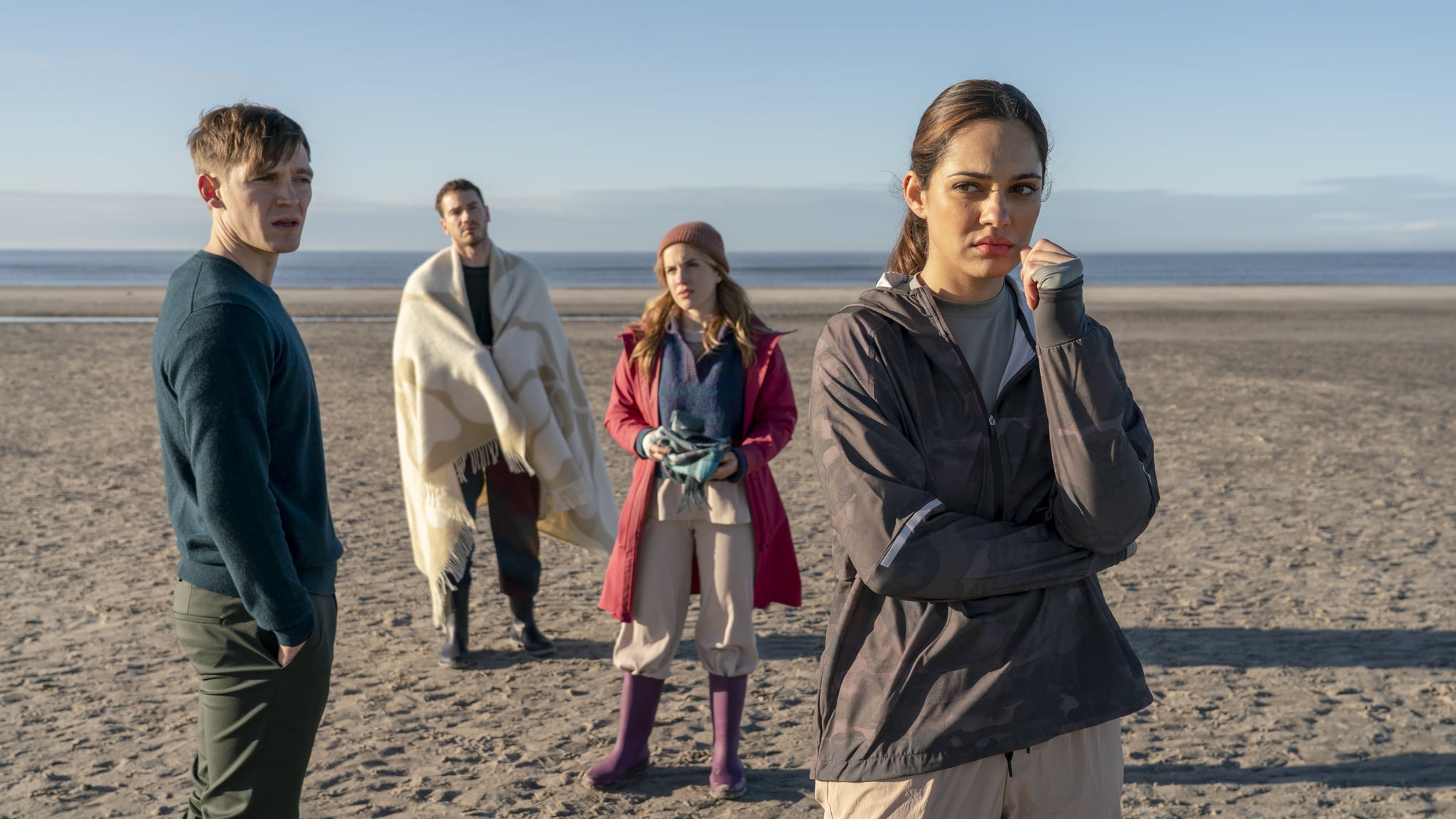
“The Four of Us” is an icily clinical German dramedy about what happens when committed but unmarried couples swap partners for a month, with “no sex” as the only rule they agree to follow.

When it throws them back together for a beach weekend, secrets come out — and then more secrets. Sparks fly, wine is tossed into somebody’s face and somebody else projectile vomits either because of the stress or maybe related to that EPT test we’ve glimpsed.

Yes, the “rule” was broken. Yes, let’s get “everything out in the open” (in German, or dubbed into English). Let the chips fall and the recriminations and fists fly. “

“You really enjoy this, don’t you?” “Yeah, kinda.”

The entire enterprise plays as workshopped, checkboxed and algorithm-assisted. But let’s not lean into German stereotypes, even if the filmmakers do.

Janina (Nilam Farooq) is a magazine journalist angling for a promotion, with one of those “If you don’t come in Saturday, don’t bother coming in Sunday” jobs with an axe hanging over her head. For the past month, she’s lived with Nils (Jonas Nay) a sarcastic workaholic real estate agent.

They’re meeting teacher Maria (Paula Kalenberg) and struggling actor Ben (Louis Nitsche) at Nils’ family beach house on the Baltic Sea. As we’ve seen Maria all kissy-face with Ben, we have a clue as to what’s up even if the film’s opening scenes present Nils and Janina as a tetchy, uncommunicative couple with “control” issues.

Janina running to Ben’s arms at the beach, when we’ve just seen him sneaking one last smooch with the blonde teacher, confirms it.

For whatever reason, they were trying “an experiment.” And it backfired. SOMEbody broke the rules. If that pregnancy stick is any indication, somebody REALLY broke the rules.

The script, co-written by director Florian Gottschick and Florian von Bornstädt, contrives all these “twists” and added complications, starting with who knows what and when. Some of them have more information than others. Every “I’m the last to know?” revelation results in a tantrum.

Nils is insufferably smug and condescending. Janina is self-righteous and vegan. Maria wants what she wants and is tired of her mother’s nagging about settling down and raising a family, and Ben is a “failed” actor with all the confidence issues that entails.

The dynamics of this quartet are tepidly interesting, at best. Scenes that almost could be comical aren’t quite. And the payoff is entirely too easy and pat for any viewer to not see it coming an hour before the closing credits.

Farooq and Nay have the most interesting characters and give the only performances that stick.

I’d say “aside from that” except there is no “aside from that.” This isn’t a compelling take on coupleshood — not quirky, not touching, not much of anything at all except disappointing.

Rating: TV-MA

Cast: Nilam Farooq, Jonas Nay, Paula Kalenberg and Louis Nitsche

Credits: Directed by Florian Gottschick, scripted by Florian Gottschick and Florian von Bornstädt. A Netflix release.

Running time: 1:28

Posted in Reviews, previews, profiles and movie news | Comments Off on Netflixable? “The Four of Us” uncover the perils of “Swapping” in Germany

Movie Review: “Maya and Her Lover” might bring her “groove” back

Longtime girlfriends can giggle and banter “You remember ‘How Stella Got Her Groove Back?'”

“You remember how it ENDED?”

But when it comes to “Maya and Her Lover,” we’re already thinking “She’s Gotta Have It Before She Turns 40.”

The latest from writer-director Nicole Sylvester (“Layla’s Girl”) leans more to the melodramatic former than the laughs-and-lust of the latter. It’s a generally frank and sober-minded essay on Black female sexuality, body image issues and the perils of dating not just somebody younger, but someone from another class.

That’s what hits Maya (Ashanti J’Aria) right in the face when she unexpectedly figures out that maybe unsatisfying sex with “potential” relationships — complemented with battery-powered assistance from the selft-service aisle afterwards — isn’t what she needs at this moment.

She’s a 39 year-old college educated Brooklynite with her own brownstone, a couple of successful business ventures — real estate, photography — behind her and nothing in particular on the horizon.

A “Daddy’s girl” whose demanding professional class father passed a year ago, her BFF Tracey (Faiven Feshazion) can’t bring her out of her ennui with tales of “exotic” sex with Europeans and can’t talk her out of Maya’s “old lady” clothes.

Then the distracted, over-familiar and “uncouth” food delivery guy (Shomari Love) comes on. Strong. The fact that he’s dreamy gives him a shot. The fact that he’s 22 suggests she ought to know better.

In a flash, Maya goes from “You couldn’t PAY me to day a younger man” to melting at Kassim’s touch.

The red flags are everywhere, and yet she persists. He’s Muslim, with the judgmental fervor of a new convert. He’s uneducated, not well-spoken and yet outspoken about all the issues, problems and self-destructiveness he sees in “Black people.” He’s callow and young and defensive about the age difference thing, entirely too quick to refer to himself as “a man” when she points out his youth.

He thinks she’s “thick,” which considering she’s touchy about her zaftig figure, isn’t a plus. He’s tactless, blurting out “You think you’re fat” and going off on sermons about Black people seeing themselves through judgmental white eyes, the racism of Tinder and the like.

“Your rhetoric is skewed and capricious,” she points out, and his swagger doesn’t let him keep “What’s that even MEAN?” to himself.

And yet, there they go. Even though she’s not exactly proud of this fling with a guy about half her age.

Sylvester doesn’t say much new in this “Stella” variation. She’s content to let her cast do the lifting and let the situations play out according to formula.

Love, a veteran bit player, makes this Nation of Islamist mouthy and faintly obnoxious, but tuned-in and woke enough to be worth Maya’s company. Barely. His boorishness gives their relationship an expiration date everyone sees but him.

J’Aria, in her first leading lady turn, internalizes much of what we’re supposed to buy into about Maya, the “Daddy’s girl” who forgets “What would your father think?” long enough to break out of her rut.

The leads could use a little more of the sass and sparkle of Feshazion, who plays “pretty and I know it” like she’s been self-aware that way her entire life.

With TV covering all of this ground via the series version of Spike Lee’s “She’s Gotta Have It” and the “Insecure” misadventures of Issa Rae, “Maya” needed a little more on the plate to play like a complete meal. Aside from that? Not bad. More of a “film festival” dramedy than anything you’d make an effort to catch in a cinema, but not bad.

Rating: Unrated, sex, nudity, marijuana use

Cast: Ashanti J’Aria, Faiven Feshazion and
Shomari Love

Credits: Scripted and directed by Nicole Sylvester. A 1091 release.

Running time: 1:46

Posted in Reviews, previews, profiles and movie news | Comments Off on Movie Review: “Maya and Her Lover” might bring her “groove” back

Movie Review: A reunion in French wine country with she who could be “The Only One”

Here’s a screenwriter who’s a bit defensive about his work. At one point in “The Only One,” a picturesque romance set in the south of France, our antagonist turns on her would-be lover with this rejoinder.

“I’m your Pixie Dream Girl or something,” she complains. “I’m exactly zero of those things.”

The only thing “Tom” (Caitlin Stasey) truly isn’t is the part of that label she left out — “manic.” A laid-back 30-year-old “wanderer” who travels on the cheap as a lifestyle, she is that “free spirit” virtually none of us are at that age. And if David (Jon Beavers) sees her as a “pixie dream girl” without the “manic,” he has cause. To him she was the one who got away.

“The Only One” started life titled “Horse Latitudes” and is a tipsy, impulsive and “romantic” without being particularly romantic romance set in wine country where two former lovers reconnect after a long separation. It’s lovely to look at and quite likeable, if more than a tad predictable.

You can’t get much more “on the nose” in your story than have one character introduce the other to Robert Frost’s “The Road Not Taken.”

Natalie just shows up at a small, remote vineyard, wanders into the kitchen, lights a smoke and waits. David comes downstairs and can’t manage so much as a double take. He hasn’t seen her in six years, since “Dublin,” where they met, connected and he gave her a nickname inspired by a bottle of gin.

“I wasn’t sure you’d be happy to see me,” says the beautiful brunette in that impertinent false modesty of her kind. And to be honest, there’s no indication he is — no smile, no hug, just a wary distance as she gets the espresso machine he hasn’t figured out working. “Tom” was a “barista in Auckland last year,” so he’s in good hands.

As she left without so much as a goodbye, he’s not sold. As his sister (Blake Lindsley) and online marketing guru brother-in-law (Hugo Armstrong) are already staying there, he expects complications. Which there are. Rob practically seethes at the sight of her.

“Pixie dream girls” “borrow” things like bikes and motorcycles, the hearts of would-be lovers, and don’t return them, just an “I thought you would get it” is all she can manage as an apology.

But Tom stays to “help,” as the organic winery has just lost its horse. Her impulses gently pull David towards something less settled, and we and Rob can see it, even if he cannot.

What would you do with a visit, a seeming expression of lingering interest, from “the one who got away?”

The debut feature of director Noah Gilbert and his screenwriter (I assume) brother Seth is a bit of an amble, if not an actual dawdle.

The story gives us directions it can go and then largely stays in one place. But it’s a gorgeous place.

Old ground is covered, wine is drunk and the charming elderly vintner next door (Niseema Theillaud) is there to offer unsolicited profundities.

The milieu makes this movie, with its traditions and history in opposition to the callow marketing of “organic” wine. That’s laid out as hairsplitting “the ‘lifestyle’ thing versus ‘the style of life’ thing.”

More is made of “secrets” that each has and will casually or drunkenly reveal. A long motorcycle ride down to the coast becomes a charming distraction.

And even if not every change in direction or character revelation is handled all that gracefully, the “conflict” is watered down and the “quest” (replacing the dead horse) abandoned, “The Only One” is never less than pleasant to sit through.

The Australian Stasey, of TV’s “Bridge and Tunnel,” and Beavers (TV’s “Animal Kingdom”) make an agreeable pairing, even if the dynamic of the relationship means “sparks” are a risk that first this one, then that one, wants to avoid.

That keeps the entire enterprise a tad too low key to wholly come off. But as I said, “wine,” “South of France,” attractive “likeable” leads, a summery whisk through a Medieval town or two. Who could do with a wistful, romantic road trip right about now?

Cast: Caitlin Stasey, Jon Beavers, Hugo Armstrong, Blake Lindsley and Niseema Theillaud

Credits: Directed by Noah Gilbert, scripted by Seth Gilbert. A Vertical release.

Running time: 1:44

Posted in Reviews, previews, profiles and movie news | Comments Off on Movie Review: A reunion in French wine country with she who could be “The Only One”

Netflixable? “David and the Elves (Dawid i Elfy)” gives us a Polish child’s holiday fantasy

We’ve gotten a bumper crop of beautifully designed, costumed and decorated collection of Christmas tales set in Santa’s world and Santa’s workshop this year. “David and the Elves” is the latest lush entry in this holiday genre, a fantasy about a little Polish boy who really believes, and the vain, showboat elf who comes to visit.

It begins with promise and end with an attempted tugging of the heartstrings. But there are few laughs in between as this one develops a serious case of the “drags” — in Polish, or dubbed into English.

Albert (Jakub Zajac, one of the stars of Poland’s version of “The Office”) is the cocky “five-time elf of the year” in Santaland, always getting profiled by Elf TV, a bit too full of himself thanks to the fact that he’s the guy Santa (Cezary Å»ak) trusts to drive the sleigh. He even has his own line of figurines, which he can leave under this or that tree for “my fans.”

David (Cyprian Grabowski) is a ten year-old who has to move from the snowy, mountain forest wonderland his family has lived in to the impersonal big city of Warsaw. David’s over-enthusiastic father Patrick (Michael Czernecki) has long filled his head with tales of Santa and his elves. David’s mother (Anna Smolowik) hopes this move is what makes “him finally grow up.”

David? He’s just 10.

“I mean PATRICK.”

Dad’s imagination has him point to Santa’s invisible sleigh in the night sky, “with Albert at the reins,” out to David is why Albert picks David’s life to drop in on when he has an existential crisis amidst the year-round toy work and toy delivery operations with Santa.

“What’s all this for?”

Thus we have the Polish version of “Elf,” with an actual magic-wielding pixie mixed up among the humans, and not Will Ferrell.

The bulk of the movie is a wan version of the culture clash that a real live elf has when interacting with people who tell him their fondest Christmas wish, only to have him grant it, with unforeseen problems when those wishes come true.

Turning a Christmas tree into Dad’s wished-for drum kit is no big deal. Sending a stranger who longs be in quiet solitude on a remote lake — without giving the guy winter clothes or taking into account he might have preferred a more tropical climate — is a bother.

David struggles to explain away Albert’s actions to his parents, who somehow always miss seeing the guy in the green suit and red-striped hosiery.

The picture drifts into the happy but sometimes touchy marriage of Santa to his “private dancer” Mrs. Claus (Monika Krzywkowska) and the odd reindeer “smell” joke amid the elaborately conceived workshop complex, which has elves of all sizes and races, from all over the world.

Yes, even Poland’s figured out “inclusion.”

There are a couple of grown-up giggles in this, maybe a few more moments that kids will find funny.

It’s no edgier than Mrs. Claus’s semi-sultry shimmy to “Beyond the Sea,” and the rare piece of North Pole profanity.

“Don’t say ‘damn!’ You’re Santa’s WIFE!”

About the best you can say for this one is that’s it’s inoffensive, bland holiday filler, something to leave on in the next room to keep the tykes tied up while you finish your holiday wrapping, cooking and such.

Rating: TV-G

Cast: Jakub Zajac, Cyprian Grabowski, Cezary Zak, Monika Krzywkowska, Anna Smolowik and Michael Czernecki

Credits: Directed by Michal Rogalski, scripted by Marcin Baczynski and Mariusz Kuczewski. A Netflix release.

Running time: 1:46

Posted in Reviews, previews, profiles and movie news | Comments Off on Netflixable? “David and the Elves (Dawid i Elfy)” gives us a Polish child’s holiday fantasy

Movie Review: A Christmas Comedy with a Corpse — “Twas the Night”

There have been other holiday movies to use the title “Twas the Night,” but it’d be hard to name one that was worse.

A farce about a family Christmas get together involving hiding a body, the only thing without a pulse about it is everything about it. Tone-deaf, ineptly scripted and directed, lifeless and tedious, it’s only 82 minutes long.

I want those 82 back.

Holly (Nicole Pringle) is prepping for the holidays, getting the house ready for her family and her fiance’s, whom she’s never met. Nick (David S. Perez) is helping mostly by “reminding” Holly to call the plumber again, locate an Advent wreath, etc.

But there’s a cloud hanging over this “night before Christmas.” Holly, a psychiatrist, has gone “viral.” Somebody videoed her having a bad day and a good old-fashioned rant at the bell-ringer charity Santa parked in front of their three story brownstone. She even made the evening news, it turns out.

Their mail is filled with “Dear Santa Killer” wishes that she drop dead.

Well, “Merry G–damned Christmas” is all she can say to that.

Don’t know about you, but I’m in her corner, right from the get-go. An incessant beardless bell-ringer outside of my house? I’m either moving or “distractedly” driving up on the sidewalk to deal with that.

But no. “Twas the Night” doesn’t have that sort of edge. Or any edge.

Holly invites beardless Santa “Jesus” (Abel Rosario) in for a peace-offering of hot chocolate and cookies. Nick comes home, there’s an accident involving a laboriously-set-up “hang the decorations without a proper ladder,” and Santa’s down, there’s blood with Nick going “Who IS this?”

“JESUS” is Holly’s only appropriate response.

As there’s no pulse and lots of blood and four parents knocking at the door, let’s hide the body and get on with our holiday. Holly can’t call the cops. She “threatened” this guy and it was caught on camera.

“I’m not ACTUALLY going to kill someone,” she sputters on the phone to a hate caller. “It’s a figure of SPEECH, genius!”

That’s the tone the movie needs, the edge that Holly should play in every moment.

Alas Pringle and co-writers/directors Chris Rodriguez and Grant Rosado didn’t see that, and their general haplessness shows up everywhere else as well.

They blow punchlines, have scenes hit their edit point long after their payoff and can’t find anything funny to do with a body in a brownstone on the night before Christmas.

There are maybe two laughs here, both of them involving Holly, both with hints of Pringle going all Sherri Shepherd “angry Black woman.”

A bigger laugh is here, on the IMDB page, where one of the directors or some sap who wrote them a check “reviewed” this dog with “10 on a scale of one to ten.”

That’s as groaningly obvious as everything else about this staggering, stumbling corpse-on-two-legs of a movie, the worst Christmas film of them all.

Rating: unrated, a little blood, some profanity

Cast: Nicole Pringle, David S. Perez, Abel Rosario, Cynthia D. Perry, Lisa Panagopoulos, Paul Van Scott, James Lee Fronck.

Credits Scripted and directed by Chris Rodriguez and Grant Rosado. A Vertical release.

Running time: 1:22

Posted in Reviews, previews, profiles and movie news | Comments Off on Movie Review: A Christmas Comedy with a Corpse — “Twas the Night”