Movie Review: A Dinner Party that Goes Wrong LONG before “Barbarians” arrive

A high end housing development is going up on a big British farm that changed hands under unsavory circumstances, a development resented by locals, including the family that lost that farm, and all on ancient land with Druid legends attached to it.

There’s a star sculptress whose work is so prized the fact that she’s creating Druid monoliths to decorate each McMansion’s entrance is a huge selling point. She and her unemployed filmmaker husband are thus presented with the first finished home.

And on this night, the hustler-developer, his lady fair and the latest designer drug are guests for a dinner celebration.

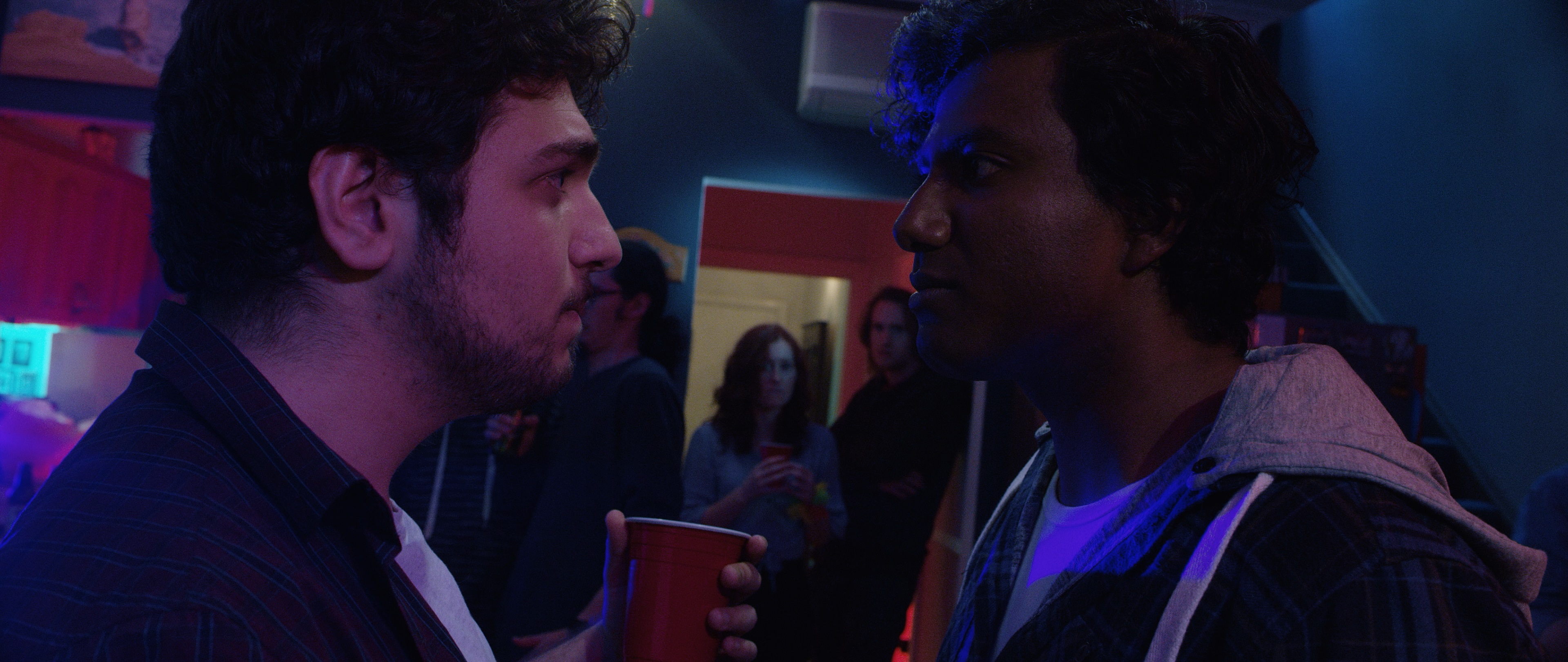
Things are sure to get interesting as “alpha male” posturing, old resentments, broken promises and a toxic personalities are thrown together. And all that’s before masked intruders, the “real” “Barbarians,” show up.

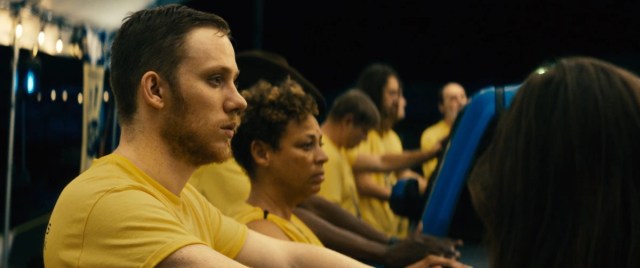
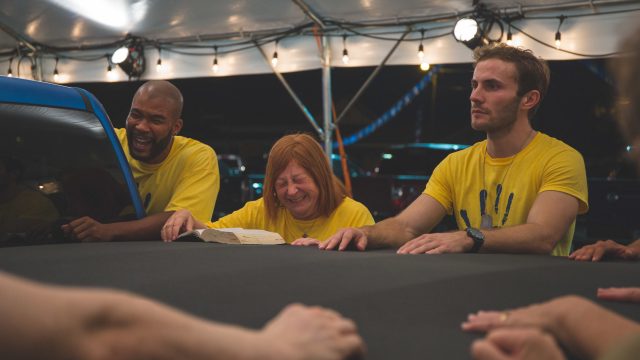
The writing-directing debut of producer Charles Dorfman (“The Lost Daughter,” “The Honest Thief”) lurches from tetchy to tense to downright harrowing as two couples/four people spend the first and much of second act showing us how they really think of each other, only to be brutally tested by the goons who crash their party.

They’re mostly Brits. Can they learn the concept of “United we stand, divided we might not survive the night?”

Catalina Sandino Moreno (“Maria Full of Grace” and TV’s “The Affair”) is Eva, the confident sculptress who figures this new house and and between-projects filmmaker Adam (Iwan Rheon of “Game of Thrones””) is a “fresh start”for them. Bitter, jealous Adam may not agree.

Because tall, swaggering, showboating developer Lucas (Tom Cullen of “Knightfall”) is a bully and a blowhard and isn’t likely to let them — or Adam — forget what he figures they owe him. Whatever else Tom’s wife Chloe (Inès Spiridonov) might be, “enabler” seems to top her list of obligations.

Their evening is already on tipsy tenterhooks when Lucas trots out an eyedrop that promises to be “like ten years of therapy in one night.” And then comes that knock on the door and you-know-what gets real.

Dorfman and his players handle the long, nerve-fraying build-up with skill. And the payoff, with its twists, escalating violence and pointed causes-and-effects, doesn’t disappoint even if it’s a tad thin on surprises.

There are scores of home invasion thrillers that “Barbarians” borrows from — “The Strangers” and the French film “Them” seem most directly related to it. Wrapped in the trappings of horror, this formula action picture doesn’t get by so much on frights as on visceral trapped-and-trying-to-escape situations, which pay off nicely.

And as the violence escalates and whatever was getting out of hand gets seriously out of hand, “Barbarians” can turn downright riveting.

Rating: unrated, violence, drug abuse, profanity

Cast: Catalina Sandino Moreno, Iwan Rheon, Tom Cullen, Inès Spiridonov

Credits: Scripted and directed by Charles Dorfman. An IFC release.

Running time: 1:29

Posted in Reviews, previews, profiles and movie news | Comments Off on Movie Review: A Dinner Party that Goes Wrong LONG before “Barbarians” arrive

Movie Review: Czech Seminarians face the Ultimate Test after the Russians Invade — “Servants”

The 2020 Czech drama “Servants (Sluzobníci)” could not be a more timely home streaming release, it being a drama set not long after the 1968 Warsaw Pact, aka “Soviet Union” aka “Russian” invasion, “regime change” and occupation of Czechoslovakia.

Director Ivan Ostrochovský’s austere black and white tale is a story of Czech passive resistance running up against fearful, over-eager collusion in the aftermath of that “keep the satellite states in line” assault. It’s a parable-as-crucible for the country as a whole, a timely reminder of past-and-present Russian repression set in a Catholic seminary.

Juraj and Michael (Samuel Skyva and Samuel Polakovic) are friends who join the prestigious Prague Catholic school for priests together. It’s around 1970, and priests and Party bureaucrats alike are obsessed with interpretations of the late Pope John XXIII’s encyclical, “Pacem in terris.” Priests at the seminary, and some of the more tuned-in and activist students, take that edict to heart, determined to stand up for human rights in the face of a brutal crackdown on civil liberties.

Those doing the cracking down, led by a government minister (Vlad Ivanov) “in the churches department,” are hellbent on interpreting the encyclical as an order AGAINST activist priests. This party-member/minister is determined to ferret out dissent in the seminary in order to please his Russian overlords.

We’re shown unanimous votes in the now-rubber-stamp legislature, and the seeming compliance if not downright collusion by the chancellor (Vladimír Strnisko) who faces “visits” that are more like “inspections” from this Ivan apparatchik.

When the chancellor cautions the new class about “some of our brothers strayed from the righteous path” (in Czech with subtitles) the previous year, he’s not talking about sex or any of the modern church’s biggest scandals. He’s talking about putting up the wrong sort of Biblical reference and call to action on the bulletin board.

Just such a note gets all their typewriters impounded, as if the goons can ferret out a dissenter this way.

As the film’s opening scene is a car pulling into a tunnel to reveal a body in the trunk, we know the stakes. Do the young priests?

One friend is approached, recruited and joins the secret group within the school which obtains and passes on smuggled-in books, and when crackdowns start, knows which payphone to call Radio Free Europe’s tip-line about this crackdown, that arrest, a suspicious death-in-custody or a clergical hunger strike.

The other friend? He might feel left out. And as the surveillance outside and interrogations inside ramp up, very young men face life or death consequences head-on as the chancellor does all in his power to “keep this school open.” But at what cost?

Even the man doing the persecuting is paying a price. He’s 50something and looks much older, living alone, in poor health with what we can see is a worsening case of stress-exacerbated eczema.

Ostrochovský’s film, which he co-wrote with Rebecca Lenkiewicz and Marek Lescák, isn’t a Cold War thriller or account of espionage behind the Iron Curtain, although there are hints of those genres around the edges. “Servants” is about those literal “servants” weighing what they know about right and wrong against what their elders — teachers, either conspiratorial or cowed, and the Russian-controlled government — are demanding of them.

The interrogations are quiet and coercive with just enough menace to heighten the moral dilemma such victims faced. Just a generation before, their parents had lived under German Nazi occupation, and strained to resist it. Now, it’s Russian communists. Are they up to the challenge, prepared for the mortal consequences if they’re ratted out, caught or falsely accused?

Ostrochovský never quite achieves “riveting” with this narrative. But he’s made a chilling reminder of the Bad Old Days, when the Cold War might have given the world moral clarity about who was for freedom and civil liberties and who sought to quash them. There was a cost to that clarity. It came with the price of a planet living on a nuclear-tipped edge and ordinary people on the front lines facing prison, torture or death for not sitting by and waiting for rescue from the Free World, but speaking out and taking the consequences when the stakes could not have been higher.

Rating: unrated, violence

Cast: Samuel Skyva, Samuel Polakovic, Vlad Ivanov, Vladimír Strnisko

Credits: Directed by Ivan Ostrochovský, scripted by Rebecca Lenkiewicz, Marek Lescák and
Ivan Ostrochovský A Film Movement release.

Running time: 1:20

Posted in Reviews, previews, profiles and movie news | Comments Off on Movie Review: Czech Seminarians face the Ultimate Test after the Russians Invade — “Servants”

Netflixable? Japanese couple discovers “Love Like the Falling Petals” can be fleeting

A practice engrained by years in newspapers has me avoiding the use of staged/photoshopped promotional photos for reviews of films.

But this image so perfectly encapsulates the Japanese weeper romance “Love Like the Falling Petals,” that avoiding it wouldn’t be fair to the reader.

It’s an insipid “meet cute” romance that never lives up to that introduction, a maudlin meander through an old fashioned Tokyo courtship (mostly chaste) that takes a turn towards “Disease of the Week” TV movie. And that’s rarely a label we trot out for films we endorse.

Yoshihiro Fukagawa’s film, based on a novel by Keisuke Uyama, reaches for a love-is-fleeting-but-love-can-be-eternal message yet struggles to not be love-can-be-damned-boring in this soggy, sentimental slog.

A young photographer (Kento Nakjami) voice-over narrates his love story with the hair dresser (Honoka Matsumoto) he took almost a year to ask out.

“People’s hearts can be more fickle than flower petals,” everybody seems to know. But when the cherry blossoms are in bloom, he gets up his nerve and springs an invitation on her while he’s in her chair. It’s just that he abruptly turns his head as he does.

Blood and profuse apologies fill the Penny Lane Salon. But Misaki’s tears and offer to “pay your medical bills, do whatever you want,” sounds like an opening to earlobe-lopped Haruto. A “date” it is.

He’s somewhat anal retentive, fretting over what day they should go see the flowers, weather being a prime factor. She’s an orphan whose gruff, bluff bartender brother considers himself her father figure and the diners/drinkers at his pub her “family.” Threats notwithstanding, a love story begins.

But it turns out Haruto only passed himself off as a photographer. He quit an internship at a prestigious photographer’s studio and subsists on dead end jobs. Misaki lights into him, and chastened, he apologizes.

“I’ll turn the lie into truth!” (subtitled, or dubbed) he promises.

There’s a lot of apologizing here, a signature of Japanese culture that decorates almost every film you see from there. But there’s little sense of the life there and how lives are lived and how love can um BLOOM in “Love Like the Falling Petals.” The liveliest milieu is that bar, the scenery sampled is limited and the romance only turns truly “real” when she gets her “An Affair to Remember/Dark Victory” news and they part.

So the arc of this story is insipid to tragically sad. And neither extreme is certain to provoke more than an indifferent shrug from even the most saccharine-tolerant viewer.

Rating: TV-14, sexual situations, possible suicide

Cast: Kento Nakajima, Honoka Matsumoto

Credits: Directed by Yoshihiro Fukagawa, scripted by Tomoko Yoshida, based on the novel by
Keisuke Uyama. A Netflix release.

Running time: 2:09

Posted in Reviews, previews, profiles and movie news | Comments Off on Netflixable? Japanese couple discovers “Love Like the Falling Petals” can be fleeting

Documentary Review: “The Sound of Scars,” a metal band’s Coming Out Story

In a streaming universe where whole channels are devoted to music documentaries, it’s inevitable that almost any band you an think of, any band anybody cares about, is going to merit a film telling their story.

Many of these films are “Behind the Music” formulaic, with the odd variation on a theme. Anvil never made it, for instance.

But “The Sound of Scars,” which tells the story of Life of Agony (LOA), stands out by telling us the story of its lead singer’s transition, from tortured and sometimes even suicidal Keith Caputo, to Mina Caputo, who she is today.

This transition happened just as they were about to break big. And the film’s story arc follows takes us from replacing their singer, to bringing her back as Mina, with struggles and triumph and a refreshing level of acceptance from their fans if not the entire hardcore scene.

The members — Caputo, guitarist Joey Zampella (Joey Z), bassist Alan Robert and recent-replacement drummer Veronica Bellino — tell tales of enduring “Raging Bull” childhoods in Brooklyn (Caputo and Zampella are cousins), where alcohol, abuse and violence were a part of daily life.

The founding cousins got their starts as roadies for other Biohazrd, which played in their local metal club L’Amour, where stage-diving and “letting out (testosteroned teen) aggression on each other” with stage diving, crowd-surfing and brawls were very much a part of that cacophonous scene.

When they formed Life of Agony, with songwriter/bassist Alan Robert coming up with the name, they staked out a more melodic, possibly even radio-friendly corner of hardcore. They still had an audience member die during a show there, and spent time in court over that calamity.

Had Caputo not wrestled with “the genderlessness of life,” and eventually quit to come out and reconcile the fact that “I’d always been feminine,” even in their most rough-and-tumble days, that accidental yet inevitable consequence of violent mosh pits (“Pitting” as Joey puts it.) might have been the focus of this film. It’s all “Somebody tried to steal my sneakers” crowd-surfing fun until the ambulances show up.

Perhaps a future Pearl Jam doc will take on that.

Director Leigh Brooks, who also did a Terrorvision-on-tour doc, interviews band members, record company folks and at one point has Robert’s parents (a lot less “Raging Bull” than the Zampella/Caputos, apparently) unironically read Alan’s bleak lyrics from the back cover of one of their LPs for a “Steve Allen Show” era laugh. As music docs go, “Scars” is almost entirely reliant on one “hook” Otherwise, the range of interviews is too narrow, the entertainment value limited.

But Mina’s journey has been an interesting one and the band is very much a big deal, as Rolling Stone referred to their debut LP, “River Runs Red,” as one of the great metal albums. And the title of their latest, which also gives the name to this film, points to exactly what this troubled journey to triumph is — “The Sound of Scars.”

Rating: unrated, profanity, violence, discussions of drug abuse, suicide, adult subject matter

Cast: Mina Caputo, Joey Zampella, Alan Robert, Veronica Bellino

Credits: Directed by Leigh Brooks. A Cinedigm release.

Running time: 1:30

Posted in Reviews, previews, profiles and movie news | Comments Off on Documentary Review: “The Sound of Scars,” a metal band’s Coming Out Story

Movie Review: Retired biologist ponders a runaway with a famous name — “The Issue With Elvis”

A mushroom expert bonds with a runaway he meets in the woods collecting mushrooms in “The Issue with Elvis,” a milder-than-mild-mannered family drama set in wild, wonderful West Virginia.

The drama is low-key/low-stakes, the pace is leisurely and the dialogue bland to inane in this All-in-the-Wincott-Family production.

Canadian character actor Jeff Wincott leaves his martial arts behind, but not his Canadian dipthongs, as retired academic mycolist Dr. Mercer, a man living alone in the woods outside of Morgantown but still able to rattle off Latin names and long lists of medicinal/culinary properties of assorted fungi on sight.

He’s not seeing nearly as much of his most treasured varieties in his corner of the woods. It turns out there’s this kid (Wolfgang Wincott) out there harvesting as well. Mercer barters for some of the kid’s mushrooms, and soon they develop a little system — food for fungi.

But no kid should be living in the woods, or the edge of them, in late winter. Mercer’s curiosity is piqued when the boy finally starts talking. The kid gives his name as “Elvis,” named after “Costello,” not Presley, he insists. And as the good doctor takes an interest he takes him in.

In between discourses on mushrooms, how you only harvest “half” from the tree so that it’ll come back, about life, religion and “modern medicine,” Mercer finds time to make some calls as he tries to figure out what to be with a runaway with a made-up name.

And that’s about all there is to this inoffensive, innocuous and dramatically-flat film by Jeff Wincott’s wife and Wolfgang Wincott’s mother. It’s not particularly interesting, and the performances do nothing to animate it.

The shot selection isn’t the best, the one pointless instance of juggled hand-held footage feels amateurish and in low-light, the shortcomings of whatever gear they used to record “Elvis” stands out.

It’s also worth pointing out that Charlotte Wincott started out as an academic neuroscientist before taking up movie making. Their son will hopefully experience a similar search for a true calling, as acting doesn’t appear to be it. Leaving your kids’ stumbling line-readings (almost every line) and awkward, coached gestures in the finished film isn’t exactly a confidence booster.

Rating: unrated, some profanity

Cast: Jeff Wincott, Wolfgang Wincott

Credits: Scripted and directed by Charlotte Wincott. A Random media release.

Running time: 1:28

Posted in Reviews, previews, profiles and movie news | Comments Off on Movie Review: Retired biologist ponders a runaway with a famous name — “The Issue With Elvis”

Movie Review: The Formative Years of a Mass Shooter — “Nitram”

Film and the culture it reflects tends towards gross oversimplifications. When a terrible crime happens, we want it explained. We want to know what “triggered” this person, what made them “finally snap.”

The truth is always muddier, more complicated. Sometimes, some disturbed people are repeatedly, almost constantly “triggered.” It’s just the last and worst incident forces us to put it all together, to “see the signs.”

For Nitram, it could be a lawnmower that won’t start, being told that he can’t/shouldn’t set off fireworks at a nearby school during recess or even a suggestion that he cut his unkempt hair that sets him off.

Nitram” is a tense thriller about a mass shooting whose edge-of-your-seat suspense comes from the viewer’s dread and growing alarm at how “off,” angry and unmanageable its subject plainly is. What will set off the title character, played with dead-eyed, hair-trigger intensity by Caleb Landry Jones, next? And how bad will it be?

“Nitram” spelled backwards is “Martin,” the filmmakers’ way of giving themselves a little distance from the worst mass shooting in Australian history, and a bit of fictional latitude in depicting it. The murderer’s name is Martin Bryant.

Director Justin Kurzel (“Assassin’s Creed”) reteams with his “True History of the Kelly Gang” screenwriter Shaun Grant to show us a developmentally-disabled child with dangerous tendencies who grew up as a medicated, almost unmanageable son lacking empathy, impulse control or a rational way of approaching any problem that confronted him.

He’s in his mid 20s when he threatens to run away. Again. His weary mother (Judy Davis) is sanguine about that.

“He’ll be back. No one else can live with that boy but us.”

There’s conflict in the house about regulating the son’s behavior. His mother still makes attempts at reining him in. His dad (Anthony LaPaglia) gives him more leeway just to limit the meltdowns.

The kid’s mania for fireworks began in childhood where we see him interviewed on television with other kids in a burn ward.

“You think you’ll be playing with firecrackers again,” the reporter wants to know? After all, he’s had skin grafts and suffered great pain.

“Yes,” the tween tells her. No “lesson learned.” He’s hooked and he cannot fathom the idea of consequences.

The adult he grows up into gets disability payments from the state and regular healthcare visits to a troubled shrink. Nitram drifts from passion to passion. He was into scuba diving. Now he’s all set to become a surfer. But he can’t earn enough extra to pay for a board, as he can’t even get a driver’s license.

So the social-signals-missing adult with the long, stringy hair and scary intensity sets off, door to door, trying to earn money mowing lawns. The neighbors, many of whom scream at him about the fireworks thing, have to ask the frankly-creepy guy to remove his foot from their doorway to close it on him. His sales pitch is blunt to the point of rude.

Yet the flighty, Gilbert & Sullivan-addicted oddball down the road, Helen (Essie Davis) takes him on. She has a constantly-spinning record player and a house full of dogs, and tells him “You look like a movie star.” His behavior around her seems calm enough, until we see what he does when somebody else is driving, until the target-practice with his air rifle comes to her yard.

And no, his “I just get sad sometimes” isn’t a real explanation.

Kurzel and Grant blend in story points from the real shooting and its prologue with fictional speculation and cinematic simplification. There was a B & B that dad had his heart set on buying so that their son could help them run it, and both parents could be there to “keep an eye” on him and regulate his behavior.

Jones, of “Three Billboards” and “Get Out,” mastered the Aussie accent of this Tasmanian killer, and gives a performance that could make one and all mutter, “Well, we saw that coming.”

Just casting the two-time Oscar-nominee Davis as his mother renders the woman bitter, brittle and resigned to the life sentence giving birth to him gave her.

One fraught scene has the son try to deliver some sort of “tough love” to his father, who turns morose, refusing to get up and get dressed after the lifeline that purchasing Seascape B & B is yanked from him. It’s a brutal moment, and we wonder if this is something the kid’s parents tried on him early on, to no avail.

And there’s the soul-sucking amorality of a “no worries,” just-make-big-sale gun dealer, who lets the lack of a firearm license slide with an “Awright, nooo dramas” as he arms this Tasmanian sociopath to the teeth.

It was always going to be a chilling, emotionally deflating film. Kurzel and Grant double-down on that by not showing the murders and not focusing on the victims. And they finish it off with a coda that doesn’t let the way this slaughter impacted Australian society get sugar-coated, the way it’s often discussed in the US.

There are people among us who are “triggered” without even trying. And if the wrong politicians get a say, there’s no keeping machine guns out of the country or out of their trigger-happy hands.

Rating: unrated, violence

Cast: Caleb Landry Jones, Judy Davis, Anthony LaPaglia, Essie Davis.

Credits: Directed by Justin Kurzel, scripted by Shaun Grant. An IFC release.

Running time: 1:51

Posted in Reviews, previews, profiles and movie news | Comments Off on Movie Review: The Formative Years of a Mass Shooter — “Nitram”

Movie Review: A Finn and a Russian share “Compartment No. 6”

Downbeat, infuriating, reluctant to give up its mystery and illogical and anticlimactic by its finale, “Compartment No. 6” parks us in a Russian train for a long journey from Moscow to Murmansk with two intriguingly mismatched traveling companions.

It might be dismissed as one of those Cannes Award winners destined to be forgotten not long after the fizz on the champagne has bubbled out. But grasping for meaning in its unsettling, occasionally comic and always cryptic “relationship” can be an interesting thought exercise.

At a vague point in time after “Titanic” and before Putin, a just-jilted gay college student and a hatefully boorish and drunken Russian mine-worker get off on the wrong foot and yet must endure one another for days of infuriating, fraught and occasionally comical interactions as they rumble north in the late Russian winter.

Chainsmoking, aggressive and bottle-emptying Ljoha (Yuriy Borisov) seems somewhere far down the obnoxious/dangerous spectrum. He’s bad enough that I wondered for a few minutes if he wasn’t going to wind up dead with the Finnish woman — who I never heard called “Laura” (Seidi Haarla) — as the suspect.

He is that insistently awful. She is that anxious to get out of there, change compartments, go down a class in accommodations or even exit the train.

But there is no going back to Moscow, where she’s been studying at the university, destined to be just another “houseguest” of the charming, sophisticated and sexy older academic Irina (Dinara Drukarova).

Loutish Ljoha staggers into the sitting/sleeping berth, fills a glass out of a fresh bottle, and instantly misreads the situation, starting in with scores of questions. Whatever she’s doing, documenting the trip to see “the petroglyphs” (ancient stone carvings) outside of the Arctic Ocean seaport of Murmansk by camcorder, collecting her thoughts or reading, he is a Russian male in his cups and will not be ignored.

“You look so serious all the time,” he says (in Russian with subtitles). “You’ll get old too soon...wrinkles.”

He’s hitting on her. She isn’t having it. And he won’t stop. Her Russian isn’t entirely fluent, but when she finally lets him engage, she gives rude, obscene mistranslations for his inane “How do you say?” queries about Finnish.

North American viewers might be puzzled that she’d engage with him at all. But director and co-writer Juho Kuosmanen, adapting a novel by his fellow Finn Rosa Liksom, forces us into her shoes — a gay foreign woman trapped in this situation, with no lifeline from the rude Russian porter, rude waiters in the dining car or instantly-moved-on lover back in Moscow.

“You think I’m a bad guy?”

“I only know what I see.”

It’s probably a mistake to read too much into the geopolitical metaphor that seems all the more obvious since Russia invaded Ukraine, which happened a year after “Compartment No. 6” was the toast of a pandemic-depleted Cannes, almost two years after it was made.

But Russia has always been Russia, even with that ’90s interlude when the world hoped it might outgrow its belligerent, vodka-soaked adolescence. And Finland’s relationship with the Bear next door has always been perilous.

Even that, coupled with a scorned woman’s softening to the abrasive “any port in a storm” jerk she’s been thrown together with, is a hard sell. I never bought that, gritted my teeth at every fresh rapprochement and took on a little extra concern for this young woman giving anything like encouragement to the bully she’s clearly paired up with.

As others are stuffed into the compartment for this or that leg of the journey, does he really seem less toxic by comparison? Even the incessant guitar-playing of a clingy, instantly-over-familiar Finnish tourist feels like a welcome respite.

Still, the stark, grey ugliness of just-post-Soviet Russia is immersive, and the grace notes — friendly mechanics offering a bottle, a slowly-softening porter, a near heroic effort to help Laura complete her quest (treated as an anticlimax) — give us something to cling to in “Compartment No. 6.”

No, Cannes didn’t discover the “new Aki Kaurismäki” (“Leningrad Cowboys Go America”) with this film. But Kuosmanen hopefully has an entire career ahead of him to make this Cannes-honored fluke a mere stepping stone to acclaim he might eventually deserve.

Rating: R for language and some sexual references

Cast: Seidi Haarla, Yuriy Borisov

Credits: Directed by Juho Kuosmanen, scripted by Andris Feldmanis and Juho Kuosmanen, loosely based on a novel by Rosa Liksom. A Sony Pictures Classics release.

Running time: 1:47

Posted in Reviews, previews, profiles and movie news | Comments Off on Movie Review: A Finn and a Russian share “Compartment No. 6”

Netflixable? Linklater affectionately remembers America’s moon-landing years with “Apollo 10 1/2”

Of all the projects Netflix has given great directors the money to film — many of them Oscar-nominated, some of them even bringing master filmmakers like Jane Campion back to the mainstream — tossing money to Richard Linklater got them the most adorable results.

Linklater, an indie icon since “Slacker,” a writer-director lionized for “Boyhood,” took Netflix money and made a rotoscoped animated film, this one a classic of American late ’60s nostalgia.

“Apollo 10 1/2” is ostensibly a space race comedy about a kid plucked from a Houston elementary school after NASA’s first moon lander is accidentally underbuilt and only has room for a child. But it turns out to be Linklater’s thoroughly-detailed survey of a childhood spent growing up at the tail end of the “space race,” when the future seemed without boundaries, America embraced the new and all that mattered was “beating the damned Russians” to the moon.

So while a couple of “Men in Black” (Zachary Levi and Glen Powell) drop by Ed White Elementary (named for an astronaut) and recruit young Stan (Milo Coy) for their “super secret” mission, telling him “Stan, you’re our only hope,” the adult Stan’s memories of that are almost crowded out by everything else that was grabbing his attention in that summer of ’69.

Jack Black reunites with his “School of Rock” director to voice-over narrate that sentimental journey, describing everything from what was on TV back then and what “Astroworld,” the amusement park next to the world’s first domed stadium, the Houston Astrodome, was like, to the now-banned corporal punishment that faced school kids, neighborhood misbehavior and even Little League players who dared to make an error.

If you grew up in that era — Linklater and I are contemporaries — you will be bowled-over by the depth of details, the toy rocket mania and every other dangerous thing under-supervised kids and their didn’t-know-any-better parents did or allowed rather than let kids stay indoors and watch TV or play video games.

If you’re too young to remember any of this, you might be gobsmacked at all the strife, struggle, shock of the new and dizzying hope for the future that went on while “Sugar Sugar” was playing on the radio.

Unrestrained freeway rides in the bed of a pickup truck, “roman candle” fights and inattentive child care all seemed to come home to roost on the evening news, where Vietnam casualty counts began as grim and found their way into “routine” — normalized for a distracted, mass-consuming public.

“We were expendable,” adult Stan (Black) drolly notes. Indeed they/we were. After previous summers’ riots and assassinations, “the last ‘duck-and-cover'” generation would expect no less.

“Twilight Zone” to Jell-O molds, “2001: A Space Odyssey” to single-breadwinner families able to enjoy the good life on a single salary, it’s all a bit shocking if all-too-warmly remembered.

Rotoscoping, which involves filming actors and then coloring their performances to turn the footage into animation, tends to render its subject matter timeless, as Linklater did with “Waking Life” and Dorota Kobiela and Hugh Welchman did with their animated/painted last days of Van Gogh classic, “Loving Vincent.”

With almost the entire film consisting of voice-over narrated memories, montages of events and vignettes as backdrop, “Apollo 10 1/2” might have been utterly forgettable without the rotoscoped adding of computer-painted rose-colored glasses.

But in this form, it becomes something timeless, not autobiography (Linklater’s parents divorced when he was 7), but a sweet and somewhat innocent memory play animated in brighter-than-real-life color, a summary of how things were in an America that accomplished great things even as its institutions strained at revolutionary/evolutionary change that continues to this day.

Rating: Injury Images|Some Suggestive Material|Smoking)

Cast: Narrated by Jack Black, with Zachary Levi, Lee Eddy, Milo Coy, Bill Wise, Josh Wiggins

Credits: Scripted and directed by Richard Linklater. A Netflix release.

Running time: 1:30

Posted in Reviews, previews, profiles and movie news | Comments Off on Netflixable? Linklater affectionately remembers America’s moon-landing years with “Apollo 10 1/2”

Documentary Preview: “Lioness: The Nicola Adams Story” profiles the first woman to medal in Olympic boxing

This story of the Great Brit who boxed her way to glory — at the 2012 London games, no less — opens April 5.

Posted in Reviews, previews, profiles and movie news | Comments Off on Documentary Preview: “Lioness: The Nicola Adams Story” profiles the first woman to medal in Olympic boxing

Movie Review: “Jujutsu Kaisen 0., the Movie”

A critic-friend I’ve sat on several film festival panels with over the years once explained to a questioner from the audience the difference between critics and filmgoers.

Most movie fans only go to films that interest them, genres, franchises, etc. that they have an investment in. If video game, comic book, horror or manga adaptations are your thing, you’re predisposed to like what you decide to go see.

Critics, on the other hand, “see everything,” he said.

It’s in that spirit that I approach a film like “Jujutsu Kaisen 0.,” a Japanese anime blockbuster that opened to very good business in North America last weekend. One wants to see what all the fuss is about, and see if all the Rotten Tomatoes reviews were merely fanboy endorsements, as even the ones that seem of mixed feelings or negative appear to be labeled “fresh.”

Fans, some of them critics, were presold on it. But is it for anybody else?

While I like some anime, I’ve seen enough of it to form an opinion of what has merit and what is pandering piffle, with “story” and “artistic ambition” being the big difference between winners and losers. And as a lover of Japanese cinema, I thought I’d sit in with the faithful to catch a subtitled (not dubbed) version of “Jujutsu.”

TV anime veteran Sunghoo Park’s “Jujutsu Kaisen O.” has a whiff of “Into the Spiderverse” about it. It’s literally like a manga come to animated life. Park uses manga-style intertitles and interstitials to introduce characters, treats us to manga-mimicking extreme action, extreme violence and exaggerated facial expressions in extreme close-up.

The animation, while still anime-jerky (under-animated) is CGI-assisted and more striking and luridly colored, “darker” than the water colorish hand-painted pastels of the classics of Hiyao Miyazaki and others. It’s a bit eye-popping.

But the story isn’t all that. It’s about a shy, bullied teen — Yuta Okkotsu — who is haunted by and protected by a curse, the vengeful spirit of a little girl he professed lifelong devotion to as a child. She was run over by a car and lives on as Rita, the curse that avenges him on others who treat him badly. In an opening scene, we see the pool of blood and the gruesome closet stuffed with mangled bodies, the aftermath of Yuta’s last “incident” at his last high school.

In the spirit of “No Child Left Behind,” Yuta isn’t executed, but summoned to a special school for special people like him. His enthusiastic teacher, Satoru Gojo, dons a blindfold each day before addressing the class. And with standoffish, gifted, curse-mastering/curse-battling classmates Maki Zenin, Toge Inumaki, and Panda, Yuta will be trained to control, fight and dispense with curses of all types, of course leading up to facing his biggest demon, the enormous, powerful and still-jealous-after-death Rita.

What an outsider sees is a sort of “Wizarding World” setting, Jujutsu High, with rules (“Only curses can affect other curses.”), students with magical powers and creatures/curses that range in appearance from “Ghost Busters” cuddly apparitions to “Alien” inspired monsters.

The students instruct each other as their sensei, aka “the dumb blindfolded guy,” “looks” on and provides guidance.

Yuta’s “normal” teen concerns, that “I want to be needed by someone,” are hindered by the burden of his childhood, a curse bound by a ring that Rita once gave him, because as his teacher intones, “There is no curse more twisted than love.” But the big question might be, “Who cursed whom?”

As an immersive experience, this adapted prequel to a best-selling manga series isn’t so much hard to follow as ornately detailed to cover what thin storytelling it actually is. One of the great things about Japanese cinema and TV is the sense that more than perhaps any other culture in the world, when we dip into it the instant feeling of “alien” comes through. I find the ingrained mythos, the legends, the cultural differences that turn up in everything from romances and gangster tales to horror movies, ghost stories, workplace and family dramas endlessly fascinating.

Hell, even “Iron Chef,” which helped introduce the “foodie” fad to North America, was a culturally illuminating hoot.

But as a medium for storytelling, anime is seriously miss-or-hit with me. There’s a world of difference between “The Wind is Rising” or “Howl’s Moving Castle,” “Ponyo” or “My Neighbor Totoro” and the average “Dragon Ball” franchise installment, and as pretty and vivid and violent as it sometimes is, “Jujutsu Kaisen O.” falls on the wrong end of that spectrum. It has all the virtues and failings of many a comic book adaptation — impressive visuals, generic supernatural action, thinly-developed characters and a “story” that barely fulfills the obligations of that label.

The jokes — many of them mouthed by the manic and not-at-all-mellow Panda — and the sight gags lean towards simply goofy or low-hanging fruit. The plot is convoluted, not the least bit inviting or deep and frankly puerile, with PG-13 violence and “darkness” draped over it.

Perhaps there’s more on the written/drawn manga page, and it’s understandable that fans would cherish the chance to see how a favorite manga is animated into motion. You made it a hit, and plenty of critic-fans have endorsed it. Cosplay away.

But does it ever really come to life? Not for me.

Rating: PG-13 for violent content, bloody images, language, thematic material and some suggestive references

Cast: The voices of Megumi Ogata, Mikako Komatsu, Kōki Uchiyama, Tomokazu Seki, Yûichi Nakamura, Subaru Kimura and Kana Hanazawa

Credits: Directed by Sunghoo Park, scripted by Hiroshi Seko and based on the Gege Akutami manga. A TOHO Animation film, a Crunchyroll release.

Running time: 1:45

Posted in Reviews, previews, profiles and movie news | Comments Off on Movie Review: “Jujutsu Kaisen 0., the Movie”