Series Review: “The Lord of the Rings: The Rings of Power”

Women drive half of the story threads of the latest version of “The Lord of the Rings,” and that’s a definite broadening of perspective for the Amazon-created origin story “The Rings of Power.”

But is it enough to answer that nagging question that hangs over every sequel, prequel or franchise reboot? “Why was this made, again?”

It’s familiar enough for even a casual fan to follow, a tale with beautiful elves and pan-ethnic humans and Irish-accented Harfoots (Harfeet?) of the Hobbit persuasion. And the dwarves are Scots, because of course they are.

It’s a good-looking series, if not a particularly cinematic take on the epic fairytale. That unmistakable generic “green screen” (fake backdrops) lighting bathes most characters in most interiors. The musical score rises to “adequate.” The forced-perspective that makes hobbits look hobbit-sized is underwhelming. And the exteriors — New Zealand or not — are fairly humdrum — mountains and digital cities seen from afar, impressive-enough tank-work for a storm at sea bit.

The dialogue has its pithy moments, and overall, I’d say the writing is canonical enough for the Tolkien crowd. Lots of solid dwarvish wisdom.

“Thair can be noooo troost between hammer and rock,” the wonderful Peter Mullan, as the dwarf king, intones. “Eventually, one of the other must surely break.”

But is this trip to Middle Earth sure to be a rewarding one, and worth eight hours of our while? For five years? That’s surprisingly hard to say, based on the first two episodes Amazon provides. The opening is a talky, backstory-and-exposition-heavy drag while the second installment finally gets around to giving us a little humor, bigger blasts of action and the latest cinematic incarnation of an orc.

We follow five basic story threads. Galadriel the evilish warrior princess, played by Morfydd Clark of “Saint Maude,” is on a quest to finish the Sauron-hunting job her brother began. Yes, pre-“Rings” Sauron was already a “cruel and cunning sorcerer” and on the lam. Perhaps in the frozen north?

The “politician” Elrond (Robert Aramayo) would like to guide his people to a different future, perhaps with the aid of the great smithy Celbrimbor (Charles Edwards). Some sort of negotiation with the dwarves is in order, if they can be reasoned with inside their mountain fastness.

The human Bronwyn (Nazanin Boniadi of “Homeland” and “How I Met Your Mother”) fell in love with an elf lieutenant Arondir (Ismael Cruz Cordova of “Mary Queen of Scots” and “Berlin Station”). But now, their borderlands village’s guardposts are being abandoned as “the long war is over” with the evil ones. Arondir’s leave-taking has him wondering if this is a good idea, and separately, he and Bronwyn and her curious son (Tyroe Muhafidin) are about to find out if he’s right.

The Harfoots — hunter-gatherer hobbits of a migratory sort — have long depended on the wisdom of Sadoc Burrows (Brit TV vet Lenny Henry). But when the curious Nori (Markella Kavenagh) and Mari (Sara Zwangobani) stumble into The Stranger (Daniel Weyman), a slow-to-speak “giant” (human) who fell out of a shooting star and a creature with particular skills, everybody’s on uncertain ground.

“The Lord of the Rings” made big stars out of a couple of actors, but a few players — Elijah Wood, Ian McKellan, Cate Blanchett, Christopher Lee, Hugo Weaving, Liv Tyler and even Sean Astin — came into it as pretty big names. That’s not where Amazon spent its money here, and that matters.

Because one thing that would help get this story on its feet quicker is star power — players who know how to use a close-up, strike a dramatic pose and make a story feel larger than life. Expecting everybody here to “grow into” the character is a reach, and a handicap in the early going. This is a generally colorless lot.

Boniadi impresses, Weyman’s Stranger intrigues. But truthfully, this enterprise doesn’t find its footing until it ventures underground with the bellowing, chiseling dwarves. Mullan, long a favorite among Scottish character actors (“Westworld,” “Tommy’s Honor,” “Hector”) lights up the series the moment he shows up, and Owain Arthur makes his mark as King Durin’s bearded blustery son.

It’s one thing to give Galadriel the most agency. But one can only hope Clark develops some swagger as the series progresses. It’s helpful to remember that Elrond is her cousin, because lowering our expectations of what their shared scenes portend is a must. Aramayo (“The King’s Man”) comes off awfully bland in the early going.

What’s left is pointlessly humorless and self-serious without stakes.

Let’s hope the whole enterprise gets better as the story reaches the middle acts and makes its turn towards the finish. Because I have to say, “Rings of Power” does not overwhelm, dazzle or sprint out of the gate.

Rating: TV-14, violence,

Cast: Morfydd Clark, Nazanin Boniadi, Ismael Cruz Cordoba, Robert Aramayo, Markella Kavenagh, Daniel Weyman and Peter Mullan

Credits: Created by Patrick McKay and John D. Payne, based on the works of J.R.R. Tolkien. An Amazon Prime release.

Running time: Eight episodes @1:00 each.

Posted in Reviews, previews, profiles and movie news | 5 Comments

Classic Film Review: Three’s a crowd — again — in Polanski’s “Cul-de-sac” (1966)

It’s entirely-too-tempting to try and psychoanalyze the Perversity of Polanski when dipping into the cinema of the Franco-Polish filmmaker Roman Polanski.

After all, we’re welcome to interpret his gory “Macbeth” as a reaction to the Manson Family’s murders of his wife Sharon Tate, and others. So it’s hard to not take the hints of his earliest films and earliest on-screen obsessions as “clues.”

“Cul-de-sac,” his third feature, revisits the dynamics of his debut, “Knife in the Water.” It’s a darkly comic thriller about what appears to be an “open marriage” and what happens when a guy with guns shows up to test it.

It’s a movie about masculinity and feminine manipulation of it, this time filtered through a Brit who doesn’t mind donning lady’s clothes and who can’t take offense when the guy with a gun refers to him as a “little fairy.”

The “darkly comic” interpretation stems from casting the fresh-off-the-Hollywood-Blacklist mug Lionel Stander as a mobster, on the run and stranded in the cliffside castle of George (Donald Pleasance, already “Blofeld” and “Night of the Generals” bald) and his younger “Continental” wife Teresa (Françoise Dorléac of “Billion Dollar Brain” and “Where the Spies Are”).

It was impossible for Stander to open his mouth and not get a laugh. From “Mr. Dees Goes to Town” to “Hart to Hart,” the guy sent up the “growling tough guy” who might be a pussycat “type.”

We meet the wounded mobster Richard or “Dickie” as he’s pushing his gut-shot partner (Jack McGowran) in their stolen driving school Morris Minor. Whatever “job” they were on went wrong. Now, they’re stranded on the North Sea coast. A search for help reveals a small, semi-restored and inhabited cliffside castle (Lindisfarne Island, Northumberland), and that the lady of the house enjoys a good nude roll in the sand dunes with a younger “friend of the family” (Iaian Quarrier).

Richard scavenges for food and drink, and hides out until the visitors motorboat away. He calls whoever hired him and Albie, and when that awakens the role-playing “lord” and lady of the house, he takes them hostage.

“One doesn’t choose the time one gets into trouble.”

The “not exactly Anglo-Saxon” Richard grates up against the effete, “snotty” old money George and insults George’s provocative “Let’s you and him fight” wife. She might be cunning enough to figure out a way out of this, but her “bravery” is almost entirely limited to trying to goad George into action.

Time and again we see escape routes — not literally, as the island’s causeway is under water for long stretches — or at least moments when they might get the better of their oafish captor. They end up cowering instead.

Polanski plays up the class conflict and plays down the sexual tension, despite having Dorléac nude in a few scenes. Veteran character actor Stander, with his boxer’s mug and foghorn-through-gravel voice, is good at suggesting native cunning in a man who can’t really get himself and his partner out of this fix without help from higher ups, and maybe a little divine intervention.

The stark, grey (black and white) sun-washed location can feel like the set for a Beckett play, moved out of doors.

The dynamics may be as simply laid-out as in “Knife in the Water,” two men, a woman seemingly manipulating and shifting allegiances as the power struggle plays out. But there’s little power struggle to this. It’s just “The Desperate Hours” in a northern English location, with visitors (including a very young Jacqueline Bisset) to chase off via insults and incidents as Richard poses as the rudest cook/”gardener” ever.

As a thriller, the film is at its most nerve-wracking in its score. Frequent Polanski collaborator Krzysztof Komeda serves up jazz-pop with a keening screech (Theremin? Synthesizer?) as the lead instrument. It gave me chest pains.

The setting lends “Cul-de-sac” a timelessness that holds up better than the plot or sexual trappings that decorate it. The “comedy” is dry, but dated.

And psychologically, all one can say about this, “Knife in the Water” and “Repulsion,” the movies that led up to “Fearless Vampire Killers” and “Rosemary’s Baby,” is that there was something decidedly off in the insecurities Polanski put on screen. It might have given direction to whatever therapy he got into, before or after the Manson murders — as in “not just strange” but “warrants keeping an eye on.”

Rating: unrated, violence, nudity, profanity

Cast: Donald Pleasance, Françoise Dorléac, Lionel Stander, Jack McGowran, Iain Quarrier, Marie Kean, Robert Dorning and Jaqueline Bisset

Credits: Directed by Roman Polanski, scripted by Roman Polanski and Gérard Brach. An MGM release on Tubi, Amazon, etc.

Running time: 1:52

Posted in Reviews, previews, profiles and movie news | Comments Off on Classic Film Review: Three’s a crowd — again — in Polanski’s “Cul-de-sac” (1966)

Movie Review: A “True Crime” mockumentary harpooned too soon — “Killer Whales”

“Killer Whales” is “true crime” mockumentary about the making of a documentary whose aim it to find the killer of a “bad boy” artist from among the four likeliest suspects.

It pokes fun at not just the genre, but the nature of “reality” on such “gotcha” enterprises and the sorts of people who often make them.

Not every investigative documentarian is Errol Morris or Alex Gibney. But everyone in Hollywood is a “type” which this picture sets out to lampoon.

Why was this artist murdered? For his apartment, of course. L.A’s housing crisis is the bizarre organizing principle of what I hesitate to label “the narrative,” because that a Screenwriting 101 disaster for the ages.

What it plays as is a movie about making a movie which recreates — half-assed “Rashomon” style — the events of the night of the murder with “the real suspects,” save for a couple who are played by the naive creator and producer of the doc, who dons dresses and makeup to portray them.

For the artist hilariously (cough cough) named Daveed Hackney, “I wanted Richard Dreyfuss,” turtle-necked doofus Donny Wunder (Wyatt Bunce, who also scripted this) complains. “I got his son, Harry.”

That’s the last thing we can accept as fact in this stumbling, clumsy struggle to not come off as the efforts of rank amateurs. Except again, Harry Dreyfuss is playing the artist in the “recreations” of “real” artist, who is played by Niel Kennedy.

The whole movie is this maddening jumble of players, players playing players, “found footage” and “new” interviews, NONE of which adds a single laugh to the picture.

A snide producer/money man (Neal Bledsoe of “Shameless” and “Ugly Betty”) won’t let Donny Wunder direct the documentary he’s dreamed up, even though Donny assures us that “I watched Carl Sagan’s ‘Cosmos.’ How hard could it be?”

So they hire Francis Falconi (Greg Vrotos), an ulfiltered, lazy rageaholic who doesn’t even bother to read the pitch before he takes the meeting. He doesn’t try to hide his contempt for documentaries or the “f—–g joke” Donny in his profane rages to his agent and anybody else within earshot.

Perfect guy to “grill” suspects, trip them up with his cleverly-conceived questions. Francis asks “I blade for Christ” roller-blading preacher T-Blade (Michael Cognata) “If you did it, if T-Blade DID murder somebody, what would T-Blade do?”

The stunningly-convoluted “frame” for this “story” is that the film was abandoned a couple of years before, and Donny, screaming Francis and others are interviewed in the fictive present to show the footage, talk about why it was abandoned and take one last stab at finding the real killer. Donny won’t let the project go. Francis supposedly “found Jesus” in the intervening years.

That’s not funny. That goes for almost the entire film, pretty much every scene — from the “splatter test” where Donny and Francis try to determine what real blood looks like and how it sprays about in a gory murder — to the screwy characters, like D & D-playing suspect Squire Naljaimon (Anthony Carrigan of TV’s “Barry”) or the spirit -guide Klara (Kristin Couture) lands like a rotten cantaloupe dropped from a great height.

Splat.

All this incompetently-handled “complexity” in the way the story is told is just a disastrous distraction for how inept the entire enterprise is.

Shockingly, a movie about a movie that was abandoned, mid-production, turns out to be a movie that should have been abandoned mid-production.

Rating: unrated, violence, profanity

Cast: Wyatt Bunce, Greg Vrotsos, Kristin Couture, Michael Cognata, Anthony Carrigan and Harry Dreyfuss.

Credits: Directed by Willow Hamilton, scripted by Wyatt Bunce. Magpie Productions — self-distributed

Running time: 1: 24

Posted in Reviews, previews, profiles and movie news | Comments Off on Movie Review: A “True Crime” mockumentary harpooned too soon — “Killer Whales”

STOP what you’re doing and watch the trailer to “WEIRD: The Al Yankovic Story”

Ok, that’s a little pushy, “Stop what you’re doing” and all.

But I laughed at a couple of the silly conceits of this Daniel Radcliffe star vehicle.

Rainn Wilson as Dr. Demento? I’m totally there.

Maybe it works, maybe it doesn’t. But Nov. 4, Roku let’s us find out.

Posted in Reviews, previews, profiles and movie news | Comments Off on STOP what you’re doing and watch the trailer to “WEIRD: The Al Yankovic Story”

Movie Review: A Youtube Pedo Punker Gets Carried Away — “Low Life”

Here’s a creepy indie snapshot of America at this moment — performative, attention-grabbing, impulsive and child-exploitation obsessed.

“Low Life” is a jittery, nerve-wracking thriller, a peek behind the “gotcha” cell phone camera of a confrontational stalker-of-stalkers. It’s also a commentary of the golden age of “projection,” a picture that asks what some of the people who are so obsessed with this subject — the quickest to scream “PEDOPHILE” at others — might have on their Internet search history.

Director Tyler Michael James and screenwriters Hunter Milano and Noah Rotter take us into the life of a Youtube exposer of pedophiles, an amped-up catfisher-for-“justice” who goes by Creep Dunk.

And even as it sometimes lapses into melodrama and goes off the deep end, it’s a seriously unsettling ride.

Benny Jansen, given Big Fanatic Energy by Wes Dunlap — is scoring page-view fame and getting the attention of the local PD in his corner of suburban Nevada. As Creep Dunk, he takes tips from fans and sets out to entrap men into approaching underage girls on the Internet. He walks viewers through the icky online conversations — the genital photos — and then videos the moment he meets and confronts these pervs.

Benny is brazen and unafraid. Benny is also a drama queen, primping and rehearsing his bits, lapsing into his best Travis Bickle tough-guy-who-might-be-psycho speech to get his game face on. He’s deep down the Holden Caulfield rabbit hole, “saving” girls from “predators,” a catcher in the wi-fi.

He self-righteously claps-back at a TV reporter who ambushes the ambusher, expressing “the sheriff’s” concerns about the “vigilante” illegality of what he’s doing.

But things chance when we see him light into the subject of an “investigation,” only to have the guy “make” him — “We went to high school together. You’re Benny Jansen, aren’t you?”

As Benny freaks out at this exposing of the exposer, he web searches for gun shops and buys “protection.” But a peek inside Benny’s life tells us why he never took that step before now.

A trip back to his old high school summons up formative memories. He used to be the star basketball player, used to be the biggest guy on the court. Benny used to be a bully. It’s not like he changed all that much.

But he has this equally-obsessed teen fan-girl (Lucy Urbano) passing on tips and siccing him on a friend’s “creeper” dad. She’s even more impulsive, less mature and less filtered. Benny’s desperate to please her, or at least not let “the fans” down.

“Low Life” takes us through Benny’s dark night of the soul, full of revelations, confrontations, violence and ugly self-discovery as he sucks a couple of old pals (Hunter Milano and Jake Dvorsky) into his obsession and his world.

James’s debut feature has its “Oh, come on” moments. But even with the occasional far-fetched turn, it’s always a bracing film, skating by on Dunlap’s nervous energy and Urbano’s heedless, never-consider-consequences high school kid.

“Low Life” is edited to the beat of a pulsating synthesizer score by Zach Michel — quick cuts, extreme close-ups, “glasses camera” shots and cell-phone video and snaps. The point-of-view wanders, like a “found footage” venture that abandons that weary conceit early on.

But they’re onto something here, a story very much of its moment. “Low Life” taps into the ugly, child-abusing zeitgeist. It toys with the “cops haven’t figured out which side they’re on” paranoia, and insane “Pizzagate” endgame of crazed vigilantism.

It’s never shy about turning the camera around on the self-righteous and suggesting “Let he who is without a sketchy side cast the first stone.”

Rating: unrated, graphic violence, pedophilia subject, profanity

Cast: Wes Dunlap, Lucas Neff, Lucy Urbano, Hunter Milano and Jake Dvorsky

Credits: Directed by Tyler Michael James, scripted by Hunter Milano and Noah Rotter. An XYZ release.

Running time: 1:44

Posted in Reviews, previews, profiles and movie news | Comments Off on Movie Review: A Youtube Pedo Punker Gets Carried Away — “Low Life”

Movie Review: Machine Gun Kelly’s on the lam and on a bus, late night — “One Way” ticket

A tattooed, pink-haired punk scrambles onto an inter-city bus, still bleeding from his latest piercing — a bullet wound to the gut.

It’ll be all right, Freddy assures his fevered pal JJ. Meet me at the bus station in Lake City. He’s got the drugs. He’s got the cash. He has a pistol.

But the low-heat panic in both their voices rises an octave when they figure out that Mac, their third musketeer, has been grabbed by the gangster Vic. Freddy fills the night with frantic phone calls from his two phones — to JJ, to buck him up, dodging incoming threats from Vic, begging for help from his baby mama and his ex-con Dad.

Whatever JJ’s prospects, Freddy is in a panic that this bus ticket from (I guess) Jacksonville to Lake City to Valdosta and Cairo (Ga.) is only going “One Way.”

A lean, somewhat tense going-into-shock blur of a film noir, “One Way” is measurably simpler and better than director Andrew Baird’s previous outing behind the camera, a cheesy “Blade Runner” impersonation titled “Zone 414.”

The entire story’s basically on a bus, with hazy flashbacks, Freddy (Colson Baker) bleeding and calling his nurse/ex Christine (Meagan Holder) who takes his calls while racing down hospital corridors pushing a gurney to an O.R., calming biz partner JJ (Luis Da Silva Jr.) down as he chases the bus in his Camaro for this planned meet-up/pick-up, or that one.

The calls to a beat-up trailer in BFE, Georgia aren’t getting Freddy anywhere. His old man (Kevin Bacon) is a drawling ex-con with no driving privileges and just enough knowledge of the nature of Freddy’s trouble to be worthy of his nickname — “Ass—e.”

And then there’s the deadly Vic (Drea de Matteo), closing in on them all, torturing JJ and Freddy’s third partner and hellbent on getting her drugs and her money back.

But things aren’t nearly so cut-and-dried on the bus. There’s this pesky girl (Storm Reid) who seems to have her own phone, but who keeps begging to borrow one of Freddy’s to call some guy she’s traveling to meet.

“How OLD are you?” gets a lot of different answer from her every time she opens her mouth.

At one stop, a stranger gets on (Travis Fimmel) and gets in Freddy’s business. As Freddy drifts in and out of shock, he keeps muttering this mantra, sometimes on the phone to his ex, sometimes to himself.

“I’m doin’ this for Lily.”

Baird, working from a Ben Conway screenplay, keeps things basic and still manages to struggle with coherence and clarity. Mumbled dialogue, hallucinations of characters we can’t quite identify, the torrent of phone calls and the “complications” presented by the shifting dynamics on board the bus make this movie more “lean” than “clean.”

Baker, aka “Machine Gun Kelly,” has basically two notes to play all the way through this, which renders the performance “authentic” without being all that compelling. Yeah, we know Freddy “took something that doesn’t belong to me.” We kind of want more than that, more than him getting involved in the drama the girl who keeps borrowing his phone generates.

“One Way” takes on the tenor of a droning bus trip, with little flashes of fear, dreamed accounts of how he got here and long, fuzzy and dull interludes between them.

Yes, it’s better than “Zone 414.” Baird, and his sometimes muse Fimmel, are heading in the right direction. But this more tight if a tad tedious thriller doesn’t quite finish the trip or seal the deal.

Rating: R, graphic violence, drug abuse, profanity

Cast: Colson Baker, Drea de Matteo, Storm Reid, Meagan Holder, Travis Fimmel and Kevin Bacon

Credits: Directed by Andrew Baird, scripted by Ben Conway. A Saban Films release.

Running time: 1:35

Posted in Reviews, previews, profiles and movie news | Comments Off on Movie Review: Machine Gun Kelly’s on the lam and on a bus, late night — “One Way” ticket

Movie Review: “Gigi & Nate” and the “No Primates as Pets” Debate

It begins with a surprisingly touching tragedy, morphs into a cute story of hope and then hurls itself headlong into a nasty take on one corner of the animal rights debate.

“Gigi & Nate” is what happens when you round up a good cast and a pretty polished director for a screenplay that turns away from its strengths, takes a swing at “important,” and misses.

British actor Charlie Rowe of the recent “Vanity Fair” adaptation for TV stars as Nate, a Nashville teen who takes that one fateful dive into a sink hole pond near the family’s N.C. mountains vacation rental. He didn’t hit the water wrong, or hit rocks once he went in. A virus in the water has him sick and feverish within hours, diagnosed with encephalitis leading to quadriplegia within days.

His mother (Oscar winner Marcia Gay Harden), father (Jim Belushi), sisters (Josephine Langford, Hannah Riley) and grandma (Diane Ladd) are distraught. College, “a normal life,” it’s all off the table, now. Nate, weepy and wailing in pain in a wheelchair, takes a shot at ending things by the means at hand — the family koi pond.

“I don’t want to be more of a burden to everyone than I already am,” he says later.

“Hope” comes from rehab and physical therapy. And “help” arrives in the form of a service animal, skittish and very smart Gigi, a capuchin monkey whom we saw rescued from a neglectful traveling petting zoo near Joshua Tree, California in the film’s opening scene. Years of training later, she’s here to be a companion, be a responsibility, be a friend and fetch the paintbrush for Nate’s paint-with-his-teeth art or grab something off the supermarket shelf.

And that’s where the new problems begin. Nate and Gigi are already social media darlings and the subject of debate. That supermarket visit turns everything ugly and public as an animal rights activist (Tara Summers) rallies her troops against the guy stuck in a wheelchair for life.

I’ve liked other films by Northern Irish director Nick Hamm. “The Journey” was good, “Killing Bono” wasn’t terrible even if “Godsend” was. But a quick online search reveals how divisive this issue is, with the countries where capuchin live in the wild banning their capture and being kept as pets, and other cities, states and countries banning primate pets for health, safety and moral reasons.

A lot of diseases make the leap from primate to primate from monkeys and apes.

Any movie that takes a stand on this issue as a major subtext is wading into a no-win scenario.

Producer turned screenwriter David Hudgens and Hamm leave all subtlety out of their depictions of shrill, fanatical activists (In Nashville?), and undercut their take on this issue in the process.

What savvy animal rights organization would go public attacking the service animal of a kid in a wheelchair? The optics are terrible, and other targets would be an easier sell to the public.

Harden, Rowe and Belushi are excellent, with Zoe Margaret Colletti doing the best she can with the cute but wholly illogical (We meet her as a local in rural NC, and she turns up in Nashville.) and under-scripted love interest part. Langford has a nice scene that underscores the weight such a calamity puts on an entire family and its future.

And Ladd cranks up another drawling, no-nonsense granny turn.

But all that goes for naught as the third act stumbles into a trap of the myopic screenwriter’s own making.

Rating: PG-13 for some thematic material and language.

Cast: Charlie Rowe, Marcia Gay Harden, Zoe Margaret Colletti,
Josephine Langford, Hannah Riley, Tara Summers, Jim Belushi and Diane Ladd.

Credits: Directed by Nick Hamm, scripted by David Hudgens. A Roadside Attractions/Hulu release.

Running time: 1:54

Posted in Reviews, previews, profiles and movie news | Comments Off on Movie Review: “Gigi & Nate” and the “No Primates as Pets” Debate

Movie Review: An Interfaith relationship is tested with “Simchas & Sorrows”

“Simchas & Sorrows” is a New York dramedy built around a Catholic-Jewish relationship, an unfortunately drab little movie entirely too tentative for its own good.

Its “edge” is the call for one member of the couple to “convert,” something the movie pokes at with trigger phrases like “chosen people,” “Palestine,” “tribal unity” and “fear of diluting our heritage,” which, any way you say it, can’t help but sound racist.

But writer-director Genevieve Adams’ script backs away from that edge when it counts, and can’t find a laugh to save its or her life.

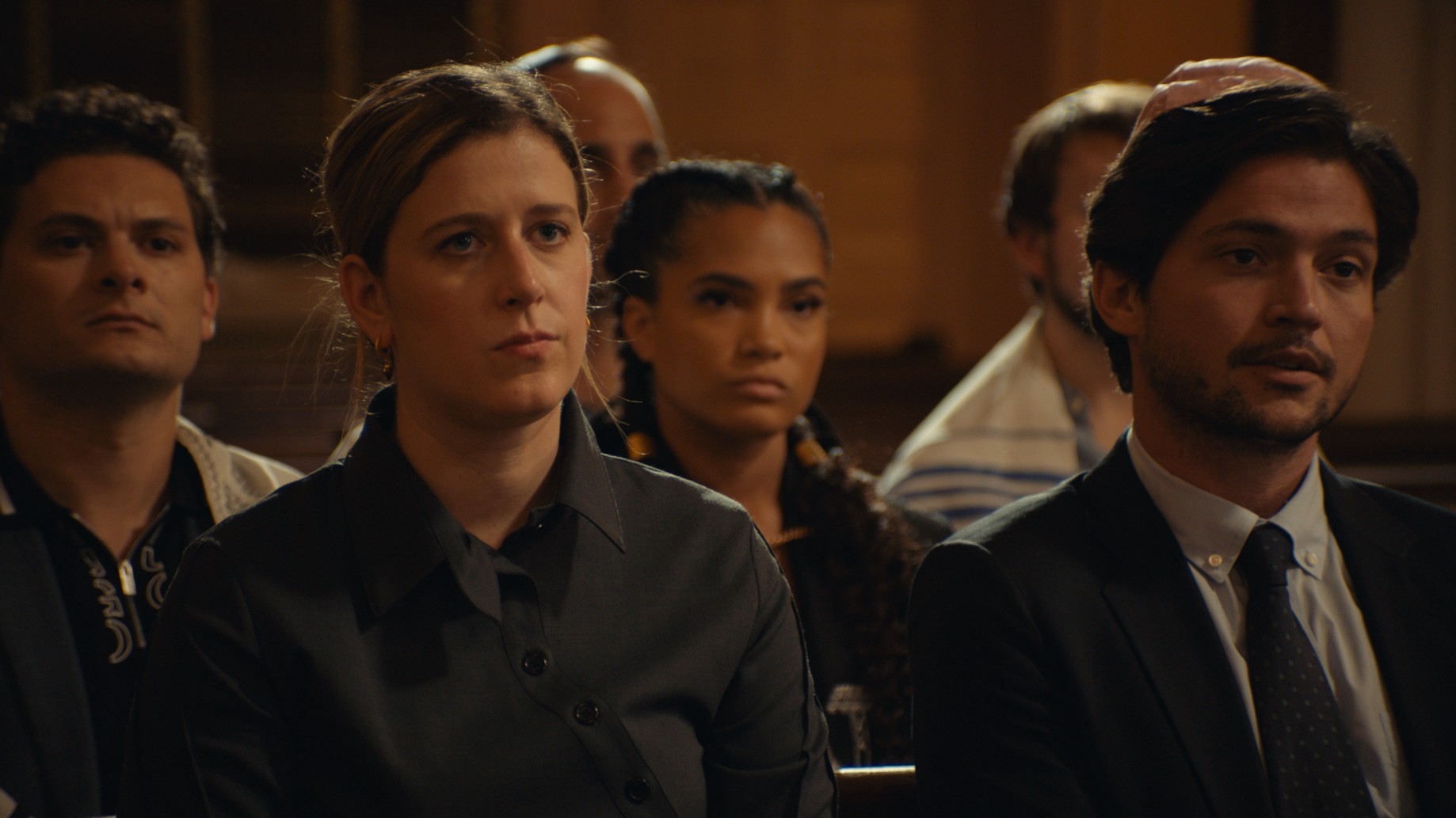
Throw in the fact that veteran bit player Adams makes herself the lead, and probably realizes only now that she’s too inexpressive and bland to carry a picture, even her own.

Yes, that photo above aptly captures her performance.

She plays Agnes, who even as a child, pondered the difference between Catholicism and Judaism when she figured out that hey, Jesus was a Jew, after all.

As an adult, aspiring actress/aspiring playwright/elementary school drama teacher and sometime Zumba instructor Agnes finds out she’s pregnant the day her beau, Levi (Thomas McDonnell) throws a “surprise” proposal party, with his family pouring onto their roof-patio, all “Mazel tovs” and “Oy veys.”

“Simcha & Sorrows” leans into the Hebrew and Yiddish exclamations and Jewish kvetching and kvelling stereotypes. A few of the attempted laughs come from pregnant actress Agnes trying to “fit in” and deploy such words like a pro to her fiance, her Jewish agents, her husband and in-laws and the rabbi (Hari Nef) who leads their “Journey into Judaism” conversion class.

Those jokes, like too much of this sad-mouthed rom-com, fall flat.

The potential for real conflict is introduced and basically abandoned as the script struggles to figure out what it wants to say. The problem is, one suspects, that figuring out what one CANNOT say ate up a lot of time in the writing and financing as well.

Testy debates in their “Journey” class cut off with invocations of “anti-Semitism” and “The Holocaust.” This is promising ground for a debate between an atheist, in Agnes’ case, or others “marrying into” the faith, and “the tribe,” almost uniformly depicted as dogmatic, uncompromising and thin-skinned.

John Cullum charms in a couple of scenes as Agnes’ aged ex-Broadway hoofer granddad. He even sings.

Nefi, who has played her share of rabbis, almost makes this one funny.

And Annelise Cepero sets off a few sparks as an obnoxious influencer/brand ambassador and “healer,” converting so that she’s allowed to marry Levi’s equally obnoxious brother.

The “Simcha” in the title translates to “joy” or “joys.” It was also the name of the late Jewish screenwriter Paddy Chayefsky’s production company.

But “Simchas & Sorrows” doesn’t have much of either.

The conflict is watered-down, the picture has no urgency or pacing, the “sparks” are in short supply, and Adams’ deadpan take on Agnes may play to her strengths, or be the only note she knows and we can’t tell the difference.

Rating: unrated, adult themes

Cast: Genevieve Adams, Thomas McDonnell, Hari Nef, Luke Forbes, Annalise Cepero, Chip Zien and Johyn Cullum.

Credits: Scripted and directed by Genevieve Adams. A Gravitas Ventures release.

Running time: 1:57

Posted in Reviews, previews, profiles and movie news | Comments Off on Movie Review: An Interfaith relationship is tested with “Simchas & Sorrows”

Classic Film Review: The Madness of George C. Scott in Paddy Chayefsky’s “The Hospital”(1971)

Fifty years after its release, screed-writing screenwriter Paddy Chayefsky’s dark comedy “The Hospital” still has the power to make your jaw drop.

Released amid growing cynicism about institutions that Vietnam inspired and Watergate proved, with documentaries such as “Titicut Follies” laying bare the stark realities of American medicine and “M*A*S*H” puncturing the TV-burnished image of doctors as “ministering angels,” “Hospital” must have felt like a kick in the teeth.

The ensuing decades have seen nothing that went this far, with only TV’s “Saint Elsewhere” and a few edgier moments on the soapier “E.R.” or comical “Scrubs” etc. even trying.

That said, the black humor in Arthur Hiller’s “comedy” doesn’t really start to work until late in the picture. And it takes the ears and eyes a while to adjust to any visit to Paddy Chayefskyland. Few conversations sound natural. Characters launch into speeches and others in the scene simply yield the floor to them. Casting Oscar winner George C. Scott as the lead meant the near-soliloquies would be epic, scene-chewing rants.

The acclaimed playwright, screenwriter and novelist, already an Oscar winner for “Marty,” was sort of the Stanley Kubrick of screenplays. He demanded complete control over his pictures (“Network,” a few years later, was his masterpiece) based on a cultivated reputation as a “genius.” But look at the years of credits leading to “The Hospital” and name one that earned him this license — casting control, producing control, his almost-unique (in the U.S.) “by” credit, as opposed to “written by” or “screenplay by.”

They gave it to him because, like Kubrick, he had the cheek to demand it. And in a town of hacks, Hollywood knew a genius when it was run over by one. Chayefsky even delivers the film’s biting, cynical opening narration.

Scott plays Dr. Herbert Bock, chief of medicine at Manhattan Medical Center (actually filmed in a new wing of New York’s Metropolitan Hospital). He looks a wreck and in a theatrical blast of exposition declares “I’m 53, with all the attendant fears. I’ve just left my wife.” Oh, and by the by, he’s depressed and suicidal.

When we dive into his workplace — a chaotic, noisy and crowded house of healing — we get it. A modern viewer will instantly wonder “How the hell did they keep it all together and keep track of who was whom” in that pre-digital age?

Because very quickly the answer becomes obvious — not well at all.

A “horn dog” resident eagerly notes the passing of a patient, giving him and his latest paramour nurse a (semi-private) room for their nightly assignation. He winds up dozing off, getting the dosage of the dead man by a nurse just doing what the chart says, and dying.

Over the course of the next day and a night, others will die, some will be clubbed by an unseen assailant, the hospital will come under siege for its efforts to demolish a neighboring tenement for expansion, the harried chief administrator (Stephen Elliott) will try to juggle all this, Dr. Bock will drink Smirnoff’s and try to pretend that he’s struggling to remember the names of the sea of white (mostly) male residents he leads on rounds and the frazzled billing officer (Frances Sternhagen, funny) will try to get the “Blue Cross? Blue Shield?” particulars from patients because the arrogant medicos — doctors and nurses — can’t be bothered.

“I mean I have to bill these people. I know you doctors are the ministering angels and I’m the bitch from the accounting department, but I’ve a job to do too. I mean, if you don’t mind, Doctor!”

Actors must have loved working for New York Paddy. Such glorious, long, attention-grabbing speeches, with everybody of any note in the cast getting one or even two.

Dr. Bock insults a careless, bottom-line lusting colleague (Edward Dysart, years before “L.A. Law”) — “You’re greedy, unfeeling, inept, indifferent, self-inflating, and unconscionably profitable. Besides that, I have nothing against you. I’m sure you play a hell of a game of golf.

There’s Barbara (Diana Rigg), the half-Bock’s-age (in the script) daughter of a mistreated patient (Barnard Hughes), a woman who brings in an Apache healer from the tribe she and her father minister to in Mexico.

“I fancied you from the first moment you came lumbering down that hallway upstairs. I said to Mr. Blacktree, ‘Who’s that hulking bear of a man?’ Apaches are reverential about bears. Won’t eat bear meat, never skin bears. Bears are thought of as both benign and evil, but very strong power. Men with bear power are highly respected and are said to be great healers. ‘That man,‘ I said, ‘gets his power from the bear.'”

You can be a fan of the writing while acknowledging Chayefsky’s penchant for male wish fulfillment fantasy romantic pairings — “Network’s” ancient William Holden pursued by bombshell Faye Dunaway, Rigg mini-skirting her way through Dr. Bock’s self-declared “impotence.”

Different era, that’s for sure.

Hiller, an accomplished comic director who went on to film “Silver Streak” and “The In-Laws” as well as sappy romances, had already made a dark and semi-daring comedy with Chayefsky, “The Americanization of Emily,” a talk-you-to-death skewering of the notion of “war hero.” Hiller’s chief contribution to “Hospital” was in keeping every shot so crowded it’s a wonder anybody had elbow room to apply a stethoscope, much less a scalpel.

The only player in the cast who treats this as an outright farce is the wild-eyed Hughes, who played two roles (he was also a mustachioed, flabbergasted, error prone surgeon) and kind of takes over the third act. Scott plays it straight, if often over the top and LOUD, as was his style.

But that’s just right for the film’s scathing, perplexed undertone of high dudgeon.

“How the hell is this allowed to happen?”

Rewatching “The Hospital” now I was struck by how much impact it plainly had in how such houses of healing are portrayed, how the darkly funny stuff lands a bit softer and how nobody writes dialogue this arch any more, and for good reason. It’s so self-conscious that it takes one right out of the scene at times.

“You know, when I say impotent, I don’t mean merely limp… When I say impotent, I mean I’ve lost even my desire to work. That’s a hell of a lot more primal passion than sex. I’ve lost my reason for being – my purpose. The only thing I ever truly loved.”

Who in heaven’s name talks like that, tells a beautiful woman they’ve just met that, outside of the printed page? And what was Chayefsky confessing here?

The “romance” between Bock and “Miss Drummond” is about as flesh and blood realistic and organically romantic as that moment a guy asks the sex worker “How much?”

Hughes would play many grumpy doctors over the years, in the sitcom “Doc” and later as the curmudgeon “Doc Hollywood” takes over for, a film which also-starred Sternhagen. Nancy Marchand, whose big break was co-starring in Chayefsky’s “Marty,” plays the ever-brow-beaten head of nursing. Her “Lou Grant” co-star Robert Walden plays an internist/confidante to Dr. Bock. And Stockard Channing (in her first screen appearance) and Katherine Helmond pop in the single scene each appears in.

It’s not the over-the-top hoot “Network” turned out to be. The topline characters simply aren’t as interesting, and the surrounding cast is often nameless — so much so that the business of giving Hughes two roles trips the movie up in a too-obvious way.

And whatever Chayefsky’s encounters with soulless “modern medicine” were, it was the profit-uber-alles world of TV he knew like the back of the hand he slapped it with. Still he, Hiller and Scott created a template for that every drama or comedy that followed with this film about America’s “most enormous medical… entity ever conceived,” built on the profit principle, leading to patients who “are sicker than ever.”

Rating: PG-13 for thematic elements, sexual content and drug references

Cast: George C. Scott, Diana Rigg, Nancy Marchand, Stephen Elliott, Frances Sternhagen, Robert Walden, Richard Dysart and Barnard Hughes.

Credits: Directed by Arthur Hiller, scripted by Paddy Chayefsky. A United Artists (MGM/UA) release on Tubi, Amazon and other streamers

Running time: 1:43

Posted in Reviews, previews, profiles and movie news | Comments Off on Classic Film Review: The Madness of George C. Scott in Paddy Chayefsky’s “The Hospital”(1971)

$3 Movie Tickets? Cinema-going party like its 1979 — “National Cinema Day”

A few classics are being re-released this coming weekend, and the most recent “Spider-Man” will be back, if you missed it.

Surely there’ll be something you haven’t seen worth checking out on National Cinema Day, Sept. 3.

$3 tickets? Worth it just for the AC, in my book.

Posted in Reviews, previews, profiles and movie news | Comments Off on $3 Movie Tickets? Cinema-going party like its 1979 — “National Cinema Day”