

Movie Review: Animated “Migration” is one long parent-child inside joke

It takes a while to figure out the sweet spot that writer Mike White (“School of Rock”?) was going for with “Migration.”

It’s got a lot of funny people doing voices — Kumail Nanjiani, Awkwafina, Keegan-Michael Key going Jamaican “mon,” Danny DeVito and Carol Kane among them. But the it’s not what I’d call quotably funny. The lines aren’t jokes.

The characters, a family of mallards struggling to convince “Why can’t we be satisfied with what we already have?” dad (Nanjiani) into “finally” taking them on a migration, are barely a shadow of the funniest ducks of them all — Daffy and (referenced here) Donald.

But there are plenty of sight gags — Awkwafina, playing a New York streetwise-but-mangled, tough-enough-to-be-named “Chump” pigeon getting smacked by one Metropolitan Transit Authority Bus after another on the edge of Central Park.

And the animated flying footage is spectacular and occasionally jokey.

It’s the first big laugh that gives away White’s game. The tiniest duck in the family, just-past-duckling Gwen (Tresi Gazal) begs her afraid-of-the-big-wide-world Dad, after Mom (Elizabeth Banks) and teen brother Max (Casper Jennings) have failed to talk him into joining passing flocks, and gives it her best shot.

Her eyes give us a Tex Avery bulge, and her plea will be recognizing by every six year-old in North America.

“PLLEEeeeeeeeeeeeeeeeeeeaaaaaaaaaaaaaaaaaaaAAAAAAAASE?”

Every parent will turn to his or her child, Every Child will guiltily grin back at said parent. It’s not inherently funny, but it’s so universally recognizable that it can be.

What White has scripted here, with co-director Benjamin Renner also a co-writer, is a “cartoon” that’s not just for kiddies, not really for adults, but plays right into the hands of parents taking their children to see it.

The “family vacation” gags — little Gwen being VERY shy about when and where and with whom she’ll go to the toilet — are simple, but on point. Vacation envy, the migrating teen girl duck who flirts with Max, grumpy Uncle Dan (Danny DeVito) coming along for the flight, fretting over accomodations and food at every stop, we’ve all been there. Most of us, anyway.

Keegan-Michael Key isn’t given a single quotably hilarious line. But as a caged long-tailed red macaw freed by the family in the one of their many quests/escapes on their journey, Key appropriates ALL of Jamaican culture with that most musical of accents in English. And every word he utters is adorable.

“Migration” shares a “fatten them up” captive ducks gag with “Chicken Run 2.” You have to be in a duck or chicken “cult” to fall for that, right?

But the threats are kind of novel here. There’s no Elmer Fudd duck hunter, perhaps because those guys have ceased to be funny. What we have instead are rumors of what duck predators HERONS are (Carol Kane? “Predator?” Don’t be ridic.), and the dread fear of that creature most feared by every sentient duck — tattooed hipster chefs and their passion for Duck a’la Orange.

The mallards free the (unspeaking) chef”s sad macaw, wreck his kitchen in the process, and are pursued to the ends of the Earth — Florida, anyway — by the man with a menu to make out.

Visually, this is a most impressive effort. But it’s not particularly smart or witty or even kiddie profound in its messaging, and in avoiding easy laughs (jokes), it achieves liftoff even if it never quite soars.

“Migration,” like that “Super Mario” blockbuster earlier this year, isn’t one of this animation outfit’s best outings. It’s their “Rio,” pleasantly diverting in the moment, not quite instantly forgotten, but almost.

Rating: PG.

Cast: The voices of Kumail Nanjiani, Elizabeth Banks, Keegan-Michael Key, Danny DeVito, Tresi Gazal, Casper Jennings, Carol Kane and Awkwafina

Credits: Directed by Benjamin Renner and Guylo Homsy, scripted by Mike White and Benjamin Renner. An Illumination/Universal release.

Running time: 1:32

Posted in Reviews, previews, profiles and movie news | Comments Off on Movie Review: Animated “Migration” is one long parent-child inside joke

Netflixable? Inspired by “Ghost Town,” remade and remade again — “Hello Ghost”

There have always been movie remakes, as long before the words “intellectual property” became common currency, studios were remaking scripts or books they had the rights to.

Hemingway’s “To Have and Have Not” was not just a 1944 classic with Bogie and “introducing” Lauren Bacall. As long as the rights were active, other versions turned up.

But “Hello Ghost” has to be a peak intellectual property moment. It was a 2010 Korean film about a suicidal man haunted by four ghosts he can see but no one else does, thanks to his “final” attempt at taking his life.

It’s similar enough to the sentimental Ricky Gervais romp “Ghost Town” as to have been inspired by it, but different enough to pack a bigger punch with a “twist” at the end.

Not content to have the rights to the original film, Netflix is behind not one but TWO fresh remakes of it — an Indonesian version, and a Taiwanese one, which I’m reviewing here.

Netflix is reaching back to a practice common during the early days of the “talkies.” MGM and other studios would make a domestic market version of a movie, and one for the Latin market, or Germany or wherever. Sometimes the star, the story and the title would be the only thing common to all the different versions. That was what you did if you wanted your property to make lots of dollars, pesos, francs and rubles in the days before dubbing or “closed captioning.”

Here Tseng Jing-hua plays a suicidal Taiwanese 20something whose 21st try at ending his miserable life comes close enough to succeeding that a paramedic (Shao Yo-wei) must bring him back to life on the way to the hospital. He hallucinates that she’s an angel come to save him.

But in the hospital, a traumatized plump and matronly woman (Tsai Jia-yin) and a fiesty older lady (Ching Lu-yi) who’d love to bitch out the nurses, if they could only see and hear her. A pranks-prone little boy (Hung Chun-hao) and an Elvis-haired chain-smoker (Chang Zhang-xing) also manifest themselves to our patient

Our lad is haunted by these folks, leading a doctor to think he’s crazy. And he will continue to be haunted by them, according to a psychic he visits, until their “wishes” come true, thanks to him.

Next thing our hapless but no longer suicidal young man knows, he’s hunting for an ancient taxi in the wrecking yard because somebody would love a last ride in his car, visiting an amusement park and rooting through a huge jar of dried radishes for an old lotto ticket.

At every step of the way, he stumbles into the paramedic, who is perplexed at these coincidences, and seriously bent out of shape at the money trouble her hustler-brother has stirred up with some gangsters.

Some story threads you can figure out, even without that banger saved for the finale.

The best sight gag in any of these adaptations has to be all the ghosts hanging off our hero’s body or crowded onto his motorbike with him — unseen, except by him. Aside from that, many of the “Ghost” pranks feeled pretty played by this point.

And in the Taiwanese version, director Hsieh Pei-ju and screenwriter Chou Ching-wen half-ruin their Big Finish by over-explaining and back-engineering the story of how that “twist” impacted everything that happened before.

“Hello Ghost” proves to be a durable comedy that more or less “travels” and works in a lot of languages. But whatever was special about the Korean version seems watered-down and pretty tired by now.

God forbid Netflix trot out Peruvian and Canadian versions.

Rating: TV-14, suicide attempts, lots of smoking

Cast: Tseng Jing-hua, Shao Yo-wei, Tsai Jia-yin, Ching Lu-yi, Hung Chun-hao and Chang Zhang-xing

Credits: Directed by Hsieh Pei-ju, scripted by Chou Ching-wen, based on the Korean film by Kim Young-tak. A Netflix release.

Running time: 1:41

Posted in Reviews, previews, profiles and movie news | Comments Off on Netflixable? Inspired by “Ghost Town,” remade and remade again — “Hello Ghost”

Movie Review: YA Fantasy in German-accented English — “Silver and the Book of Dreams”

It’s about time filmmakers turned their attention away from English-language young adult fantasy fiction and returned to the land where the Western tradition in literary fantasy began, in the land of the Brothers Grimm.

But the Amazon/MGM production of Kerstin Gier’s “Dream” trilogy has been seriously Anglicized for mass cinematic consumption.

“Silver and the Book of Dreams” transplants characters and situations to London, a posh (ish) high school and the weird goings on with dream-obsessed boys and the latest student to stuff her books and backpack in a “cursed” locker.” But it’s still oddly off-center in some distinctly German ways, and it doesn’t look like any other YA screen fantasy of recent memory.

That’s not so much an endorsement as a suggestion that it might pique your curiosity. It certainly did mine.

Liv and Mia (Jana McKinnon and Riva Krymalowski) are siblings who have been shuffled about a lot — “seven school (introductory) tours in five years,” according to older sister Liv — since the death of their father.

Now they’re in London, with their mother (Nicolette Krebitz) and the new makeshift family she and partner Ernest (Rory Nolan) have formed.

French step-sister Florence (Gwenaelle Gillet) is openly rude and hostile, demanding her dad pay her to spend time — even mealtime — with these two upstarts. Stepbrother Grayson (Théo Augier Bonaventure), named for the dirtiest player in the history of Dook basketball, is less judgmental.

Liv’s dreams are often about her dead father and her trapped under the ice, drowning with him. Moving into this London townhouse, she finds herself wandering into dreams with Grayson. Is she really following him and his three mates into Highgate Cemetery in the foggy wee hours of the morning?

What’s this talk about needing “four men and a maiden” to “complete the ritual?” And this “Book of Dreams,” is that why she’s “lucid dreaming” her way down a fancifully-colored enclosed alley, opening doors into the dreams of others?

Having a “cursed” locker at school that ties her to the missing Annabell Scott would seem the reason for all this. Grayson’s pals Jasper (Efeosa Afolabi), Arthur (Chaneil Kular) and sweet-on-Liv Henry (Rhys Mannion) insist she’s the “Chosen One,” “a natural dreamer.”

Perhaps the locker “chose” her?

All the business about initiating Liv Silver into their cult of dreams, the “rules” of visiting the dreams of others, making their “fondest dreams” come true and avoiding their “worst nightmares” are colorfully pedantic and dull. It’s the quirky but recognizable teen “types” and high school world that’s more interesting here.

Exotic and outgoing school class president Persephone (Samirah Breuer), the generic rites-of-affluent-teen passage depicted — raves, popularity contests, young love, inclusion — are all just set decoration for a story that lacks urgency and that has a difficult time selling us its hgh stakes.

Are kids “disappearing” into this dreamscape, or truly dying in their own “worst nightmares?” Helena Hufnagel’s film doesn’t manage the feat of making one care about that.

What I want to know is what got up French-girl Florence’s bum that has her hating and looking down on the world, aside from Euro-stereotypes in action? Setting up the Silver siblings as thick as thieves, and all but abandoning Mia as a character seems clumsy. But then, that might not leave time for Liv and Henry to make eyes at each other and eventually make out.

The whole business of dreamland being a Diagon Alley with “Monsters, Inc.” doors to the dreams of others is a bit of an eye-roller, no matter how luridly imagined. But perhaps that’s the idea, a YA fantasy made-to-order for kids of any nation where Pixar and J.K. Rowling are what they grew up on.

Rating: TV-16

Cast: Jana McKinnon, Rhys Mannion, Josephine Blazier, Théo Augier Bonaventure, Efeosa Afolabi, Chaneil Kular, Riva Krymalowski and Samirah Breuer

Credits: Directed by Helena Hufnagel, scripted by Sina Flammang based on a novel by Kerstin Gier. An MGM/Amazon Prime release.

Running time: 1:32

Posted in Reviews, previews, profiles and movie news | Comments Off on Movie Review: YA Fantasy in German-accented English — “Silver and the Book of Dreams”

Movie Review: An ex-con, a sailor lass and a killer face their fates outside the “Breakwater”

Don’t tell his momma, or his wife. But there’s something just right about casting Dermot Mulroney as an ex-con.

He’s got the look. Hell, he’s had it all along. But damned if that rough-hewn, more-rugged-than-handsome-mug wasn’t in “My Best Friend’s Wedding,” “The Family Stone,” lots of movies in which Dermot M. had no trouble at all passing for a sensitive romantic lead.

Mulroney’s at that “Here’s another offer to play a heavy” stage of his career, and in “Breakwater,” he’s all the richer for it, no matter how tiny the paycheck.

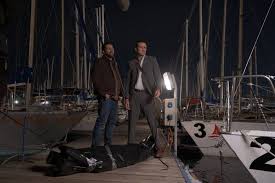
“Breakwater” is an indie thriller about a young ex-con (Darren Mann) send to find a “long lost daughter” for her “dying” daddy, the Old Man of the Yard in a prison in coastal Virginia.

The young guy, named “Dovey,” as in “Lovey Dovey,” only figures out that his prison mentor was using him when the hardened lifer busts out to settle matters with that “daughter (Alyssa Goss) after Dovey’s reported back that, yeah, that’s her, using a different name but running a bookstore in Currituck on the Outer Banks of N.C.

What has Dovey done? What can ”Eve” do? Will she let the gullible Dovey help her get out of this fix? Because at many a juncture, jailbird Ray has shown he’s capable of things and probably of a mind to do his worst.

Mulroney’s Ray charmed and counseled Dovey, warning him about “the straight and narrow” and how life for an ex-con has a “long way down, each side” set of choices.

But when he shows his true colors, staging his escape and calculating how long it’ll take “help” to arrive before plugging a guard, he’s downright sadistic.

“Ain’t no place to get shot better’n an ambulance!”

Goss, of TV’s “Bruh,” is convincingly salty as Eve, aka Marina, a single mom leading lighthouse tours and running a book shop full of “beach reads,” but more than willing to offload a few F-bombs to take the genteel edge off. She’s convincingly salty in other ways, showing off her 38 foot ketch to Dovey, who is a skilled swimmer and ex-con’s son who’s worked on the water — crabbing — his whole life.

Mann manages the unworldly side of Dovey with ease, letting him almost get mauled by the first barmaid he stumbles across when he “gets out” (Mena Suvari, in kinky mode).

And Carolina native filmmaker James Rowe, who’s made two films in 25 years (“Blue Ridge Fall”) really hit the jackpot with little Ezra DuVall, playing Eve’s little — VERY little — girl in documentary-real strokes.

“Breakwater” was shot in “Hollywood East,” as it used to be called — in and around Wilmington, N.C., with a little filming, from the looks of things, at the Currituck Lighthouse. Movies filmed there have a vivid sense of place about them — swamp and sand and salt-scented sea breezes, funky little fishing villages and crab shack tourist towns.

I know this part of the world well, and I loved the film’s grounding in that sense of place and appreciated the lack of false notes in the performances, the action beats and the generally unfussy plot.

This “simple” genre thriller is entirely too simple for its own good. It feels so familiar that we’ve seen it all before. But even if it never transcends its genre, Mulroney, Goss, Mann and the rest of the cast keep “Breakwater” pretty close to above water, start to finish.

Rating: R, violence, sexual situations, profanity

Cast: Darren Mann, Alyssa Goss, Sonja Sohn, JD Evermore,
Daniel Williams-Lopez, Ezra DuVall, Mena Suvari and Dermot Mulroney.

Credits: Scripted and directed by James Rowe. An XYZ Films/Vertical release.

Running time: 1:37

Posted in Reviews, previews, profiles and movie news | Comments Off on Movie Review: An ex-con, a sailor lass and a killer face their fates outside the “Breakwater”

Movie Review: “Merry Good Enough?” Not really

“Merry Good Enough” is an indifferent, listless and generally lifeless holiday comedy built around the admission, “It’s the holidays. We’re all a little suicidal.”

It’s about three unhappy 30ish children coming home to their long-divorced mom in Massachusetts suburbia wondering what the chances are that they could “wake up and be the perfect family.”

“Slim to none” seems like the safe answer.

When your only laugh line is uttered by actress Raye Levine to actor Sawyer Spielberg — “I always wished that I was Jewish.” — you have to know you aren’t quite “getting into the Christmas spirit.”

A leaden prologue introduces us to Lucy (Levine), who gets lectured on how “No one likes a Scrooge” over the holidays on the slowest elevator ride in Greater Boston.

She’s going “home” for Christmas, to the small-town Massachusetts where she grew up. Flaky Mom (Susan Gallagher) seems more forgetful than usual. When they get into an argument over Mom leaving a wedding album out to remind Lucy of her failed marriage, they fight.

Lucy and just-flew-in-from-Singapore brother Tim (Daniel Desmaris) wake up to an empty house. Mom is nowhere to be found, unreachable by phone.

Youngest sister Cynthia (Comfort Clinton) is hardly surprised. She’s a hard-driving Chicago lawyer with a fiance and big plans and little patience for her older sister/Mom drama.

Lucy seems the most concerned, but even she — like everybody else — kind of takes Mom disappearing in stride. We don’t need that much-delayed moment of checking the bathroom to see what medications Mom is on to get the drift.

She’s depressed. This is kind of in-character. Her long-divorced husband, a big shot TV host, shows up and confirms that.

By the way? Jovial, upbeat Joel Murray in this part is the life of this listless party.

“Merry Good Enough” is a motion picture of long, static stretches scored with colorless conversations and Christmas carols. We’re treated to a little eggnog dance party montage, a trip to the skating rink, and a stop at the police station — almost as an afterthought — to report a missing person.

There is history in this house and “baggage” in every trip to the store, the rink and that police station.

Levine makes a passable lead, but pairing her up with the neighbor boy (Spielberg), now all grown up and between love affairs, pays zero dividends.

The clumsy plot advances at a crawl, the resolution is nonsensical and a downmarket bar interlude is lame enough to make one long for the pleasures, the stakes and the performances of “The Family Stone” or any of a dozen other imperfect but as least lively and life-affirming holiday movies.

“Merry Good Enough” isn’t even good enough for The Hallmark Channel.

Rating: unrated, some profanity

Cast: Raye Levine, Susan Gallagher, Daniel Desmaris, Comfort Clinton, Sawyer Spielberg, and Joel Murray.

Credits: Directed by Caroline Keene, scripted by Caroline Keene and Dan Kennedy. A Freestyle release.

Running time: 1:37

Posted in Reviews, previews, profiles and movie news | Comments Off on Movie Review: “Merry Good Enough?” Not really

Movie Review: Lift Up “The Color Purple” and sing!

Let it be said that the new musical “The Color Purple” in no way replaces the sometimes-wrenching 1985 film adaptation of Alice Walker’s acclaimed novel.

The film version of Marsha Norman’s 2005 stage musical is best appreciated with a word that means one thing on Broadway and another in American Protestantism — “revival.” Packed with tunes in the pre-“Hamilton” stage musical tradition, bubbling over with production numbers that dance right off the screen, it’s a feel-good holiday event that reprises many of the highlights of Steven Spielberg’s earlier film.

First and foremost, it floods the frame with fresh faces, celebrating African American singing and acting talent.

Didn’t catch Fantasia Barrino on Broadway? Her Celie is immortalized here.

Slow to pick up on the brilliance of Colman Domingo and Halle Bailey? Domingo makes a lean, banjo-picking (and singing) menace as “Mister,” and Bailey (“The Little Mermaid”) is the very embodiment of the beautiful sister “lost,” pined-for and found as Nettie.

Forgot Taraji P. Henson can sing? And dance? Danielle Brooks didn’t give us any “Jailhouse Rock” or R&B in “Orange is the New Black.” She does here.

Ghanese New York music video (Beyonce? Naturally.) and film director Blitz Bazawi and screenwriter Marcus Gardley expand on themes and story threads sometimes treated more tentatively in Spielberg’s film. Sexual abuse, same sex attraction, Black enterprise and life in the racist Georgia of the early 1910s through the ’40s are front and center.

It’s quite similar, just more upbeat.

If you don’t remember the story, here’s a refresher. Sisters Celie (Phylicia Pearl Mpasi) and Nettie (Bailey) are tighter-than-tight, bonded under the roof of their shopkeeper/sexually-abusive stepfather (Deon Cole, chilling).

Teen Celie is pregnant when we meet her, but the baby is taken away. Not the first time that has happened. “Daddy” then comes for Nettie, who resists and flees. And when glowering widower Mister makes the stepfather an offer, there’s nothing for it but for Nettie to leave town altogether.

Mister will settle for heartbroken Celie, who will raise his children and keep his house and satisfy his sexual urges and take his beatings. Meeting the cussed “Old Mister,” the ornery bastard’s father (Oscar winner Louis Gossett Jr.) explains a lot.

Celie’s liberation begins when she meets Shug (Hensen), Mister’s one true love, a blues singer who enjoys regional fame and celebrity, and her pick among the men. They “renew” their acquaintance whenever the hard-living, hard-drinking blues shouter swings through.

But “Miss Celie’s” in love, and Shug knows it.

Celie draws further inspiration from the spirited Sophia (Brooks), who wants to marry Mister’s smitten son Harpo (Corey Hawkins). Sophia doesn’t take any guff from Harpo, Mister or racist white folks, and pays a price.

Years and decades pass as we see Celie’s broken spirit renewed and repaired via a sisterhood of women.

This “Color Purple” may not be as pictorially pristine as Spielberg’s film, as he was famed for borrowing shots and inspiration from the great films of John Ford, among others. But the juke joint scenes pop, taking their visual cues from great Black painters and paintings like Ernie Barnes’ “Sugar Shack.”

Bazawule’s brisk “Purple” lacks the emotional gut-punches and taut suspense — How will Celie act-out/lash out? — of master manipulator Spielberg’s film. This is altogether a lighter and sunnier cinematic experience. But Celie’s faith is moved front and center, showing the difference between Black filmmakers with an awareness of the role of the Black church in the South in African American life.

The redemption stories are much more clearly delineated, with Bazawule and the Broadway show seeing “Mister” as both a monster, and another victim of the time and his own cruel upbringing.

And some of the biggest delights come from some very clever casting coups. Henson brings a brassy, world-weary bravado and sexual confidence to Shug, a woman who knows her power and uses it. She beautifully reprises “Miss Celie’s Blues,” a tune co-written by Quincy Jones from the 1985 “Color Purple,” and stomps through “Push Da Button,” a suggestive blues showpiece by the songwriting team of the stage musical, Brenda Russell, Allee Willis and Stephen Bray.

Domingo adds banjo-playing to his sky’s-the-limit repertoire.

The great character actor David Alan Grier steals his scenes as a wry, spirit-filled but judgmental preacher, just tearing through a celebratory opening ensemble hymn “God Works in Mysterious Ways.” He is Shug’s estranged, disapproving dad, but being the twinkly and tuneful Grier, we know a tearful rapprochement duet (“Maybe God is Tryin’ to Tell You Somethin'”) is in the cards.

And watch singer, piano player and former “Late Show” bandleader Jon Batiste as Grady, the piano-player/bandleader whom Shug marries. He sits at the keyboard, vamping the hell out of one of her numbers, turning it into a giddy, mugging-over-her-shoulder romp with his musicianship and comic timing.

“The Color Purple” wasn’t a Broadway-changing blockbuster on the stage, and the songs, pleasant and fun in their context, don’t exactly stick with you after one viewing. Maybe the soundtrack will grow on us.

Some of the casting nods to Black cinema history — two Oscar winners are in the cast — smack of “fan service.”

But this cast and crew ensure that the film is a brisk, upbeat, feel-good bounce through an aching tale of trials and tribulations to triumph story that has become an American classic, and well worth a holiday family outing at the movies.

Rating: PG-13 for mature thematic content, sexual content, violence and language.

Cast: Fantasia Barrino, Taraji P. Henson, Halle Bailey, Phylicia Pearl Mpasi, Colman Domingo, Danielle Brooks, Corey Hawkins, Jon Batiste and David Alan Grier

Credits: Directed by Blitz Bazawule, scripted by Marcus Gardley, based on the stage musical by Marsha Norman which is based on the novel by Alice Walker and movie by Steven Spielberg. A Warner Bros. release.

Running time: 2:20

Posted in Reviews, previews, profiles and movie news | Comments Off on Movie Review: Lift Up “The Color Purple” and sing!

Classic Film Review: Hitchcock goes “screwball” — almost — with Gielgud, Lorre, Carroll, Robert Young and a Daschund — “Secret Agent” (1936)

Alfred Hitchcock’s fame and reputation for crackling, stylish and expressionistic thrillers was pretty well established by the time he got around to “Secret Agent” in 1936.

“The Lodger” has made his name, and “The 39 Steps” and “The Man Who Knew Too Much” had established his stardom in the eyes of critics and his “brand” with the general public.

But “screwball” comedies were all the rage in Hollywood. And Hitchcock, nothing if not a filmmaker keenly aware of what everybody else was up to, indulged in a bit of that himself with “Secret Agent” and quite a bit more of the witty banter, goofy characters and such with “The Lady Vanishes” a couple of years later.

“Secret Agent” has a goofy premise, a couple of seriously screwy characters and some of the wittiest dialogue ever to grace a Hitchock thriller.

A young officer (John Gielgud), a novelist in civilian life, is summoned home from the trenches of France only to see his death notice in the papers. He’d like to know what this is all about from the fellow (Charles Carson) who summoned him.

Now see here, he blusters, but “I don’t even how what your name is.”

“You can call me ‘R.'”

“‘Argh’ as an exclamation?”

“‘R’ as in ‘Rhododendron.”

An entire James Bond franchise spins out of that very exchange.

Capt. Brodie is no more. He is to be Richard Ashendon, ordered to Switzerland to hear the yodeling and see the folk dancing, identify a German agent about to go bribe the Arabs into fighting for Turkey and keep that spy from traveling to Constantinople and Arabia and foiling Britain’s plans for taking Turkey out of the war and taking over much of the Middle East.

Tell me, do you love your country?”

“Well, I’ve just died for it.”

“Ashendon” must have an assistant, somebody the intelligence service refers to as “the hairless Mexican.” He’s considerably more experienced at cold-blooded killings than Captain Brodie/Ashendon. Hitchcock cast the pop-eyed German expressionist star Peter Lorre as “The General.”

“General Pompellio Montezuma De La Vilia De Conde De La Rue,” as our “assistant” grandly introduces himself many times in the movie, is not a “general” any more than he is “hairless” or “a Mexican.” Lorre oozes amoral menace with such glee that we can’t help but be delighted every time he shows up on camera.

“General Pompellio Montezuma De- oh, we’ve already met.”

On arriving in neutral Switzerland, Ashendon and the General stumble into a Germanic Brit (Percy Marmont) with a dashund and a very German wife. Might he be their quarry? Perhaps.

What’s that? “Mrs. Ashendon” has already checked in?

Unflappable Ashendon asks the concierge how fetching she is without letting on his surprise. And he doesn’t let the fact that dropping in on “their” room, he finds the unexpected Missus (Hitchcock blonde Madeleine Carroll) in the tub with an American-accented rake (Robert Young) flirting and coming on strong just outside the bathroom door.

Gielgud, already a star of the British stage but decades before his Oscar-winning wit was put on display in “Arthur,” makes Ashendon the epitome of droll.

“I hope you haven’t been lonely?”

The rat-a-tat dialogue of the early scenes make one grateful for the advent of streaming movies. One almost has to rewatch to catch every arch zinger from Gielgud, Lorre or Young, as Mr. Marvin.

 “Do you understand German, Mr. Marvin?”

“Not a word. But I speak it fluently.”

The tone’s so light and breezy that we have just enough time to forget that this is an espionage thriller, after all. And then there’s a death — a church organist whom we hear has died before our intrepid agents figure out why that organ is hitting and holding such a wailing, dissonant note. The poor man has been strangled and collapsed on the keyboard.

Hitchcock brilliantly (sound) stages a murder at a distance as the novice agent witnesses (we don’t) his hardened killer “assistant” in action on a mountainside.

Mrs. Ashendon is witness to one of the most poignant moments in a Hitchcock film, in the company of the now-dead-man’s wife as their dachsund scratches at a door and then lets out of wailing howl because she knows her owner is dead before anybody else there.

“Secret Agent” has state-of-the-era effects that still manage a chill — a twilight air raid on a Turkish troop train — violence that is mostly off camera, except for the corny finale.

It’s a film that also suffers from dim, dark and washed out prints in streaming circulation, a movie that’s almost lost in the murk that that Hitchcock cooked-up in another black and white homage to his German expressionism fandom.

Look for Lilli Palmer as a “loose” woman The General makes bug-eyes at, flirts with and toys with when it suits him.

It’s always fun to see the sorts of too-handsome-to-be-the-hero roles Robert Young took in the ’30s and early ’40s, decades before “Father Knows Best” or “Marcus Welby: M.D.”

But if we leap to conclusions about his character here, as we inevitably do, it’s only because of a lifetime of getting wise to the tricks of “The Master of Suspense.” Hitchcock coined the phrase “Good villains make good thrillers,” and would have loved for Cary Grant and many other leading men he cast to be “bad guys” that the audience would have to reconcile itself with adoring.

In “Secret Agent,” the dark, dirty and immoral business of murder by government edict is hinted at if never wholly grappled with in a sort of “Thin Man” spy mystery that’s more “Thin Man” witty than mysterious.

It’s movies like this that remind us Hitchock didn’t set out to make “classics,” just entertaining manipulations, suspenseful thrill-rides with a touch of wit and a hint of art about them. It’s movies like “Secret Agent” that made the director, not the stars, the household name, the “brand” film fans would seek out then and for generations to come.

Rating: “approved,” violence

Cast: John Gielgud, Peter Lorre, Madeleine Carroll, Percy Marmont, Lilli Palmer and Robert Young.

Credits: Directed by Albert Hitchcock, scripted by Charles Bennett, based on a play by Campbell Dixon which was based on stories by W. Somerset Maugham. A British Gaumont release on Roku TV, Amazon, etc

Running time: 1:36

Posted in Reviews, previews, profiles and movie news | Comments Off on Classic Film Review: Hitchcock goes “screwball” — almost — with Gielgud, Lorre, Carroll, Robert Young and a Daschund — “Secret Agent” (1936)

Netflixable? A Big “Familia” gathers on their Olive Ranch in this Mexican Dramedy

The Colombian filmmaker Rodrigo García’s new Netflix movie is a big, inclusive family gathering for a family meal and a little family drama in rural Mexico.

“Familia” isn’t a tale of any cosequence, and a bit of a letdown considering he gave us a Glenn Close/Janet McTeer Oscar contender (“Albert Knobbs”), “Mother and Child” and last year’s “Raymond & Ray.”

“Familia” is as innocuous as its title.

Daniel Giménez Cacho is Leo, the patriarch, who has his many daughters driving in from all over the country for one of their summer outdoor meals at the olive ranch that supports their artisinal “extra virgin olive oil” family business.

“Leo the Lion” his daughters call him.

They will come and eat with Leo and their Down syndrome little brother Benny (Ricardo Selmen) and try to bond with Dad’s new marine biologist girlfriend Clara (Maribel Verdú).

Daughter Rebecca (Ilse Sala) is the oldest, a married anesthesiologist with husband Dan and “the twins” — teens Erika (Andrea Sutton) and Alan (Zury Shasho) in tow. She picks up younger sister Julia (Cassandra Ciangherotti) in the middle of Julia’s latest Tijuana tempest. Her husband’s caught her cheating again and walked out. Her precocious daughter Amanda (Isabella Arroyo) doesn’t know. Yet.

Julia’s an impulsive, narcissistic “writer” sure of her “talent” but lazy and undisciplined. Coming from a “rich” family afforded her all these indulgences.

Mariana (Natalia Solián) is younger still, and very pregnant. She’s rolling in with her latest lover Monica (Natalia Plascencia), who will learn that she “looks like all the others” Mariana has taken up with over the years. Nobody, even unfiltered Benny, is tacky enough to say “short haired and butch” aloud.

And I guess we’ll figure out who the father of that baby is at an opportune moment.

Monica’s concern about acceptance and revealing the nature of their relationship are unfounded. Mariana’s family is hip, tolerant and given to over-sharing, over-questioning — the sisters asking Clara how Dad is as a lover — and over-apologizing.

“Over-sharing is ‘the family glue,'” one wag offers.

Maybe the younger daughters are still rattled by their mother’s untimely death a half dozen years before. Maybe Leo’s extra hard on the one impressionable male, teen Alan, he can perhaps mold in his image or groom to the family business.

“You only get along with women,” is the kid’s astute assessment (in subtitled Spanish, with lots of Spanglish).

Leo, of course, apologizes the way people do in “family movies,” if not most real families.

Maybe teen Erika “kissed a girl” and didn’t “like it” because she wanted to fit in, or our Colombian writer and director was getting all carried away folding Hollywood values and predelictions into his Mexican story of a familia facing a couple of mildly traumatic, dramatically thin “big decisions.”

Erika also apologizes. For not “feeling a tingle” for kissing a girl.

The “surprises” aren’t particularly surprising. The heated arguments blow up, seemingly out of nowhere, even if these indulged, living-their-best-lives kids have had little clue about the strain their father is under. And the cast is big and cluttered, made moreso by including little dollops of the family cook and housekeepers’ love life and troubled past.

“Familia” makes for a pleasantly messy movie that plays and passes the time, but falls well short of offering insight into the human condition in broader terms or the Mexican one in narrower ones. Garcia has made a “We’re all the same” tale that feels a LOT more Hollywood than any “Mexican” melodrama or dramedy I’ve seen of late. The question you ask at the end is “Did we really need that?”

Rating: TV-MA, profanity, sexual conversations

Cast: Daniel Giménez Cacho, Maribel Verdú, Cassandra Ciangherotti, Ilse Salas, Cassandra Ciangherotti, Natalia Solián, Natalia Plascencia, Ricardo Selmen, Andrea Sutton and Zury Shasho

Credits: Directed by Rodrigo García, scripted by Rodrigo García and Bárbara Colio. Netflix release.

Running time: 1:44

Posted in Reviews, previews, profiles and movie news | Comments Off on Netflixable? A Big “Familia” gathers on their Olive Ranch in this Mexican Dramedy

Movie Review: A grim tale of 1901 Tierra del Fuego is Chile’s hope for an Oscar — “The Settlers”

If we’ve learned anything from historical books and films such as “Bury My Heart at Wounded Knee” and “Killers of the Flower Moon,” it’s that there is rarely an avenging angel, a righteous man or woman who comes and saves people in the middle of an indigenous genocide and gives the viewer a real life “Hollywood ending.”

In Canada and Australia, Africa, Central and South America and the American West it happened. It was condoned, sanctioned and endorsed, or at the very least tolerated by governments, communities and the clergy. Nobody rode in and saved them.

“The Settlers” is a genocidal story set in a place so forbidding it was nicknamed “Desolation Island,” its main city “Port Hunger” and that harbor “Useless Bay” — Tierra del Fuego. This film isn’t about ancient history. Events depicted here went on into the early 20th century. And “official” history didn’t want to acknowledge it, any more than the wealthy and powerful Catholic Church which, at best, turned a blind eye.

Writer/director Felipe Gálvez Habere treats this as a grim myth, an ugly “Odyssey” about men on a quest for a “safe” path to transport “white gold” — sheep — to the Atlantic on the huge island shared by Argentina and Chile. “Safe,” means territory free of sheep-eating Ona Indians. Making it “safe” means killing them.

This dark film about the ugliest tendencies of human nature under rapacious “colonial” capitalism is Chile’s bid to earn an Oscar nomination for the upcoming 96th Academy Awards. It deserves that recognition.

“Wool stained with blood loses all its value,” a politically-savvy sage notes at one point in this story. Reason enough for the still-young nation and its power-connected Church to be reluctant to stop this while it was happening, or condemn it when it started coming to light.

Inspired by true events and crimes commited by real villains named here, it’s about the desire of a rich landowner, José Menéndez (Alfredo Castro) to find a path to get his vast herds of sheep to a port and then to market.

His “Lieutenant,” foreman and enforcer is Alexander MacLennan (Mark Stanley), a former British soldier who wears his Army red coat years after his service “in the war.” He’s a pitiless brute with “clean this island” orders.

An accident slices off a European laborer’s arm, and MacLennan shoots him, as he’s of no value. If this is how this racist treats “a white man,” we don’t have to guess how he treats the sheep-eating natives. They didn’t name him “Red Pig” for nothing.

He chooses the best shot among his fence crew to accompany him. That’s Segundo (Camilo Arancibia), whom Bill (Benjamin Westfall), the Texas “tracker” Don Jose also assigns to this mission, sizes up as “not white, not Indian,” although “halfbreed” never crosses his lips.

“You never know ‘who‘ they’re gonna shoot.”

They set off — the tippling, bullying Scotsman bickering with the “You’re doin’ everythin’ WRONG, Lieutenant!” Texan, who learned his trade hunting Apache, and the conflicted half-Native given a gun and expected join in the violence when ordered to.

For his debut feature — the film is in English and Spanish with subtitles — Gálvez structures his quest around three encounters — the first with an Argentine army surveying crew. Their surveyor scientist (Mariano Llinás) notes the “delicate features” and intelligence of the indigenous people and ponders the primitive governments, the winner-take-all capitalism of the rich and connected like Don Jose, of this and many other continents in 1901.

“These people, Mister MacLennan, should be taken to the university, to OXFORD, to make them engineers and lawyers!”

But even the “enlightened” surveyor and man of science insists his Native servant join him in his tent, and it is assumed, his bed.

Then there’s an odd party led by an English officer (Sam Spruell), a man one and all get a bad vibe about, but who will not hear of them refusing his hospitality. Something the Argentines said earlier lingers on the viewer’s mind.

“Nothing good happens when military (men) get bored.”

And later still, our hunting party spies a Native tribal group — women and children included. A third encounter will be the ugliest.

Stanley, Arancibia and Spruell are the stand-outs in the cast, with Arancibia letting us see the anguish and fret, at every point, as to how Segundo will respond to this latest threat, affront or crime against humanity.

Structurally, “The Settlers” is a bit cumbersome as it abandons that three-stop quest and we revisit the region and some of those involved in these events a few years later. In this informative history lesson part of the film, the “government” wants to meet survivors and perhaps hear their stories, or at least confirm their loyalty to a country about to celebrate its 100th birthday.

That plays as a theatrical and clumsy epilogue.

But it’s an engrossing story, even at its most gruesome or theatrical. For my money, it’s more satisfying, cinematic and exotic than the thematically and historically similar “Killers of the Flower Moon.”

Rating: unrated, graphic violence, rape, profanity, alcohol abuse

Cast: Mark Stanley, Camilo Arancibia, Benjamin Westfall,
Mariano Llinás, Mishell Guaña, Alfredo Castro, Marcelo Alonso and Sam Spruell

Credits: Directed by Felipe Gálvez Habere, scripted by Antonia Girardi, Felipe Gálvez Haberle and Mariano Llinás. A Mubi release.

Running time: 1:40

Posted in Reviews, previews, profiles and movie news | Comments Off on Movie Review: A grim tale of 1901 Tierra del Fuego is Chile’s hope for an Oscar — “The Settlers”

Movie Review: Hopkins and Goode are Sigmund and C.S. Lewis squaring off in “Freud’s Last Session”

“Freud’s Last Session” is a period piece about an imagined meeting between the Father of Psychoanalysis Sigmund Freud and an “Oxford don,” the emerging “Christian apologist” who would go on to write “The Chronicles of Narnia,” C.S. Lewis.

Based on a play by Matthew St. Germain, it’ s a thoughtful, literary-minded war of wills and words. The The “godless” rational Viennese Jew challenges the traumatized World War I veteran who’d come home to Oxford, reaffirmed his Christianity as he studied and taught English literature, and compared notes on the mythology and lore of many cultures with some like-minded friends and colleagues, most famously J.R.R. Tolkien.

Anthony Hopkins adds another grand laurel to his much-honored career, giving a grumpy, imperious twinkle to Freud, at the end of his life, lauded the world over and not above insulting the 40 year-old Lewis (Matthew Goode, spot-on as always) to his face.

They gently and sometimes testily spar, a sick old man fretting over the pain from his primitively-treated oral cancer and puzzled about how “someone of your supreme intellect” could “embrace an insidious lie” and not let go of “this fairy tale of faith” told by the Christian Bible.

Lewis counters by suggesting Freud has replaced faith with “sex,” in his theories and writings about understanding the human condition, but leans on every Christian apologist’s favorite comeback when backed into a corner.

“Have you ever considered how terrifying it would be if you’re wrong?”

In Matt Brown’s film — he gave us “The Man Who Knew Infinity” — the well-matched leads go at it in this often uneven battle of wits in what is certainly the most quotable film of the year.

Lewis, already well-known, having published “The Pilgrim’s Regress” and taken a pretty good shot at Freud in it a few years before, makes a reluctant and tardy trek to The Great Freud’s rented house two days after Germany invaded Poland. He’s been summoned.

That’s the jumping off point for their to and fro during a day in which the radio is switched on and off to hear war updates — Britain has given Germany an ultimatum, which the Germans are ignoring. We’ve heard their leader calling for the “anihillation of the Jewish race in Europe” in a radio speech under the opening credits. We will hear actual BBC updates, and British Prime Minister Neville Chamberlain’s response before the day is done.

Brown expands the play, opening it up into the garden, a quick hike to a nearby church as air raid shelter, adding to Freud’s thoughts on Christianity as “art appreciation.” He admires the statuary and stained glass of it all. And we’re treated to vivid Vienna flashbacks for Freud and WWI trench trauma for Lewis.

That gives the film more context and visual variety, adding to the richness of the text and the wonderful actors performing it.

But this “opening up” also makes for some mischief, as it adds Anna Freud (Liv Lisa Fries) and the early years of her lifelong relationship with Dorothy Burlingham (Jodi Balfour) and references Anna’s father’s disapproval. Jeremy Northam (Uncredited?) plays a psychoanalyst suitor to Anna that Sigmund most contend with.

The film also gives credence to the possibility that pioneering childhood psychologist Anna was not just her father’s heir apparent in psychology, his caretaker and pupil, but perhaps something worse, an accusation I can find no credible source to back up.

Is the purpose of this to diminish the already somewhat historically-diminished Freud? Seeing as how the simple existence of this speculative play-turned-film serves to place the “Chronicles of Narnia” children’s fantasy novelist and famous WWII era BBC radio Christian apologist on the same level as Sigmund Freud, that seems a reasonable guess.

But for the viewer, even that just embellishes what is a lovely, poignant thought exercise in the most eloquently argued film of the year.

Rating: PG-13 for thematic material, some bloody/violent images, sexual material and smoking.

Cast: Anthony Hopkins, Matthew Goode, Liv Lisa Fries, Jodi Balfour and Jeremy Northam

Credits: Directed by Matt Brown, scripted by Mark St. Germain and Matt Brown, based on St. Germain’s play. A Sony Pictures Classics release.

Running time: 1:48

Posted in Reviews, previews, profiles and movie news | Comments Off on Movie Review: Hopkins and Goode are Sigmund and C.S. Lewis squaring off in “Freud’s Last Session”